

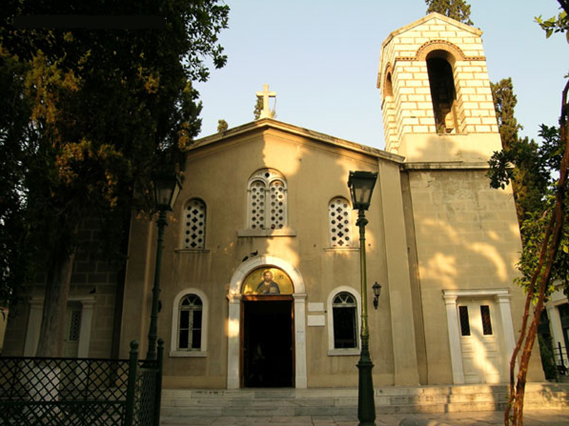
Metamorphosis Sotiros Kotaki (Transfiguration of the Savior- Kotaki) (1)
The church is dedicated to the Sotira Virgin, and it is named after Kotakis family, great donors of the church. The church was built in the first half of the 11nth century. It follows the cross-in-square plan, with dome, representative of the Athenian style, – the dome rest on two columns and on the two antae (jambs) of the sanctuary. This type is called Helladic because it can be frequently encountered on the mainland of Greece. On the East side of the holy sanctuary there are three semicircular apses, while the roof, forms a cross. The cross-shaped arrangement on the roof and the semi-circular apses on the eastern side of the building are the only remains of the original church. In the year 1908 new additions transform the church into a trihedral basilica with a dome. A new addition in 1971 took place, expanding the church’s main building to the west side. This improvement adds two belfries. Adjacent to the main church, two chapels exists. On the right side the chapel of St. George and on the left side the chapel of St. Demetrious. The elaborate icon of ’ Neas Kyras , dated around the 14nth century, is especially worth noted. It is a part of the holy templon ( proskinitari ) of the St. Demetrius chapel. The icon of the Virgin Odigitria (16nth century), beautifully modeled can be viewed at the same chapel. Relics of ancient columns, together with a marble fountain, can be found around the yard of the church.
Address: KIDATHINEON STREET, METRO STATION: SYNTAGMA & ACROPOLIS. Tel: (0030) 210 32 24 633
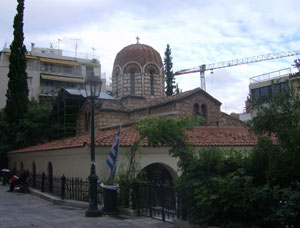
Hagia Ekaterini church – Plaka (Saint Catherine church- Plaka) (2)
The church dates back to the first half of the eleventh (11nth). At that period Emperor Comnenus Family rein the Byzantine Empire. During that period elegant monuments begun to build in Athens. It is built on the ruins of the ancient temple of the Goddess Artemis. During the Roman period, Emperor Hadrian adorned Athens with beautiful monuments; one of those was the public baths that were constructed in the courtyard of Artemis ancient temple, and some ruins can still be seen in the corner of the small palm tree shaded square, where the church is situated. Saint Catherine church follows the complex tetrastyle , cross-in-square architectural plan with dome. Before any of the posterior existing alterations, the buildings initially form a cross shape type and one can still see small part of the atrium. The altar of the church rests on a part of an ancient colonnade with inscriptions. Initially the church was dedicated to the military Saint Theodore’s, but at a later stage in response to the public demand, the church became a parish church and dedicated to Saint Catherine. The church is considered to be a triune (three to one). The right-hand side aisle is dedicated to St. Antonios , while the left-hand side aisle is dedicated to St. Sofia. Apart from the elaborated Byzantine frescoes, portable icons of St. John the Baptist which is represented in the basis of the stylistic and iconographic criteria of the Cretan School of art- fifteenth century (15nth), St. Catherin’s icon (placed on the west marble iconostasis) which the iconographic style affiliates to a mere folk view (17nth century). Also of great importance is the icon of St.Catherine enthroned, which is depicted following the representative iconographic style of folk art pertained during the Turkish occupation and can be seen on the right side of the wooden iconostasis. The icon of St.Srpiridon , a representative artistic visualization of the Ionian School of art (18nth century), is of excellent beauty.
ADDRESS: CHEREFONTOS&GALANOY PLAKA, METRO STATION: ACROPOLIS
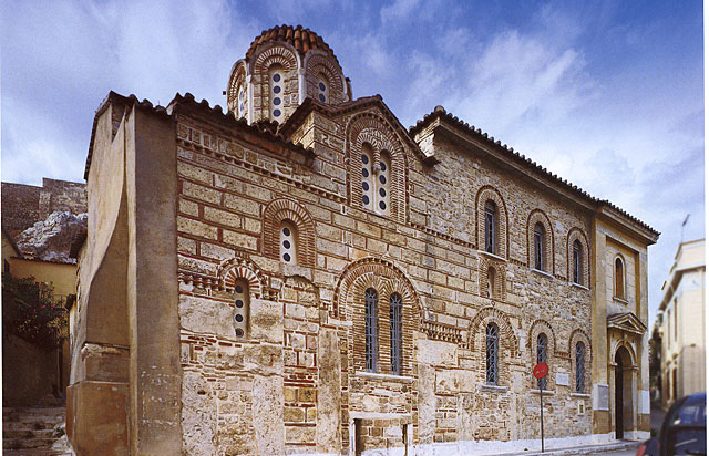
Hagios Nikolaos church-Rangava- (Saint Nikolaos church- Rangava) (3)
The church was built by the Byzantine aristocratic family of Rangavas , after whom it is named. It is situated north-east of Acropolis and it is considered to be one of the city’s most important Byzantine monuments. It is dated to the first half of the eleventh century (11nth), which at that time was built as regular tetrastyle cross-in-square type. Its present form is an amalgamation of reconstructions and additions of three different periods. The masonry up to the middle of the building is made of voluminous boulders and lime stones, as well as inlaid parts of ancient buildings. From the middle and upwards the walls were build with the cloisonné system. The Dome of the church is of an octahedral type, resembling the typical Athenian basilica type of that time. The altar of the church is supported by a marble column capital in reverse. In more recent years, significant additions and alterations took place. In 1838 the church has been extended to the west with the addition of the narthex and the bell tower. In more recent years the chapel of Saint Paraskeni was added on the northern side. Unfortunately nothing was preserved from the old hagiographic ornamentation, and the today’s frescoes belong to the period when the Bavarian King Otto (1815-1867) ruled Greece.
Address: 1 PRITANIOU STREET PLAKA, METRO STATION: ACROPOLIS. Tel. (0030 210 32 28 193
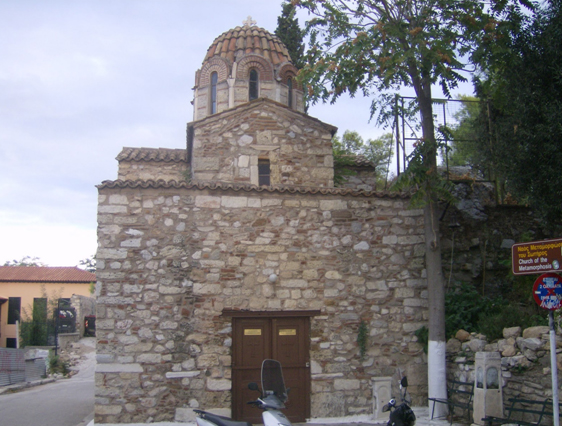
Metamorphosis Sotiros Acropolis (Transfiguration of the Savior-Acropolis) (4)
The church is dated to the first half of the eleventh (11nth) century. It is located on the northern foot of the Acropolis. It is tetrastyle , cross-in-square plan, with dome that was the prominent type of that period in Athens. The masonry, in the cloisonné system is representative of the particular type, plain in the ornamentation with rectilinear dentil cornice. Pseudo Kufic motifs decorate the vertical lintels of the temple. The extensions of the church on the West and East faces, took place at a later time. The central part of the church remains untouched from any renovation or intervention and thus keeping its form to its original stage. On the North part of the church, a small chapel exists, a part of which is curved into the Acropolis rock. The chapel is dedicated to Saint Paraskevi (Agia Paraskevi). Traces of frescoes that dated to the fourteenth (14nth) century were founded under successive layers of plaster.
Address: THEORIAS & KLEPSIDRAS STREET, METRO STATION: ACROPOLIS.
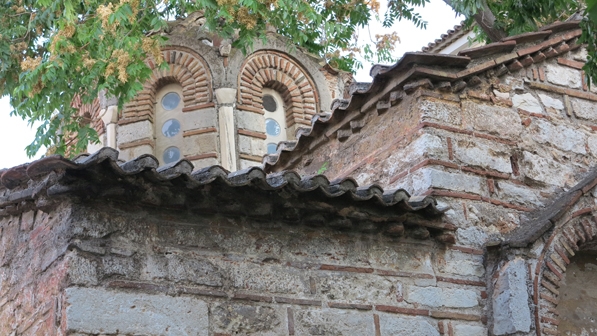
Hagios Ioannis o Theologos (Saint John the Theologian)
The small church of St John the Theologian (Hagios Ioannis o Theologos), is located in Erechtheas street,inder the northern side of Acropolis. The church dates back to the twelve century (12nth), and still remains in good condition without any significant alterations or additions. Architecturally, the church is of a distyle cross-in-square type with an Athenian dome and narthex. It is one of the few Byzantine monuments which preserve parts of its original frescoes. The church’s exterior with the exception of the southern side, follows the cloisonné masonry, creating the particular Byzantine color effect (white stones and red bricks), typical of that period. The dome is one of the most characteristic of the Athenian type. Internally is supported by the sanctuary walls and two column bearing Roman capitals. The interior mural decoration, especially the Christ Pantocrator depicted on the dome dominates the small church. On the northern compartment to the greater part of the prosthesis-the soldier Saint, probably St Georgios is depicted occupying most of the wall. The stylistic representation and the iconographic style attest affiliation of the mural technique employed round the thirteenth century (13AC).
ADDRESS: ERECHTHEOS AND EROTOKRITOU STREET, METRO STATION: ACROPOLI.
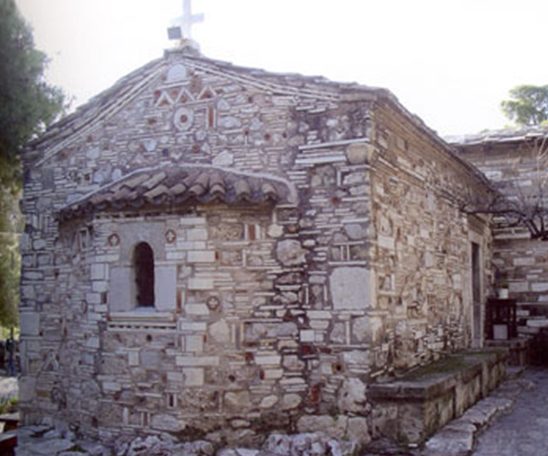 Hagiou Dimitriou church – The Loumpardiaris (Saint Demetrius church – The Loumpardiaris) (5)
The church is a one-aisled arched basilica, close to the Pnika and to the Filopapou monument. The initial building dates back to the ninth century (9nthBC), and multiple interventions and renovations took place since then, especially during the Turkish occupancy. In order to support the plate-made circular roof, two supportive crossbeams, one in the above the holy sanctuary and the one at the west facing entrance are incorporated. Two long arched beams support the north and the south side of the building. The extension of the western wall was added at a later time. The church was reconstructed by the well known architect Pikionis in 1955, which under his supervision the external wall of the church was decorated with ceramic geometrical patterns and marble slabs. During the reconstruction period, post byzantine frescoes were discovered which they were completely restored around 1987. An ancient pillar is used as a supportive mean for the Mensa Sacra, while two more can be seen at the courtyard of the church.
ADDRESS: FILOPAPOU HILL, METRO STATION: ACROPOLIS
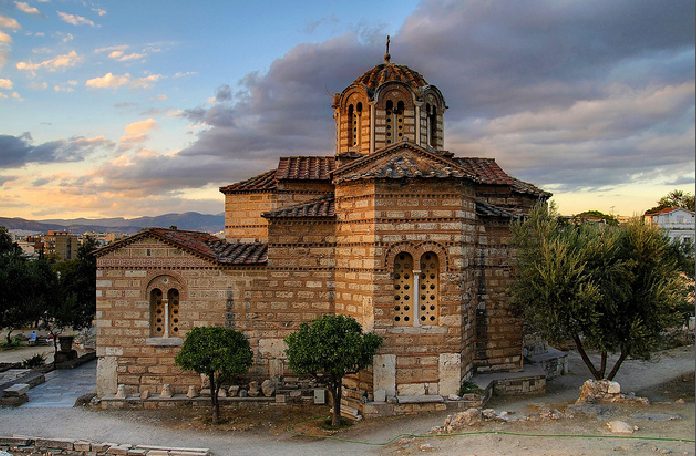 Hagion Apostolon Church (Church of The Holy Apostles) (6)
The church of the Holy Apostles Solakis is located on the south-eastern side of the ancient Agora. It is dated back to the second half of the tenth century. It is the first significant mid-byzantine church in Athens and the first of the so called Athenian type. The dome of the church is the oldest one of the particular type. The church is also known by the name Solakis, probably from the family name to which the church belonged during the Ottoman period. Architecturally, the church is a rare example of an amalgamation of the cross-in-square with dome, and a successful combination of a tetraconch a central square space with conches on all four sides- nave with the general layout being a circular one. The simple, four-columned, cross-shaped center is covered with a dome. Interposed by four smaller ones, which constitute the corners of the square that inscribes the cross. The conchs of the church on the North and South side are built in accordance to the Mount Athos (Hagio Oros) church type. The octahedral dome with two-lobe windows and arched cornices, the beautiful ornamental brickworks of the dentil band along with the frieze Kufic motifs on the upper part of the external walls, suggest a work of a very talented architect. The inventiveness of the architect can also be identified by the integration of the church main narthex, with two proportionally smaller ones in each the church sides. This gave a well balance and harmonious structure. The building suffered many damages through several periods in history, but managed to survive through many reconstructions and renovations until today.
ADDRESS: ANCIENT AGORA, METRO STATION: MONASTIRAKI
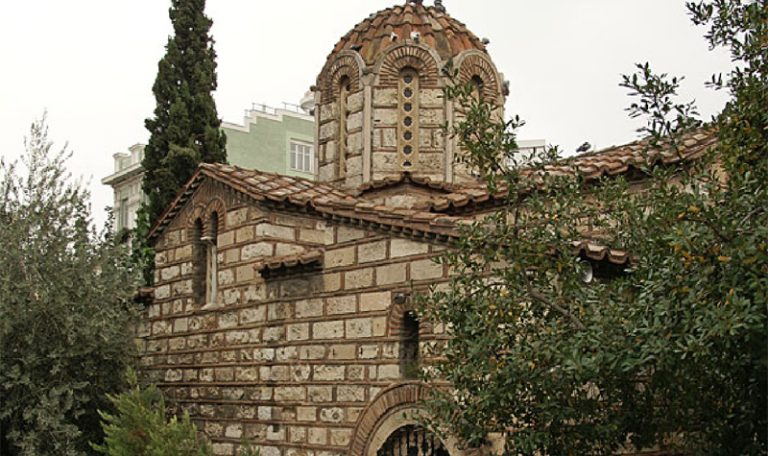 Hagion Asomaton church Thisio (Church of the Incorporeals Thision) (7)
The church is situated northwest of the Thision, in Ermou Street. It is dated back to the second halve of the eleventh century. Architecturally follows the cross-in-square type with dome, the representative style of the Byzantine Athenian School of church architecture of that period. Rubble masonry flanks the lower parts of the side walls of the church, placed in a cross-shape, which is typical of the masonry ornamentation of many churches of that period. The brick dentils on the external sides of the building attest affiliation to the masonry of that period also. During the 1960 the church had undergone a rewarded renovation that brought the church to its original morphology, by eliminating the interventions made in the course of the years. On the northern entrance of the building, a semicircular arch exists. Its shape imitates the Islamic architectural influences that inspire various Byzantine artifacts and decorative details. Incorporated on the western walls of the building, there are two ceramic plates with Kufic patterns and motifs. The use of Islamic decorative elements was a trend of that period and one can suggest the relation of those oriental decorative influences with the small Islamic commercial-mostly merchants and manufacturers- community in the city towards the end of the tenth century.
ADDRESS: 5 THERMOPYLON STREET, METRO STATION: THISION STATION
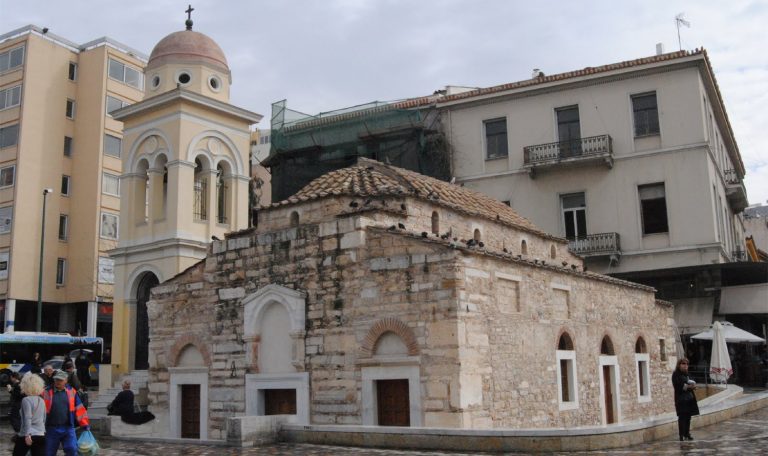
Panagias Pantanasas church – (Virgin Mary Churh Pantanassas) (8)
The church is dedicated to Panagia Pantanassa. It is celebrated on the 15th of August, the day of the Assumption of the Virgin Mary. The church is located in Monastiraki square, opposite Monastiraki metro station. The church is referred to as Big Monastery (Abbey) around 1678 and it is thus named during these years. Since the second half of the sixteenth century and onwards the church became a parish church and the church was no longer called Big Monastery but Mikromonastiro (Small Monastery) or Monastiraki. Architecturally the church belongs to the three-aisled barrel vaulted basilica, a type that can be ascribed between the establishments and transition of the early Christian basilica type and the well known cross-in-square type. The building’s masonry is not of a rectilinear order but more of cobbles not in array (rubble masonry). The side aisles of the church are covered by cross vaults. The central aisle is proportionally higher than the others and supports the barrel vault. In all four conches, pieces from ancient capitals (kionokrano, the head part of a column that crowns’ it parametrically) are incorporated. On the western side three doors, one for each aisle and on the eastern side a tri-conch exist externally, while in the interior is a semi-circular one. The Holy Sanctuary is segregated with walls dividing the internal structure of the church in three parts, the Vima (the Ambo – t he ambo stands directly in front of the holy Doors), the Prothesis (the place, where the preparation of the bread and wine for the Eucharist is used) and the Diakoniko ( originally the place where the deacons kept the vessels used for the church service). The three parts communicates through arched portals. Due to geological particularities of the Monastiraki square ground, almost thirty percent (30%), of the building is under the ground. The church is famous for the grand icons that decorate the iconostasis (first half of nineteenth century), the miraculous icon of Saint Thecla among the other important portable icons and the Holy relics of the Saint Nectarios from Pentapoli.
ADDRESS: MONASTIRAKI SQUARE, METRO STATION: MONASTIRAKI, Tel.0030 210 3113 038
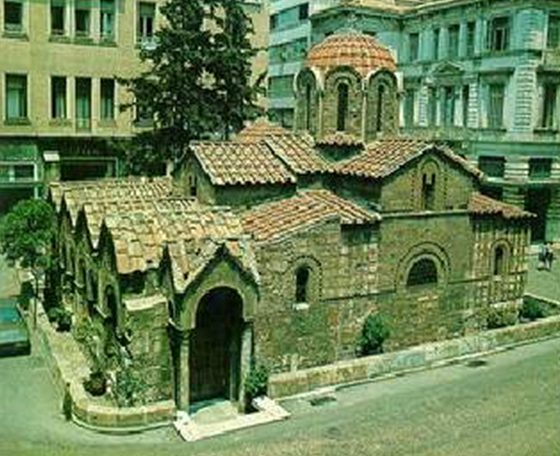
Panagias Kapnikarea church (Virgin Mary church Kapnikarea) (9)
The church dates back to the early 10nth century (1050AC), and it is one of the most beautiful oeuvre of the Byzantine period in the centre of Athens. It is located in the middle of Ermou Street. The limited use of dentils and the arrangement of the windows also lead to the dating of the building. Variations’ regarding the origin of the church’s name exists according to several theories. The one that still prevailed is the Kapnikarea , which relates the Kapnikarea family, which was responsible that time to collect the kapnikon- a certain tax imposed by the Byzantines- around the eighth century- to the houses that had chimneys ( kapnodohos ). Older documents frequently refer to the church with the name Kamoucharea”, – kamoucha is a luxurious textile, due to the fact that at that time people were selling this kind of fabrics, located there. The church also used to be called the Princess church, based on the tradition that relates Athens with the Athenians Byzantine Empresses. The name Panagia Kapnikarea dominates and it is used today. The architecture of the church is of a complex cross-in-square plan, tetrastyle which are reposed to capitals of the Romanesque period. It was constructed in remembrance and dedication of the Entrance of Virgin Mary to the temple. Shortly after the foundation of the church, a chapel dedicated to Saint Barbara was constructed on the north side. The exonarthex extending all over the western side of the church was added in the third quarter of the 11th century. On the south side of the narthex a small colonnaded entrance which on the upper side a semicircular conch exist, was added in the twelfth century (12AC). On the west side are sculptures in relief and inscriptions in Kufic motifs, the presence of them should be emphasized. Of great importance, is the icon of the Virgin Plaritera, a work of art employed by the famous hagiographer Fotis Kontoglou. The rest of the church’s icons are identified as a work of him and of his students dated around the 1942. The opus mosaic floor over the entrance is a work of Ellie Voila created in 1936. The church survived from being demolished twice, but thanks to the intervention of Ludwig of Bavaria, father of King Otto, in 1836 was survived. The second danger of demolition was abolished thanks to the intervention of Archibishop of Athens in 1863. The church of Kapnikarea nowadays is under the supervision of the University of Athens-School of Theology.
ADDRESS: ERMOU STREET METRO STATION: MONASTIRAKI
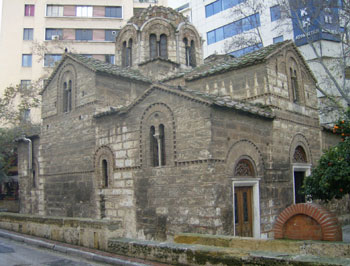 Hagion Theodoron church (Saint Theodor’s church) (10)
The church was built around the first half of the eleventh century. It is located on the south-west side of Klafthmonos square. Mounted on the church’s west wall, a marble slab inscribe that the church was renovated by an official of the Byzantine Empire named Nikolaos Kalomolos, as a devout act for the Saint Theodoros of Tyron. The church was reconstructed over the ruins of an older church, which according to the tradition, was one of the twelve churches, Empress Evdokia founded in Athens around the second half of the fifth century. The church is of a distyle, cross-in-square type with an octahedral dome, having two lobed windows and supported, on the east side by two pillars and on the west by two peccaries (square columns that supports the dome). The masonry is in the cloisonné style bearing many ornamental decorations, Kufic motives, guilloche patters and animal figures. The voluminous stones on the lower side of the church that supports the masonry are mounted with expertise forming a cross pattern resembling the trends of the church architecture in Athens at that time (eleventh century). On the east side of the church, three trihedral apses, of which the middle one is proportionally higher and wider, exist. In the larger apse a one lobed window is incorporated. The rest of the three apses incorporate a two-lobed widow. On the west side of the building, two entrances exist both in an apse shape and with jambs. The one in the centre has a two-lobed window with an apse. The second one faces the north. On the South side of the church another apse shaped entrance exists with two-lobed windows. The bell-tower is a later addition and brings a three-lobed window. On the same side (South) of the church, a one-lobe window and two two-lobed one exists, following the same pattern of the North side. Of particular interest is the copious ceramic decoration of the church: pseudo- kufic motifs, a frieze with small ceramic plates with kufic -like reliefs, and other decorative elements like the dentil arches as well as the brick arches around the windows. The church has great similarities with the nearby Kapnikarea church, but is of ponderous proportions and of a more austere architectural structure. The church was badly damaged due to the Greek War of Independence (1821-1832), and reconstructed in 1840.
ADDRESS: PLATIA KLAFTHMONOS, METRO STATION: PANEPISTIMIO
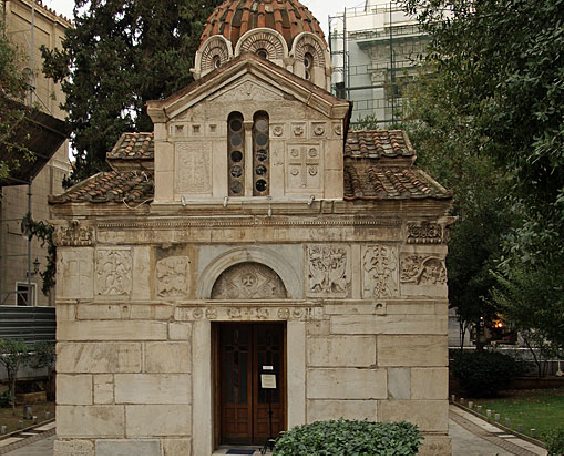
Hagiou Eleftheriou church (Saint Eleftherios church) (11)
The church dated to the second half of the twelfth century. It is located south of the Cathedral Church Athens (Kathedrikos Naos of Athens) on Metropoleos square. It is also known as the Little Cathedral. The architectural type belongs to the tetrastyle, cross-in-square plan with dome. The side walls were built from large marble slabs from the ancestry. On the upper side ninety (90), reliefs taken from various historical phases Greek, Roman, Early Christian and Byzantine, are incorporated in such a way so as to simulate a frieze that flanks the whole church. The dome of this small size church reflects in perfect way the Athenian type. The external courtyard was used as a cemetery for the Benizelos-Paleologan families. This monument was dedicated to the Panagia Gorgoipikoos. In 1861, after an unsuccessful murder attempt against the King Otto, Queen Amalia suggests to rename the church to Saint Sozon. After the end of the Bavarian occupation, the church named Agios Eleftherios.
ADDRESS: MITROPOLEOS STREET. METRO STATION: SYNTAGMA
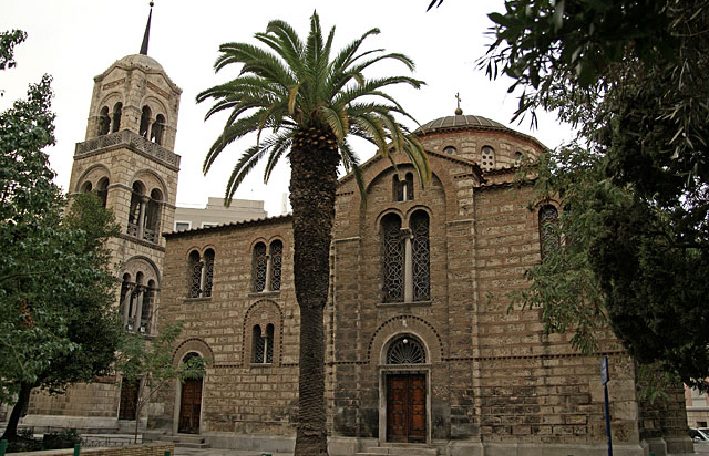
Hagias Triado – Rossiki (Holy Trinity church – Russian) (12)
The church differs from all of the other monuments, apart from the fact that, it is the largest medieval building in Athens, but also from the fact that it follows a different architectural type, the octagon. It is a variation of the cross-in-square church but in this case the dome is supported by eight pilasters peripherally. It is also named the Russian Church because it is the parish church of the Orthodox Russian community in Athens. Its architectural structure forms an octahedral dome with a low tympanum. The dome covers the whole center of the church and it is supported by four square columns. The layout is constructed in such a way that unifies the internal space and at the same time adding a sense of grandeur. This architectural type of the church follows faithfully the original structure of Osios Loukas monastery in the town Distomo in Biotia, which is dated around the first half of the tenth century. It is of Middle Byzantine architecture and has been listed on UNESCO’s World Heritage sides, along with the monasteries of Nea Moni and Dafnion. Rich ornamentations flank the North side of the Agia Triada church with kufic motifs and dentil bands. Three apses exists on the East side of the church, while on the West there are three square portals decorated with marble frames and brick arches. The Holy Sanctury is segregated from the main nave with a distinctively high iconostasis according to the Russian order and replaces the low Byzantine templon screen. On the left-hand of the church, lies the chapel of Saint Nikodimos, and on the right hand side lies the chapel of Saint Nikolaos. In 1847 the church was bought by the Russian government which undertook also the huge renovating expenses, so as to be used as a parish church of the Russian Orthodox community in Athens and was dedicated to the Holy Trinity (Agia Triada). The Western iconographic style of the church murals is a work of Ludvig Thiersch (1847), which covered the still extant Byzantine frescoes. The impressive bell-tower standing today was added when the church was renovated. The church opening of the reconstructed church were done in 1855 and from then the church’s name establish as Holy Trinity (Agia Triada).
ADDRESS: FILENNINON-SYNTAGMA, METRO STATION: SYNTAGMA
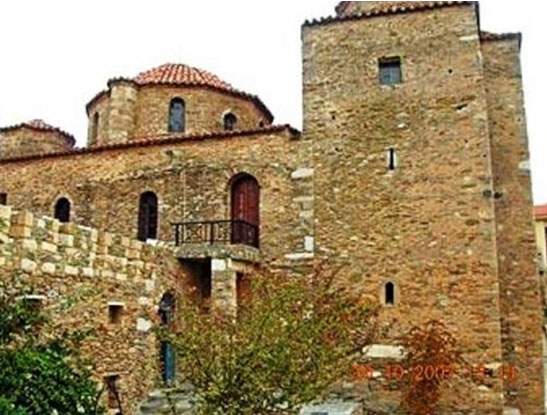
Monastery of DAU Penteli (Convent of DAU Penteli)
The Monastery lies on the eastern slope of Penteli Mountain in the outskirts of Athens. The today’s katholikon is dated in the post Byzantine period, but according to numerous Byzantine sculptures and wall integrated inscriptions, become evident that it must have been founded on an older building dated to the middle Byzantine period (10nth century), and renovated around the twelfth century. The central dome is supported in six tall pilasters and three of smaller dimensions. The katholikon is a hexagonal one, a type that often encountered in Armenia and Georgia. During the Ottoman occupancy the Monastery was looted by the Turks and terminates its functions for over a century. According to a post Byzantine religious document (sigillium), the Monastery was renovated in the second half of the 16nt century. The katholikon of the monastery remains intact since then. In the second half of the 17nth century, the Monastery was destroyed again, this time by Algerian pirates who slaughtered all the monks (179). Their relics are displayed in a sacred building inside the monastic complex. The Monastery closed again this time for more than 250 years. In 1963 the Monastery was reconstructed and functions as a nun’s coenobium. Nowadays the monastic complex consists of the katholikon, the Refectory and the cells. The defensive tower still exists in the entrance gate. School of Byzantine music, workshops of hagiography and waxworks and an atelier for Exercising the art of sewing liturgical vestments actively operates in the monastery.
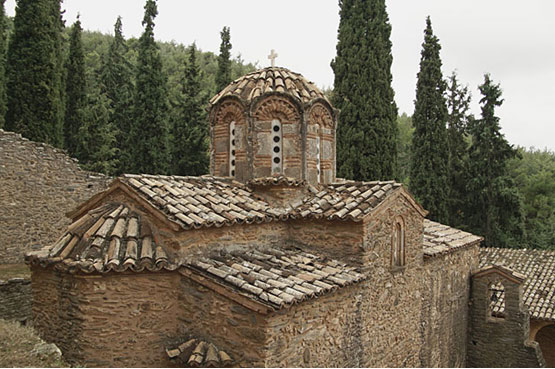 Monastery of the Pamegiston Taxiarchon Imitos (Convent of the Great Taxiarches – Archangels Imitos)
A beautiful katholikon situated on the west side of mount Ymmitos close to Kesariani Monastery. Built in the regular, cross-in-square layout, the katholikon has an octahedral dome and a narthex. The church dated back to the 11nth century and it is surmised that is built upon the ancient ruins of the so called Diodoros school. Its masonry it’s ponderous and almost rectilinear. The monastery is dedicated to the Taxiarches (Archangels) and established around the eleventh century. The katholikon is flanked by an old castle-like enceinte, two transept buildings and the katholikon. The church’s internal walls are covered with frescoes dated back to the 16nth century. During the 17nth and 18nth century the church had a very rich and important library. In 1957 the church, was illegitimately vested to the 1st curatorship of Byzantine authority, The Holy Archdiocese of Athens with continuous efforts, tries to bring the church again under its jurisdiction in order to renovate it and establish a coenobium again.
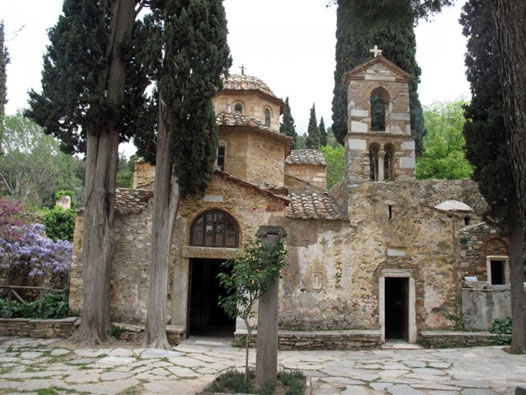 Monastery’s Katholikon Kesariani (The main church of the Convent devoted to the Entrance of Virgin Mary- Kessariani)
The katholicon (main church) of the monastery dates back to the 11nth century, and the building surrounding the monastery belongs to the Ottoman period. It is of tetrastyle cross-in-square type with octagonal dome. Instead of the undulating dentil cornices that usually ornaments the Athenian domes; the particular dome is of a rectilinear form. Eight single lobed windows flank the dome. Two rows of brick arches also surround the dome. The masonry, in the cloisonné system is void of ornamental brickwork. In the post Byzantine period a narthex was added to the west side. A vaulted-roofed chapel was attached to the south side dedicated to Saint Marcus, added during the Franks period. The original decoration of the katholikon was ruined and today, the sanctuary and the nave are decorated with early 18nth century mural following the stylization and iconographic type of the Cretan painters. From 1682 up to 1716 the monastery was under the authority of the Ecumenical Patriarchate. Nowadays is under the jurisdiction of the Greek Archaeological Service.
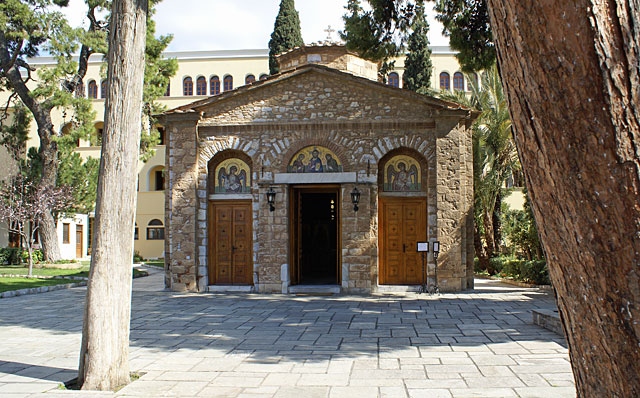 Petrakis Monastery – (Petrakis Convent)
The Petrakis Monastery is located in the densely populated area of Lycavitos district. One of the earliest katholikon (=the most important building-church- in a monastic complex) of the Middle Byzantinine is the one of the monastery of the Incorporeal (Moni Asomaton). It is almost know as the Petrakis monastery almost adjacent to the Evangelismos hospital. In 1840, the abbots (Hgoumenoi), of the Monastery, constitute the members of the Petraki family, and continued to keep the monastery alive, keep on reconstructing it and ornament it. The church is a tetrastyle cross-in-square with dome and build with rubble masonry and the cloisonné style adopted only on the higher reconstructed part only on the higher parts. Due to various repairs the dome of the church with a high tympanum does not belong to a Byzantine style, but this is due to the renovation took place on the 17th century. The church has three external semicircular apses, three-lobed wide high windows of equal height, and the rubble masonry denotes earlier architectural techniques and archaic traits that can allocate the dating of the building in the second half of the 10nth century. A large narthex (=frontal door) with dome, replace the original narthex in the 19nth century. The present exonarthex was added in the beginning of the 18nth century, when the katholicon extended to the west. A very important 18nth century painter named Georgios Markos with rich oeuvre, cover the interior wall in 1719.
ADDRESS: 14 IOANNOY GENNADIOY, METRO STATION: EVANGELISMOS