

 SAINT JASON AND SOSIPATER
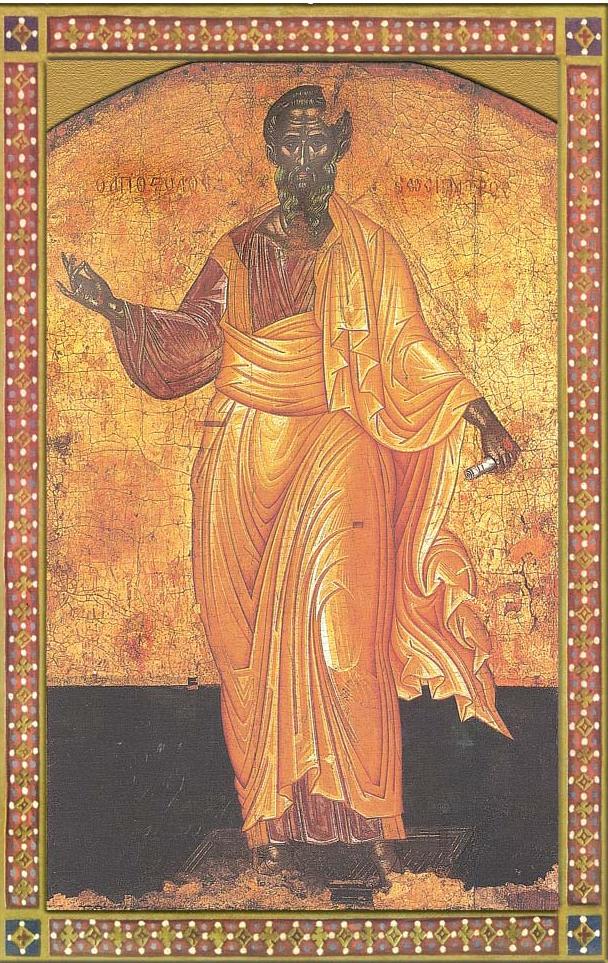
The island of Kerkyra (Corfu) has attracted down through the ages any number of visitors, ranging from mainland marauders who envied its strategic proximity to the continent to peaceful lovers of nature who admired its great beauty. The island’s prominence was also an attraction to the early Christian missionaries, chief among whom were two men of such stature in the New Faith of Jesus Christ that they are addressed by no less than the great Saint Paul who acknowledged their great service to the Savior. The two are Jason and Sosipater who were assured immortality by mere mention in the New Testament but who offered far greater reason for their being venerated as saints. In addition to Saint Paul’s reference to this holy pair in his Epistle to the Romans which reads, “Jason and Sosipater my kinsmen, salute you” (Romans 16.21), Saint Luke says in reference to Jason in Acts (17.6), “And when they found them not, they drew Jason and certain brethren unto the rulers of the city, crying “These that have turned the world upside down are come hither also.” Sosipater might well have been one of the brethren referred to, although he is not mentioned in this passage by name. Having served with enthusiasm, both were rewarded by Saint Paul with sees, Jason as Bishop of Tarsus and Sosipater as Bishop of Ikonion where, independent of each other, they implanted Christianity. Jointly serving Saint Paul, then separately serving as bishops, they were rejoined in the common cause of bringing the word of Jesus Christ to the island of Corfu. With such a pair of devout preachers, the success of their mission in Corfu was assured, and within a short period of time, Christian converts were attending services in a church dedicated to the memory of the Protomartyr Saint Stephen. At first disregarded by King Kerylinos, their spread of Christianity caused sufficient stir in the royal court so that two holy men were questioned by the king himself. Ignoring their case in the name of the Savior, the king ordered their imprisonment for insulting his pagan deity, and the two found themselves sharing the squalor of a dungeon with seven convicted felons. There the two holy men preached the word of Jesus convincingly enough to convert their fellow prisoners. The king greeted this disquieting bit of news with an order that all but the two holy men be put to death, sparing Jason and Sosipater as a matter of expediency in light of their popularity with a fraction on the island now to be reckoned with. Seeking to disgrace them, the king had Jason and Sosipater dragged through the streets by a horse at a speed calculated to be slow enough to bruise them without killing them, a spectacle which was looked upon by the king’s daughter not as an act of shame but as an act of wretchedness on the part of her father. The daughter, aptly named Kerkyra, visited the hapless pair in their prison cell and was won over by them as a Christian convert, a conversion which was to cost her life. With mounting vengeance the king mounted a campaign against the Christians, even embarking on a voyage that was doomed when his ship went down in a howling storm. The succeeding king, Donatios, deemed it his royal duty to continue the course of persecution, and in an ill-considered decision to flaunt his authority, he ordered that Sosipater be put to death. It was presumed that Jason would follow his comrade in death, but the king decided to question the surviving partner first. A gnawing sense of guilt had predicted the meeting of Jason and Donatios, after which the repentant monarch was himself converted to Christianity, bringing about official acknowledgement of the truth of Jesus Christ. The body of Sosipater was entombed within the confines of a church on the island named after Saint Andrew. Not long after this, the twelve-year-old daughter of Donatios was stricken with the fatal illness, but after Jason had knelt in prayer she recovered. Jason continued to work for the Messiah until his death at the age of sixty on April 29, the day on which Sosipater had died for Christ.
SAINT BASIL OF OSTROG
Basil was born in Popova, a village in Hercegovina of simple and God-fearing parents. From his youth, he was filled with love for the Church of God and when he reached maturity, he entered to the Monastery of the Dormition (Assumption) of the Birth-giver of God in Trebinje and there received the monastic tonsure. As a monk, he quickly became renown because of his genuine and rare ascetical life. Saint Basil took upon himself mortification upon mortification each one heavier and more difficult than the last. Later, against his will, he was elected and consecrated bishop of Zahumlje and Skenderia. As a hierarch, he first lived in the Monastery Tvrdosh and from there, as a good shepherd, strengthened his flock in the Orthodox Faith, protecting them from the cruelty of the Turks and the cunning ways of the Latins. When Basil was exceedingly pressed by his enemies and, when Tvrdosh was destroyed by the Turks, he moved to Ostrog, where he lived an austere ascetical life, protecting his flock by his ceaseless and fervent prayer. He died peacefully in the Lord in the sixteenth century, leaving behind his incorruptible relics; incorruptible and miracle-working to the present day. The miracles at the grave of St. Basil are without number. Christians and Muslims alike come before his relics and find healing of their most grave illnesses and afflictions. A great people’s assembly (pilgrimage) occurs there annually on the Feast of Pentecost.
THE NINE MARTYRS IN CYZICUS
These nine brave martyrs, enflamed with love for Christ, refused to offer sacrifices to the idols or to deny Christ the Lord, for which they were brutally tortured and finally beheaded. During the reign of Emperor Constantine, a church was built in Cyzicus in honor of these martyrs where their incorruptible relics were placed. Countless healings have taken place over their relics. Their names were: THEOGONIUS, RUFUS, ANTIPATER, THEOCTIST, ARTEMAS, MAGNUS, THEODOTUS, THAUMASILUS AND PHILEMON. All of them despised everything temporal for the eternal, the corruptible for the incorruptible. That is why the Lord led them to His eternal home and crowned them with unfading wreaths of glory. They suffered honorably and were glorified in the eighth century.
VENERABLE MEMNON THE WONDER-WORKER
From his youth Memnon dedicated himself to fasting, prayer and purified himself so much that he became a dwelling place for the Holy Spirit. He healed incurable diseases and worked many other miracles. He appeared on the tempests of the seas and rescued ships from disaster. He died peacefully in the Lord in the second century and took up habitation in the heavenly courts of the Lord.