

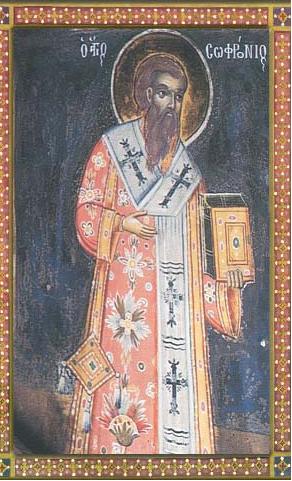
 St. Sophronius, Patriarch of Jerusalem
One of the lesser known heresies that cropped up to pose a mild yet ominous threat to accepted Church dogma was the handiwork of Monotheletism, and the Church’s suppression of this heresy was the handiwork of a man known as Sophronios, a Patriarch of Jerusalem in the seventh century, against whose eloquent logic no voice of Monotheletism was any match. It may seem trivial by comparison with the iconoclastic movement which ravaged the Church for 150 years, but in theory, nevertheless, was an affront to God that could have had disastrous consequences without the forceful opposition of such as Sophronios. Quite simply, the doctrine of Monotheletism held that Christ had one will, not two, which was in contrast to the traditional concept of the Lord’s having two wills, one divine and the other human, inasmuch as He was both human and divine. Surprisingly, a number of well-respected theologians were swayed to this view and their short-sightedness may have spread except for the compelling reasoning of the Jerusalem prelate. Sophronios was born to a Christian couple named Plythas and Mary, whose circumstances were such that they provided more than adequately for the educational and spiritual needs of their son. More fortunate than most, the boy grew to maturity with the gnawing feeling that the void could only be filled by an approach to God through the medium of asceticism, and to that end he gave up all social and economic ties to take up monasticism. Sophronios was enrolled in a monastery in Egypt, there to encounter a monk named John for whom he developed a deep personal attachment in acquiring from him the benefit of his prolonged experience as a monk and tutor. An authority on dogmatic theology, John imparted to Sophronios the wisdom which was to stand him in good stead in his service to Jesus Christ, and in due course the student was to excel the teacher. The extent of the knowledge of both these pious monks was encyclopedic and they delighted on testing each other, with John usually yielding to his superior friend. After Sophronios had taken up his successful stand against Monotheletism, a posture which brought him wide recognition, he was given the post of Archbishop of Jerusalem, a prestigious office in which he gave full expression to his piety and wisdom. In 638 the Persian hordes of King Uram overran the Holy Land, terrorizing the people and removing all authority except one—that of Patriarch Sophronios, who refused to be intimidated by the infidels. Not wishing to stir up an insurrection, they retreated from the holy ground of the Patriarchate. The invaders did surround the city, however, forbidding travel in or out of the limits, but when Sophronios heard news of the death of John the Merciful, Patriarch of Alexandria, he went through the guard post without incident and continued to Alexandria where he delivered a stirring eulogy for his longtime friend, John. He returned to the Holy City, again passing through the barricades without incident because not even the wretched Persians dared to approach this holy and resolute man of God. In the ensuing months of siege, Sophronios ventured out into the crowded city daily, offering his blessing to those who were needlessly oppressed and bolstering the flagging spirits of those whose hopes were growing faint. Even the enemy came to respect this awesome prelate as he exhorted the populace to continue their work as though the enemies of Christianity did not exist, and his inspirational leadership brought heart to the long suffering people, who found within themselves the capacity to bear burdens they had never anticipated. For as long as he remained patriarch, the spiritual business of the entire community went on uninterrupted and the social order remained intact. While all this was going on Sophronios found time to express himself in writing, thereby creating some of the finest works in ecclesiastical history, particularly the books that touched on exegetics. He also produced the quite marvelous biography, “Mary of Egypt,” among his many outstanding writings. He died peacefully in Jerusalem on 669.
Saint George the Sinaite
Abbot of Mount Sinai, he was a great ascetic and a righteous man. On Easter night an angel of God carried him to Jerusalem for the service, and took him back the same day to Sinai. He entered peace-fully into rest in the 6th century.
The HolyMartyr PioNius
A priest of Smyrna, he suffered there in the time of Decius’s perse-cution. They condemned him to be crucified, which was a great joy to him. And as soon as the soldiers assembled the cross and laid it on the ground, Pionius laid himself on it and stretched out his arms, calling to the soldiers to put the nails into his hands. The cross was inserted into the ground upside down, and a fire lit under the mar-tyr’s head. There were many bystanders. Pionius closed his eyes and prayed to God within himself. The flames could not succeed in ignit-ing even his hair, and when the fire had at last gone out and everyone thought that he was dead, Pionius opened his eyes and cried out joyfully: `O Lord, receive my spirit!’, and breathed his last. This saint wrote the life of St Polycarp of Smyrna, together with whom he now makes merry in the Kingdom of Christ. He suffered and was glorified in 250.