

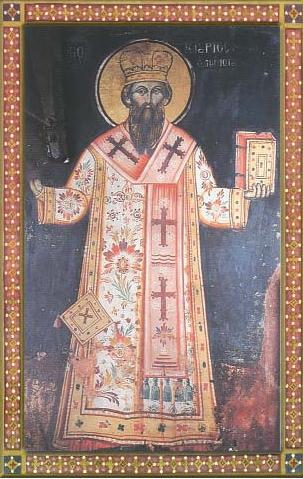
 SAINT Gregory the Dialogist, Pope of Rome
Son of the senator Gordianus, he himself became a senator and gov-ernor of the city of Rome, but, as soon as his father died, he gave himself to the spiritual life. He built six monasteries in Sicily and a seventh in Rome itself, out of his great wealth, being tonsured in this last, which he dedicated to the Apostle Andrew. His mother, Sylvia, also received the monastic habit in a women’s monastery. After the death of Pope Pelagius, Gregory was chosen as Pope. He fled from this honour and power and bid himself in the mountains and ravines, but God showed people where to find him by making a fiery column, reaching from earth to heaven, appear at the place where Gregory was hiding. He had a rare compassion, using all his income for the housing of the poor and on hospitality. He frequently brought the poor in and fed them from his own table. He occupied himself with the writing of instructive books. `The Dialogist’, or `the one who converses’ was the name he was known by, having written a book entitled `The Dialogues’ in which he brought to light the vir-tues and miracles of the Italian saints. He also compiled the services of the Presanctified Gifts that is used on Wednesdays and Fridays in the Great Fast. His archdeacon, Peter, often saw a dove hovering over his head when he was writing. He went to the Lord in 604.
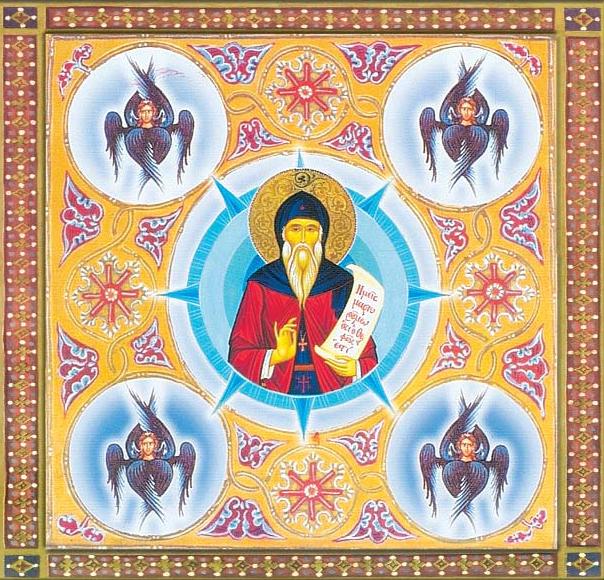 SAINT NEW SYMEON, THE NEW THEOLOGIAN
The superlatives applied to the wondrous gifts of men such as Saint John Chrysostom and Saint Gregory the Theologian allow no comparison with either of these church greats, each of whom compares with the other but invites no comparison with any other Saint. They were considered incomparable until there appeared in the tenth century a man now known to us as Saint Symeon the New Theologian, a churchman of such intellect that neither Saint John Chrysostom nor Saint Gregory the Theologian suffers the least by the recognition of Symeon as their intellectual equal. Symeon was born with the given name of George in 957, the son of Basil and Eugenia who were devout Christians and of high social standing in the city of Galantine, Paphlagonia. After completing his elementary studies, he was sent at the age of fourteen to Constantinople in the care of an uncle of considerable influence in the capital city. Despite a high intellect which had been amply demonstrated, he was disinterested in the study program offered, and to relieve the boredom he sought a change by paying a visit to the famous Monastery of Studious in Constantinople. It proved to be a visit that was to alter the course of his life, much to the benefit of Christendom. At the Studious Monastery, George spent many hours in conversation with a remarkable and quite pious monk who had earned the name of Symeon the Devout, who so inspired the young student that he asked permission to remain as a novice. Because of his youth and relative lack of study, the request was denied, and George returned to his uncle with a determination to be the brightest scholar of his day. Returning after some years of intense study, he was again denied admission to Studios because his learning had been misdirected, and he was advised to apply himself to the study of the fathers and Scriptures. the resolute George took this course of religious preparation, and at long last he was admitted to the monastery in 984 when he was twenty-seven years old. No man has ever entered a cloister better prepared for the service of the Savior than the eager George, but again he was denied permission to be at the side of the elder monk Symeon because it was in violation of monastic rules to allow such privilege to a novice, and he was, therefore, sent to the monastery of Saint Mamas where he was finally ordained a priest at the age of thirty by Patriarch Nicholas Chrysoberges. At his ordination he assumed the name of his spiritual father, Symeon, with whom he remained close until the latter’s death. Appointed by the patriarch to be the abbot of the Monastery of Saint Mamas, the younger Symeon brought about sweeping reforms within the monastery which called for a strict adherence to the rules concerning self-denial and fasting, reforms which brought protest from the monks. An appeal to the Patriarch availed the monks little because he knew Symeon’s sterling character and supported him in his disciplinary action. A former Metropolitan of Nikomedia named Stephanos, now chancellor at the Patriarchate, sided with the insurgent monks and for reasons best known to himself sought to discredit Symeon with a series of harassments that after six years finally influenced the Patriarch to the point of where Symeon was exiled and sent out to fend for himself. After some wandering, Symeon came upon a private chapel owned by one Christopher Faguras, a man of deep religious faith, who welcomed the pariah and allowed him to establish a monastery of his own. It was at his private chapel that Symeon composed sacred hymns of great beauty as well as masterful writings which encompassed all phases of theology, including catechisms. His prolific writing was of such caliber that it was recognized throughout Christendom and acknowledged by the Patriarch to be the works of a man divinely inspired. Vindicated at last, Symeon was asked to return to Constantinople, but he preferred to remain at the chapel to continue his literary efforts which form an integral part of church reading.
Saint Theophanes the Confessor
Named `the Sygrian’ from his birthplace, Sygriane, he was a kinsman of the Emperor Leo the Isaurian (717-41) and his son Cop-ronymos (741-75). He had enormous wealth and lived in great splendour. But all this lost its value for Theophanes when he en-throned Christ the Lord in his soul. Then he was hindered by a mar-riage which he was obliged to make. He succeeded, though, in per-suading his bride that they should live as brother and sister in chas-tity, and, as soon as his parents died, his wife went to one monastery and he to another. His monastery was in the Syrian mountains in the Cyzicus region. The splendid and wealthy Theophanes lived for some time in the monastery us the poorest wretch. And all marvel-led at the great change in him. Then, because he had become so known for his firm faith, abstinence and wisdom, he was invited to the 7th Ecumenical Council at Nicaea in 787, at which the venera-tion of icons was upheld. Because of his great purity and chastity, God gave him the gift of wonder-working and he was able to heal all manner of illness, especially mania and madness. He prayed to God for all the sick and distressed and helped them by his prayers. Only when he himself fell ill and was sick for a long time did he refuse to pray for his own healing but endured it with thanksgiving. When another iconoclast period arose under the wicked Emperor Leo the Armenian, Theophanes was taken to Constantinople and thrown into prison, where he spent two years in discomfort, pain and humiliation. The Emperor then sent him into exile on the island of Samothrace, an exile which he had forseen in his spirit and foretold to the prison warders. When he arrived on Samothrace, he lived for only twenty-three days, then went to his Lord and Creator to receive the deserved wreath of glory.