

 Saint Cyrill, Patriarch of Constantinople
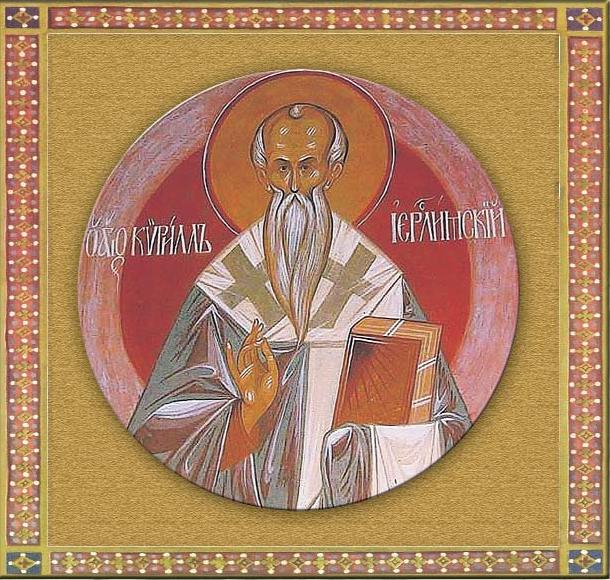
Saint Cyril, Archbishop of Jerusalem, was born in Jerusalem in the year 315 and was raised in strict Christian piety. Upon reaching the age of maturity, he became a monk, and in the year 346 he became a presbyter. In the year 350, upon the death of Archbishop Maximos, he succeeded him on the episcopal throne of Jerusalem. As Patriarch of Jerusalem, St. Cyril zealously fought against the heresies of Arius and Macedonius. In so doing, he aroused the animosity of the Arian bishops, who sought to have him deposed and banished from Jerusalem. There was a miraculous portent in 351 at Jerusalem: at the third hour of the day on the Feast of Pentecost, the Holy Cross appeared in the heavens, shining with a radiant light. It stretched from Golgotha above the Mount of Olives. St. Cyril reported this portent to the Arian emperor Constantius (351-363), hoping to convert him to Orthodoxy.The heretic Akakios, deposed by the Council of Sardica, was formerly the Metropolitan of Caesarea, and he collaborated with the emperor to have St. Cyril removed. An intense famine struck Jerusalem, and St. Cyril expended all his wealth in charity. But since the famine did not abate, the saint pawned church utensils, and used the money to buy wheat for the starving. The saint’s enemies spread a scandalous rumor that they had seen a woman in the city dancing around in clerical garb. Taking advantage of this rumor, the heretics forcibly expelled the saint. The saint found shelter with Bishop Silvanos in Tarsus. After this, a local Council at Seleucia, at which there were about 150 bishops, and among them St. Cyril. The heretical Metropolitan Akakios did not want to allow him to take a seat, but the Council would not consent to this. Akakios stormed out of the Council, and before the emperor and the Arian patriarch Eudoxios, he denounced both the Council and St. Cyril. The emperor had the saint imprisoned. When the emperor Julian the Apostate (361-363) ascended the throne he repealed all the anti-Orthodox decrees of Constantius, seemingly out of piety. St. Cyril returned to his own flock. But after a certain while, when Julian had become secure upon the throne, he openly apostasized and renounced Christ. He permitted the Jews to start rebuilding the Temple of Jerusalem that had been destroyed by the Romans, and he even provided them part of the funds for the building from the state treasury. St. Cyril predicted that the words of the Savior about the destruction of the Temple down to its very stones (Lk. 21:6) would undoubtedly transpire, and the blasphemous intent of Julian would come to naught. Soon there was such a powerful earthquake, that even the solidly set foundation of the ancient Temple ofSolomon shifted in its place, and what had been rebuilt fell down and shattered into dust. When the Jews resumed construction, a fire came down from the heavens and destroyed the tools of the workmen. Great terror seized everyone. On the following night, the Sign of the Cross appeared on the clothing of the Jews, which they could not remove by any means. After this heavenly confirmation of St. Cyril’s prediction, they banished him again, and the bishop’s throne was occupied by St. Kyriakos. After the emperor Julian perished in 363, St. Cyril returned to his See, but during the reign of the emperor Valens (364-378) he was exiled for a third time. It was only under the holy emperor St. Theodosios the Great (379-395) that he finally returned to his archpastoral activity. In 381 St. Cyril participated in the Second Ecumenical Council, which condemned the heresy of Macedonius and affirmed the Nicea-Constantinople Symbol of Faith (Creed). St. Cyril’s works include twenty-three Instructions (Eighteen are Catechetical, intended for those preparing for Baptism, and five are for the newly-baptized) and two discourses on Gospel themes: “On the Paralytic,” and “Concerning the Transformation of Water into Wine at Cana.”. At the heart of the Catechetical Instructions is a detailed explanation of the Symbol of Faith. The saint suggests that a Christian should inscribe the Symbol of Faith upon “the tablets of the heart.”.”The articles of the Faith,” St. Cyril teaches, “were not written through human cleverness, but they contain everything that is most important in all the Scriptures, in a single teaching of faith. Just as the mustard seed contains all its plethora of branches within its small kernel, so also does the Faith in its several declarations combine all the pious teachings of the Old and the New Testaments.”. St. Cyril, a great ascetic and a champion of Orthodoxy, died in the year 386.
The Martyrs Trophimos and Eukarpios
They were soldiers at Nicomedia during the persecution against Christians under the emperor Diocletian (284-305). They distinguished themselves by their great ferocity in carrying out all of the emperor’s decrees. Once, when these soldiers had caught up with some Christians, they suddenly saw a large fiery cloud which had come down from the sky, thickening in form as it drew close to them. From out of the cloud came forth a Voice: “Why are you so zealous in threatening My servants? Don’t be deluded! No one can suppress those believing in Me through their own strength. It is better to join them and discover the Heavenly Kingdom yourselves.” The soldiers fell to the ground in fright, not daring to lift up their eyes, and only said to one another, “Truly this is the great God, Who has manifested Himself to us. We would do well to become His servants.” The Lord then spoke saying, “Rise up, repent, for your sins are forgiven.” As they got up, they beheld within the cloud the image of a Radiant Man and a great multitude standing about Him. The astonished soldiers cried out with one voice, “Receive us, for our sins are inexpressibly wicked. There is no other God but You, the Creator and true God, and we are not yet numbered among Your servants.” But just as they spoke this, the cloud receded and rose up into the sky. Spiritually reborn after this miracle, the soldiers released all the jailed Christians from the prisons. For this Sts. Trophimos and Eukarpios were handed over to terrible torments: they suspended the saints and tore their bodies with iron hooks. They gave thanks unto God, certain that the Lord would forgive them their former sins. When a fire had been lit, the holy martyrs went willingly into the fire and there gave up their souls to God.
Saint Aninas
Saint Aninas was born at Chalcedon into a Christian family. After the death of his parents, he withdrew at age fifteen into a monastery, where he received monastic tonsure. In search of complete solitude, he went off into the heart of the desert where the River Euphrates separates Syria from Persia. There he came upon an Elder named Maium and settled there with him. Both ascetics led a very strict life. During the forty days of the Great Fast they ate nothing, taking delight and joy instead in spiritual nourishment. Every day St. Aninas carried drinking water from afar. Once, he returned with full water pitchers earlier than usual, since an angel had filled the vessels with water. The Elder Maium realized that his disciple had attained to high level of spiritual accomplishment, and he in turn asled St. Aninas to become his guide, but he refused out of humility. Later, the Elder went to a monastery, and St. Aninas remained alone in the wilderness. By constant struggles the saint conquered the passions within himself, and he was granted gifts of healing and clairvoyance. Even the wild beasts became docile and served him. Wherever the saint went, two lions followed after him, one of which he had healed of a wound on its paw. Accounts of the saint spread throughout all the surrounding area, and the sick and those afflicted by evil spirits began to come to him, seeking healing. Several disciples also gathered around the saint. Once, in his seventeenth year as an ascetic, several men had come to the saint and asked for something to quench their thirst. Relying on the power of God, the saint sent one of his disciples to a dried-up well. The well miraculously filled up to its very top, and this water remained for many days. When the water ended, the saint did not dare to ask for a miracle for himself, and so he began to carry water from the Euphrates at night. Bishop Patrikios of Neocaesarea repeatedly visited the monk and ordained him presbyter, although the humble ascetic was resolved not to accept the priestly office. When he learned that the saint himself carried water from a distance, Bishop Patrikios twice gave him donkeys, but each time St. Aninas gave them away to the poor and continued to carry the water himself. Then the bishop ordered that a large well be dug, which they filled from time to time, bringing donkeys from the city. St. Aninas discerned the desire of a certain stylite monk, who struggled far from him, to come down off his pillar and make a complaint in court against a robber who had hurt him with a stone. St. Aninas wrote a letter to the stylite, advising him not to carry out his intent. The letter was brought to the stylite by a trusty lion, and it brought him to his senses. A certain pious woman, who had fallen ill, went to St. Aninas to ask for his prayers. Along the way a robber chanced upon her. Since the woman had no money, he decided to assault her and force her into sin. The woman called on the saint’s help and cried out, “St. Aninas, help me!” Terror suddenly overcame the robber, and he let go of the woman. The woman went to St. Aninas and told him everything, and she also received healing. The robber also came to the monk in repentance, was baptized, and then tonsured as a monk. A spear which he had thrust into the ground when he attacked the woman, grew into a mighty oak. At the age of 110 the saint predicted the time of his death, and he directed his successor as igumen to assemble the brethren. Before his death, St. Aninas conversed with the holy Prophets Moses, Aaron and Or [or Hur: Ex. 24:14]. He fell asleep in the Lord saying, ” O Lord, receive my soul.”
Saint Daniel
He lived in Egypt in the sixth century. Prompted by the Devil, they accused him of profligacy, and he endured all the unjust abuse without complaint, taking comfort in the words of the Lord: “Blessed are you when men shall revile you… and shall say all manner of evil against you falsely, for My sake” (Mt. 5:11). The saint was the teacher of St. Anastasios the Patrician.
SAINT CYRILL OF ASTRAKHAN
Saint Cyril of Astrakhan was archimandrite of the Trinity monastery in Astrakhan. He had been sent to the newly-built monasteryas igumen in 1568. He constructed churches at the monastery in honor of the Most Holy Trinity, the Entry of the Most Holy Theotokos into the Temple, and St. Nicholas. He zealously devoted himself to the enlightenment of the Astrakhan region. By his meekness and piety, he even won the respect of the Moslems, who called him Kara-Daud (the Black David) in distinction from the holy Prophet King David. St. Cyril died around 1576. The saint’s icon was painted in 1676 in fulfillment of a vow of Emelian Paphentiev, whom St. Cyril had saved when he was drowning in the Volga. The Life of the saint was written in the year 1790, and there is a troparion and kontakion for him. The Church established St. Cyril’s commemoration on March 18 [probably because of his namesake St. Cyril of Jerusalem].