

SAINT John of Sinai, author of “The Ladder of Divine Ascent”
St. John Climacus of Sinai accepted the ascetical life from the age of about sixteen and was tonsured as a monk three or four years later. Then, at the age of 35, he isolated himself from the world and lived as a hermit for 40 years at a monastery church called Thola, about 10 kilometres from the Mount Sinai monastery. While living an ascetical life he is reported to have received the gift of tears and the grace of continual prayer. Fellow monks in large numbers began to seek him out for spiritual guidance. When criticized for making a mockery of his hermitage by entertaining so many people there, he decided to keep total silence. After a year or so of this, those who had criticized him pleaded with him to resume guiding others. Experienced both in the solitary life of the hermit and in the communal life of cenobitic monasticism, he was appointed Abbot of the Monastery at Mount Sinai (built at the site of the burning bush where Moses spoke to God). The day he was made Abbot of Sinai, the Prophet Moses was seen giving commands to those who served at the table. St John wrote a book containing thirty homilies. Each homily deals with one virtue, and progressing from those that deal with holy and righteous activity (praxis) unto those that deal with divine vision (theoria), they raise a man up as though by means of steps unto the height of Heaven; thus the book is called “The Ladder of Divine Ascent”, and the saint is know as “Climacus”. “The Ladder of Divine Ascent” is so greatly is this God-inspired book esteemed in the Orthodox Christian Church that its author, St. John Climacus, is celebrated twice a year – on 30th March (the day of his repose), and the Fourth Sunday of the Great Lent. Each monastic community of the Orthodox Church reads “The Ladder of Divine Ascent” during each day of the Great Lent, in their common dining hall (or refectory) during the daily meal. This is a period of strict fasting, struggle, prostration and extensive prayers; when only one meal is eaten in the day and after 3 pm, and water is only consumed during 3-6pm. The book, by means of thirty steps (or logoi), calls us to the spiritual life; it inspires, instructs, speeds the reader towards the “things on high”, and points-out the dangers and pitfalls. Each step describes the origin of a certain virtue or passion and the path it can take us. The Ladder does not offer us a formula to accomplish salvation, for “the life you have is hidden with Christ in God” (Col. 3:3), but: “Let us try to learn Divine truth more by toil and sweat than by mere word, for at the time of our departure it is not words but deeds that will have to be shown” (Step 26:36). Saint John reposed in 603 AD, at eighty years of age.
Prophet Joad
Prophet Joad came from Samaria and prophesied during the tenth century before Christ (See 1/3 Kings 13). The prophet was sent by the Lord from Judea to Bethel to denounce the Israelite king Jereboam for polluting his nation with idol worship. The Lord commanded the prophet, “Eat no bread, and drink no water, and do not return by the way you came” (1/3 Kings 13:9). The prophet Joad appeared to King Jereboam and prophesied to him concerning the wrath of the Lord. When the king tried to gesture with his hand to seize the prophet, his hand suddenly withered. The king entreated the prophet to pray to the Lord that his hand would be healed. By Joad’s prayer he received healing.Deceived by the false prophet Emba of Bethel, Joad disobeyed the command given him by the Lord. The older man lied and told Joad that an angel had commanded him to bring him to his home and feed him. Because of his disobedience, the prophet Joad was killed by a lion. His body did not rest with his fathers, but was buried near the abode of the false prophet who led him astray.
The Apostles Sosthenes, Apollos, Cephas, Caesari-us and Epaphroditos
The Apostles Sosthenes, Apollos, Cephas, Caesarius and Epaphro-ditos of the Seventy: St. Sosthenes was head of the Corinthian synagogue before his conversion. The Apostle Paul converted him to Christianity and made him his helper in his work. In addressing the Corinthian church, St. Paul sent greetings from both of them: “Paul, by the will of God called to be an apostle of Jesus Christ, and brother Sosthenes…” (1 Cor 1:1). Afterwards, St. Sosthenes was made bishop at Colophon (Asia Minor). In the Acts of the Holy Apostles we read the following: “A certain Jew named Apollos, born in Alexandria, eloquent and well-versed in the Scriptures, came to Ephesus. He was instructed in the way of the Lord; and being fervent in the spirit, he spoke and taught diligently the things of the Lord, knowing only the baptism of John. He began to speak boldly in the synagogue. Hearing him, Aquila and Priscilla took him and more precisely explained to him the way of the Lord. And when he resolved to go to Achaia, the brethren wrote and asked the disciples to receive him. When he got there, he greatly helped those who believed by grace, for he powerfully confounded the Jews in public, showing by the Scriptures that Jesus is the Christ” (Acts 18:24-28). St. Apollos assisted the Apostle Paul. St. Paul speaks about the spread of Christianity among the Corinthians, “I have planted, Apollos watered, but God gave the growth” (1 Cor 3:6). St. Apollos was later bishop at Smyrna (Asia Minor). According to Tradition, St. Cephas was Bishop of Iconium. No accounts of him have been preserved. It is assumed that he is the one who is mentioned by the Apostle Paul (1 Cor 15:5). St. Epaphroditos was a companion of St. Paul who sent him to the Christians of Philippi. He speaks about his own hard work in the vineyard of Christ: “I thought it necesary to send you Epaphroditos, my brother and coworker and fellow soldier, your messenger and minister to my needs… he was sick and near to death; but God had mercy on him, and not only him but also on me, lest I should have sorrow upon sorrow… Receive him in the Lord with all joy; and honor such men, for he almost died for the work of Christ, risking his life to complete your lack of service to me” (Phil 2: 25-30). St. Epaphroditos was Bishop of Adrianium (Italy). These holy apostles are also commemorated on December 8 and the Synaxis of the Seventy Apostles on January 4.
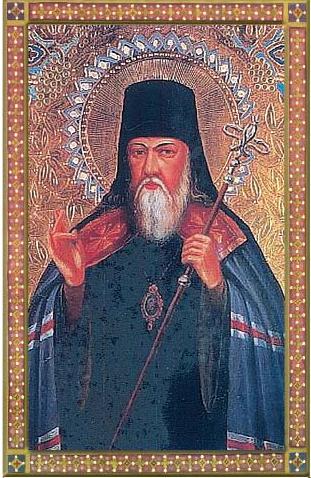 Saint Sophronios, Bishop of Irkutsk
Saint Sophronios, Bishop of Irkutsk and Wonderworker of all Siberia, whose family name was Kristalevsky, was born in Malorussia in the Chernigov region in 1704. His father, Nazarios, was “a common man in his affairs, and the saint was named Stephen, in honor of the protomartyr St. Stephen. He had two brothers and a sister, Pelagia. The name of one brother was Paul. The name of the other older brother is unknown, but it is said that he was head of the Krasnogorsk Zolotonosh monastery. Stephen’s childhood years were spent in the settlement of Berezan in the Pereyaslavl district of the Poltava governance, where the family settled after the father was discharged from service. When he came of age, Stephen entered the Kiev Theological Academy, where two other future hierarchs were studying: Joasaph, future Bishop of Belgorod, and Paul, future Metropolitan of Tobolsk. After completing his religious education, Stephen entered the Krasnogorsk Transfiguration monastery (later renamed the Protection monastery. In 1789, it was transformed into a women’s monastery), where his elder brother already labored in asceticism. On April 23, 1730 he received monastic tonsure with the name of Sophronios, in honor of St. Sophronios of Jerusalem. On the night after his monastic tonsure, St. Sophronios heard a Voice in the Protection church predicting his future service: “When you become bishop, build a church dedicated to All Saints.” In 1732, he was summoned to Kiev. There he was ordained hierodeacon, and then hieromonk in St. Sophia cathedral. After St. Sophronios had been a monk for two years, he became treasurer of the Zolotonosh monastery for two years, and then His Grace Bishop Arsenios (Berlov) of the Pereyaslavl diocese sent him into the house of his archbishop, where he was steward for eight years. These facts testify to the connections of the saint with his original Protection monastery. During his obedience under the presiding hierarch at Pereyaslavl, he often visited his monastery, spending the day in quiet contemplation and work, serving as an example to the brethren. When Hieromonk Sophronios traveled to the Holy Synod on behalf of his bishop, they paid close attention to him. In January 1742, the future saint was transferred to the St. Alexander Nevsky Lavra in St. Peterburg, the foremost monastery of the capital. A year later he was appointed treasurer of the monastery, and in 1746 he was appointed as Superior of the monastery. He summoned his fellow countryman, the hieromonk Sinesios (Ivanoff), a native of the city of Priluki, and made him igumen of the St. Sergius Hermitage, a dependancy of St. Alexander Nevsky Lavra. From this time the friendship of the two ascetics, hieromonk Sophronios and hieromonk Sinesios, was strengthened by their joint pastoral effort, and they were inseparable until they died in Siberia. During these years St. Sophronios worked hard at managing the monastery and improvement of teaching at the seminary located nearby. He and Archbishop Theodosios made it their task to acquire more books for the monastic library. St. Sophronios built a two storey church: the upper church was dedicated to St. Theodore, the older brother of St. Alexander Nevsky; and the lower to St. John Chrysostom. Bishop Innocent II (Nerunovich) of Irkutsk died in 1747. For six years afterwards, the Irkutsk diocese remained without a spiritual head. Finally, on February 23, 1753, the empress Elizabeth (1741-1761) recommended the pious Igumen Sophronios of the Alexander Nevsky monastery to the Holy Synod as “a person, not only worthy of episcopal rank, but also someone completely able to fulfill the wishes and the hopes of the state and the Synod, and take up the burden of episcopal service on the far frontier and satisfy the needs of his flock in that harsh land, among wild primitives and lawless people.” On April 18, 1753, Thomas Sunday, Hieromonk Sophronios was consecrated Bishop of Irkutsk and Nerchinsk in the Dormition cathedral. Foreseeing difficult service on the distant Siberian frontier, the new bishop did not immediately travel to the Irkutsk eparchy, but rather began to gather educated and spiritually experienced co-workers. During this period St. Sophronios visited at his original Krasnogorsk monastery. At the holy places of Kiev, he also sought the blessings of the Kiev Caves Saints for his service. The constant companion of the saint, as had been before, was the hieromonk Sinesios, sharing in his friend’s work. At Moscow, Archbishop Platon of Moscow and Sevsk provided him with further assistance. He gave him fatherly advice for his task, since he was quite familiar with the peculiarities of the Siberian religious life. He forewarned him about the self-willed local authorities, and advised him to surround himself with trustworthy helpers. On March 20, 1754 the saint arrived at Irkutsk. He went first to the Ascension monastery, his predecessor’s residence, and prayed at the grave of Bishop Innocent (Kulchitz), asking his blessing as he took up his assignment. Familiarizing himself with the state of affairs in the diocese, the saint began the reorganization of the Spiritual consistory, monasteries and parishes, and appealed to the Holy Synod to send worthy men to the Irkutsk eparchy for priestly service. Before the arrival of St. Sophronios, the Irkutsk monasteries had already a century-old history. The founders of these monasteries were motivated by a fervent desire for monastic life. The wise hierarch appointed people of piety, wisdom, virtue, and with great experience both of life and spiritual matters as heads of the monastic communities. In 1754, Bishop Sophronios elevated his friend and companion Hieromonk Sinesios to be Archimandrite of Ascension monastery. He served the monastery for thirty-three years until his blessed repose. In September 1754, the bishop issued a decree in which he expressed concern for the education and upbringing of the children of the clergy. He wanted them to learn the HOROLOGION, the PSALTER, singing and letters, and this instruction “ought to be conducted with all industriousness and the utmost diligence, so that the children might be able to fulfill the responsibilities of sacristan and deacon.” Studying both people and circumstances, the bishop in his sermons and conversations exhorted all to a higher moral ideal. He devoted particular attention to the reverent and correct performance of the divine services and the Holy Mysteries, and he also looked after the moral purity of laymen. He was concerned about the position of women in the family, and defended them against their unjust inequality. The bishop attempted to set straight the Rule of divine services, and so he summoned priests, deacons, subdeacons and sacristans, and those who sang in the choir during services. Traveling about the diocese, the saint noticed that censing and the ringing of bells were not being done properly in all places, and therefore he issued a decree restoring the proper way of censing and bell-ringing. Called to apostolic service in this frontier region, St. Sophronios realized that his duty was to enlighten the Christians of the area, and also to convert the idol-worshippers, who were very numerous in Siberia. It was difficult to bring pagans to the Church of Christ, especially because sometimes there was no one to serve in the churches, and to borrow priests for missionary activity only made matters worse. Knowing that the Church services would have a salutary effect on non-Russians, the saint not only served with reverence himself, but also required it of all his clergy. St. Sophronios also contributed to the development of a stable culture among the local people. He offered them monastic lands for settlements and in every way he endeavored to isolate them from the influence of paganism. A constant throng of visitors came from faraway places for his blessing. Even with his many cares, he did not forget his own spiritual life and eternity. He also led an ascetical life. His cell-attendant said that the saint “used simple food in small quantities. He served often, spent the greater part of the night at prayer, sleeping on the floor under a sheepskin or a fur, a deerskin or bear hide, and a small simple pillow. The spirit of his ascetic life fit in with the general uplifting of the Christian spirit in Russia after the glorification of St. Dimitrios of Rostov, Theodosios of Chernigov, and the uncovering of the incorrupt relics of his predecessor, St. Innocent of Irkutsk. This event inspired St. Sophronios to greater efforts and encouraged him to ask for the help of St. Innocent in his task of building up the diocese. Until the end of his days St. Sophronios kept his love for the Krasnogor Zolotonosh monastery, which had nurtured him in the days of his youth. He constantly contributed support for its upkeep, sending the necessary means for this. Noticing a deterioration in his health, St. Sophronios petitioned the Holy Synod to let him retire. The answer from Peterburg did not come right away, since it was difficult to choose a worthy successor. The final days of St. Sophronios’ s life were spent in asceticism and prayer. The light, which shone on the good deeds of St. Sophronios, continues to the present time to testify to the glory of the Heavenly Father, “Who mercifully strengthens His saints.” Now the holy memory of St. Sophronios is reverently preserved not only in Siberia at the place of his final deeds, but also at the place of his first deeds. St. Sophronios is also commemorated on June 30 (his glorification in 1918).
SAINT EUBOLA
Saint Eubola, Mother of the Great Martyr Panteleimon (July 27), died peacefully around 303, before the martyrdom of her son.
Saint John the Silent
Saint John the Silent Bishop of the city of Colonia, was a model of a good Christian life for his flock. Persecuted by the governor, he was deprived of the archbishop’s cathedra and went to the monastery of St. Sabbas the Sanctified, where he was glorified in ascetic deeds of silence, prayer, and desert-dwelling. The monk died at age 104 (+ 558).
SAINT ZOSIMAS, BISHPO OF SYRAKUSE
Saint Zosimas, Bishop of Syracuse, was born in answer to the fervent prayers of his parents, who were childless for a long time. When their son reached the age of seven, his parents sent him to a monastery to be educated. When the holy ascetic became an adult, he received monastic tonsure, and governed the monastery for forty years. Pope Theodore (641-649) consecrated him Bishop of Syracuse. St. Zosimas was distinguished by his charity and lack of avarice, and led his flock by word and by example. Toward the end of his life St. Zosimas fell grievously ill, but endured his suffering with magnanimity and humility. He died in the year 662, after he had led his flock for thirteen years. Later, many of the sick received healing by merely touching his tomb.
Hieromartyr Zacharias
Hieromartyr Zacharias, Bishop of Corinth, suffered for Christ under the Turks in 1684. The Moslems accused him of secret correspondence with the Franks (French), whom the saint supposedly would have appealed to and promised to aid them seize the city. The Moslems in a rage fell upon the Christian bishop and, shackled in chains and subjected to beatings, they led him to trial. The judge demanded that St. Zacharias accept Islam and, when he heard the bishop’s refusal, he ordered that he be beaten without mercy. Then they locked the confessor of Christ in prison, where the Moslem fanatics did not cease beating the martyr. The hieromartyr Zacharias was beheaded on the third Sunday after the Sunday of the Veneration of the Cross.