

 SAINT NICEPHORUS, CONFESSOR AND PATRIARCH OF CONSTANTINIOPLE
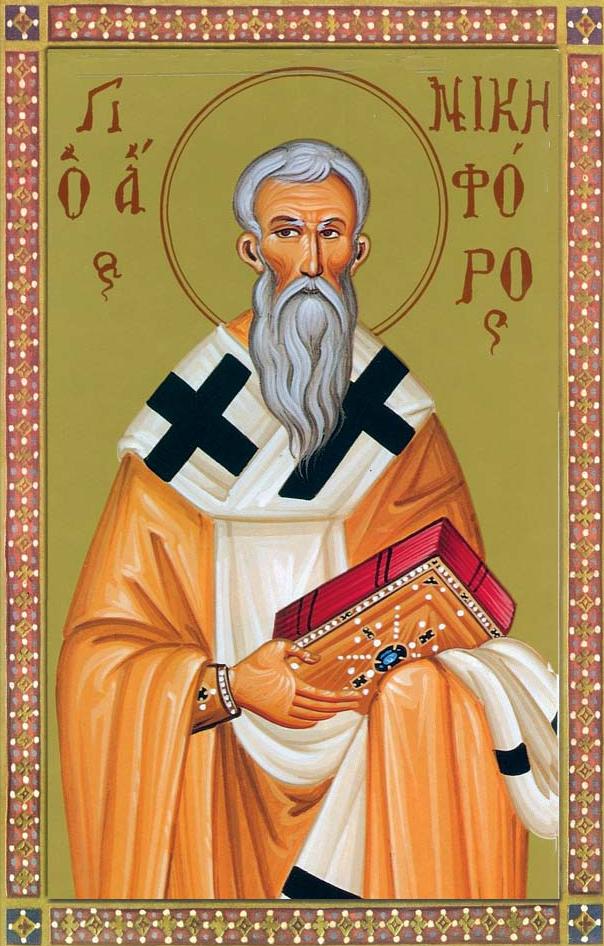
Nicephorus was a nobleman of Constantinople. His father Theodore, a high- ranking official of the imperial court, was wealthy and pious. Nicephorus served at the court for several years in the same profession as his father. Seeing all the vanity of the world, he withdrew to the shores of the Bosphorus and founded a monastery. The monastery was quickly filled with monks and he governed it but was not willing to receive the monastic tonsure under the pretext that he was not worthy, even though, in all things he served as a model to all. Before that, he participated in the Seventh Ecumenical Council [Nicea, 783 A.D.] as a layman at the wishes of the emperor and the patriarch and the Council benefited greatly by his superior knowledge of Sacred Scripture. When Patriarch Tarasius died, Nicephorus was elected patriarch against his will. Immediately following his election in the year 806 A.D., he received the monastic tonsure and in succession all other ecclesiastical ranks. He was enthroned as patriarch in the Church of the Divine Wisdom of God [Hagia Sophia]. This took place during the reign of Emperor Nicephorus who immediately, after that, went to war against the Bulgarians and was slain. His son, Stauracius, reigned only two months and died. After him, the good Emperor Michael, surnamed Rangabe, ruled but he reigned for only two years until he was overthrown by Leo the Armenian and banished into exile. When Leo was crowned, the patriarch sent him a book of the Orthodox Confession of Faith to sign (according to the custom of all Byzantine emperors which was considered an oath that they will uphold and defend the True Faith). The emperor did not sign it but rather postponed it until after the coronation. When the patriarch crowned him, Leo refused to sign the book and quickly proved himself to be a heretic; an iconoclast. The patriarch attempted to advise him and to restore him to the True Faith, but in vain. The emperor forcibly banished Nicephorus into exile to the island of Proconnesus where he remained for thirteen years enduring every kind of misery and privation and entered eternity in the year 827 A.D. As patriarch he governed the Church of Christ for nine years.
THE NEO-MARTYR CONSTANTINE
Constantine was born of Muslim parents on the island of Mitylene. Having been healed of a grave illness with the help of holy water in the church and witnessing other miracles of the Faith of Christ, he was baptized on Mt. Athos in the Scete of Kapsokalyvia. Later on Constantine fell into the hands of the Turks who hanged him in Constantinople on June 2, 1819 A.D. after forty days of cruel tortures.
THE HOLY NEO-MARTYR JOHN OF SOCHAVA
John was a nobleman from Trebizond. He was accused by an envious Latin and suffered for Christ in the city of Akerman in the year 1492 A.D. After being tortured for refusing to embrace the Persian religion (for the mayor of this town was an adherent of that faith), St. John was tied to the legs of a horse and dragged throughout the town. An evil Jew, upon seeing him, ran up to John and slaughtered him. That night, many saw a fiery pillar over his body and three light-bearing men around it. Later, the Moldavian commander, Joalexander, with great homage translated his honorable body to the town of Sochava and buried it in the metropolitan church where it reposes even today and miraculously saves men from various pains and illnesses. John suffered honorably and was glorified on June 2, 1492 A.D.
 THE PRIESTLY-MARTYR ERASMUS OF OHRID
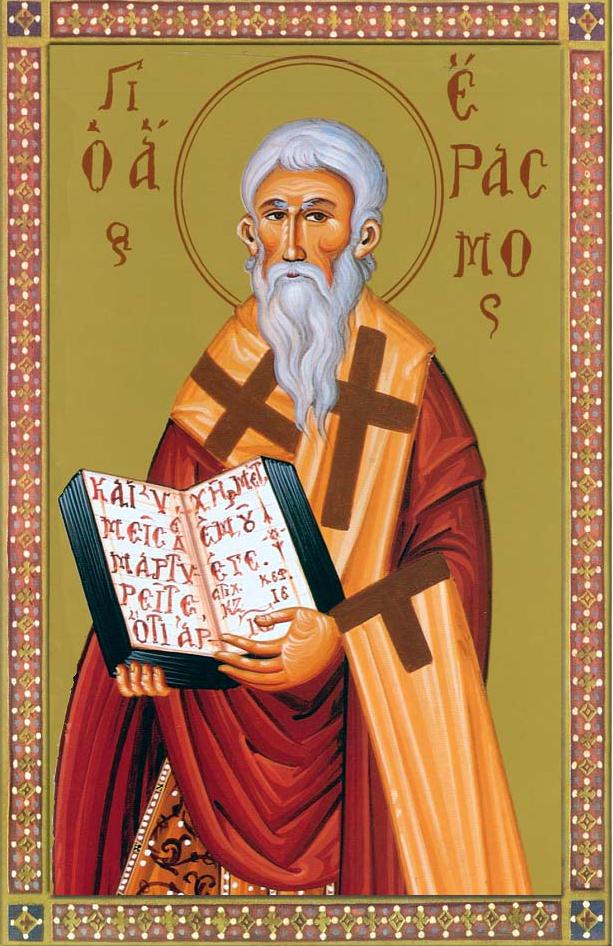
This saint was born in Antioch and lived during the reign of Emperors Diocletian and Maximian. He lived a strict life of asceticism on Mt. Lebanon and was endowed by God with the great gift of working miracles. As an bishop, he went out to preach the Good News. Arriving at the town of Ohrid, Erasmus, by his prayers, resurrected the son of a man named Anastasius and baptized him. At this time, Erasmus baptized many other pagans and destroyed the altars of the idols in Ohrid. For that he was denounced before Emperor Maximian who, at that time, was residing in Illyria. The emperor brought him before a copper idol of Zeus and ordered him to offer sacrifice and to worship the idol. St. Erasmus manifested so great a power that a horrible dragon came out from the idol, which frightened the people. Again the saint manifested great power and the dragon died. The saint then preached Christ and baptized twenty thousand souls. The embittered emperor ordered that all twenty thousand be beheaded and subjected Erasmus to severe tortures and then cast him into prison. An angel of God appeared to Erasmus as once to the Apostle Peter and led Erasmus out of the prison. After that, this servant of God departed for Campania where he preached the Gospel to the people and then again returned to the town of Hermelia where he retreated to a cave and desired to live a life of asceticism until his death. Before his death, he bowed down three times toward the east and with uplifted arms prayed to God that He forgive sins and to grant eternal life to all those who, with faith, would invoke his name. At the completion of his prayer a voice from heaven was heard: “So let it be as you prayed, my little healer Erasmus!” Completely joyful, the saint gazed up at the heavens once more and saw a wreath of glory as it was descending upon him and saw the choirs of angels, prophets, apostles and martyrs who came toward him to receive his holy soul. Finally he cried out: “O Lord, receive my spirit!” and died about the year 303 A.D. The cave with a small church dedicated to St. Erasmus, exists today not far from Ohrid and, from it, even today the great power of the chosen one of God, Erasmus the priestly-martyr, is manifested.