

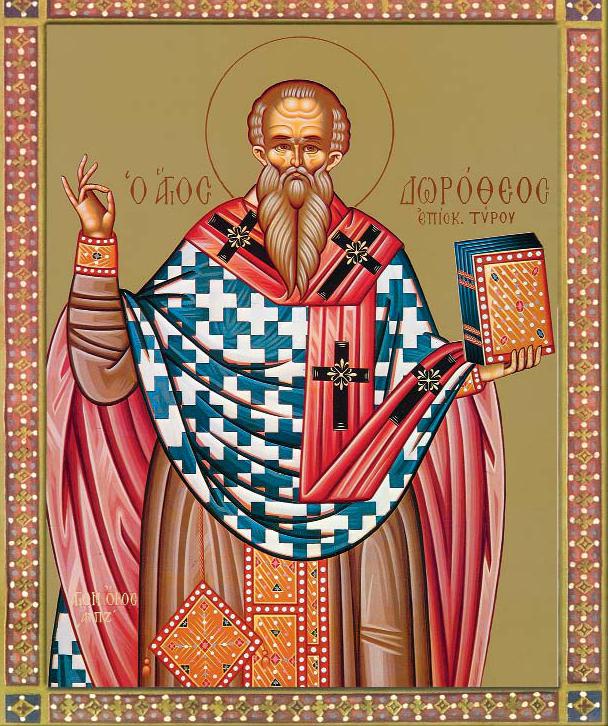
 THE PRIESTLY-MARTYR DOROTHEUS, BISHOP OF TYRE
Dorotheus was Bishop of Tyre from the time of Diocletian to the time of Julian the Apostate under whom he was tortured and suffered for the Orthodox Faith. He lived on earth one hundred seven years and, pleasing God, he took up habitation in life eternal in the year 361 A.D. Dorotheus was a very educated man and wrote many instructive works in Greek and Latin. Especially famous is his Greek-Latin Syntagma.
VENERABLE THEODORE, THE HERMIT
Theodore was a miracle-worker. Purifying his spirit through a long life of asceticism in the wilderness of Jordan, Theodore received from God the gift of working miracles. Traveling by boat to Constantinople, it happened that the boat wandered off course and water for drinking ceased to exist. Because of thirst all the travelers on the boat were at the point of death. Theodore raised his hands to heaven, prayed to God and traced the sign of the cross over the sea water. After that, he said to the boatmen to draw water from the sea and drink. When they drank the water it was sweet. When they all began to bow down before Theodore, he beseeched them not to thank him but to thank the Lord God Who worked this miracle because of His love for mankind. Theodore died peacefully in the year 583 A.D.
THE VENERABLE ANOUB
Anoub was one of the great Egyptian monks. He suffered much for the True Faith. Prior to his death, three aged hermits visited him and he, “a discerner of the thoughts of man,” revealed all the secrets of their hearts to them. Anoub died peacefully in the second half of the fifth century.
BLESSED IGOR
Igor was the Prince of Chernigov and Kiev. Persecuted by his kinsmen, he withdrew from the world and was tonsured a monk. The inhabitants of Kiev, dissatisfied with the Olgovitch dynasty, wanted to exterminate it. They charged the monastery, captured the innocent and young Schemnik Igor and slew him. As a result of this crime, many were the misfortunes that befell the inhabitants of Kiev and over the grave of this blessed monk candles were seen on several occasions lighted by themselves and a fiery pillar was seen over the church where he was buried. This occurred in the year 1147 A.D.
THE VENERABLE FATHER PETER OF KORISHE
Peter was born in the village of Korishe beyond the monastery of St. Mark near Prizren. (According to another legend, he was from a village near Pec). As a young man, he plowed with a one-eyed ox. Peter was exceptionally meek and mild tempered. He withdrew at an early age to lead a life of asceticism, as did his sister Helen. He mortified himself very strictly and persistently. In difficult combat with demonic temptations, Peter proved himself victorious. He was a teacher to the many monks who gathered around him. Fleeing from the glory of men, he hid himself for a period of time by the Black river where, later on, St. Joanicius of Devich lived a life of asceticism. Peter died in old age in his cave at Korishe. The night in which he died a light from many candles was seen in his cave and angelic singing was heard. This saint probably lived in the thirteenth century. Over his miracle-working relics Tsar Dusan built a church, which was a dependency (metoch) of Hilendar. In more recent times the remains of the relics of St. Peter were secretly translated to the Black river where they repose today.
BLESSED CONSTANTINE, METROPOLITAN OF KIEV
In the days of Blessed Prince Igor when there was great litigation and confusion among the Russian princes, there was also disorder in the Church and frequent changes on the thrones of the hierarchs. Thus, after the death of Metropolitan Michael of Kiev, Prince Izyaslav brought the famous and learned monk Klim as metropolitan not seeking the blessing of the patriarch of Constantinople, contrary to the age-old tradition. Thus, the patriarch sent Metropolitan Constantine to investigate the matter. Constantine removed Klim and banished all those clerics from the Church that he had ordained. Because of this the people were divided; some adhered to Klim and others adhered to Constantine. Then, according to the wishes of the Russian princes, the patriarch sent a third, Theodore, and both Klim and Constantine were removed. When Constantine died in the year 1159 A.D. they opened his will and in it he requested that he not be buried but that his body be thrown in the field to be consumed by dogs because he considered himself the culprit responsible for the confusion in the Church. Not daring to disobey his testament, nevertheless, with great horror men took the body of the metropolitan and tossed it into the field where it lay for three days. For three days it thundered terribly over Kiev, lightening flashed all around, thunder struck and the earth quaked. Eight men perished from the thunder. Three fiery pillars appeared over Constantine’s lifeless body. Seeing all of this, the prince of Kiev ordered that the body of Constantine be taken and honorably buried in the church where the tomb of Igor was located. Immediately following, a calm ensued in nature. Thus God justified His humble servant.