

 THE VENERABLE FEMALE MACRINA
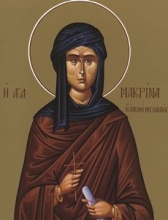
Macrina was the eldest sister of St. Basil the Great and St. Gregory of Nyssa. As a young virgin, Macrina was bethrothed to a nobleman. When her betrothed died, Macrina vowed never to enter into marriage saying: “It is not right for a maiden once betrothed to a young man to seek another: according to the law of nature there must be only one marriage as there is but one birth and one death.” She further justified this by her faith in the resurrection considering her bridegroom, not dead but alive in God. “It is a sin and a shame,” says Macrina, “for a wife not to safeguard her faithfulness when her husband travels to a distant land.” After this, together with her mother, Emilia, she received the monastic tonsure in a convent, where they lived a life of asceticism with other nuns. They lived from the labors of their hands devoting a greater part of their time to godly thoughts, prayer and the constant uplifting of their minds to God. In time her mother died and, afterward her brother Basil. Nine months after the death of St. Basil, Gregory came to visit with his sister and found her on her death bed. Before her death, Macrina lifted up her prayers to God: “You, O Lord, Who gives rest to our bodies in the sleep of death for a time, will again awaken them [the bodies] at the last trump. Forgive me and when my soul divests itself of its bodily attire and presents itself before You, pure and without sin, grant that it may be as incense before You.” After that she traced the sign of the cross on the forehead, eyes, face and on her heart and gave up her soul. She found rest in the Lord in the year 379 A.D.
THE VENERABLE DIUS
Dius was born of Christian parents in Antioch, Syria. From his youth, he was taught by godly-inspired men in the monastic life and in asceticism. Since he persevered in a lengthy and laborious battle with the devil and passions of the flesh, God endowed Dius with the great gift of working miracles. In his prayers he, most often, turned to the Holy Trinity. He performed great and awesome miracles through the power of his prayers: he caused a withered staff to blossom, a dry well to be replenished with water and an unbelieving man he struck dead and then resurrected him again. After two brief heavenly visions, Dius departed from Antioch and settled in Constantinople where, in the proximity of the city, he continued his life of asceticism. His fame spread rapidly and even Emperor Theodosius the Younger visited him to receive counsel from him and Patriarch Atticus persuaded and ordained him a presbyter. Having lived for many years, Dius began to prepare for death, received Holy Communion, instructed the brethren, lay down on his bed and died before the eyes of all. The news of his death drew many people; even Patriarch Atticus came with Alexander, the Patriarch of Antioch. When they were about to bury him, he suddenly arose as though awakening from sleep and said: “God has given me fifteen more years of this life.” St. Dius lived for exactly fifteen years and led many to the path of salvation, healed many, helped many in various misfortunes and needs and finally gave up his soul to the Lord, Whom he faithfully served all his life. He died in the year 430 A.D. in extreme old age.
THE COMMEMORATION OF STEPHEN THE TALL
Stephen was the son of the Serbian Prince Lazarus and Princess Militza. He was a protector of Christianity in the Balkans during most difficult times. He was the founder of the beautiful monumental monasteries of Manasija and Kalenich. After many labors and troubles he died on July 19, 1427 A.D.