

 VENERABLE THEODOSIUS THE GREAT [THE CENOBIARCH]
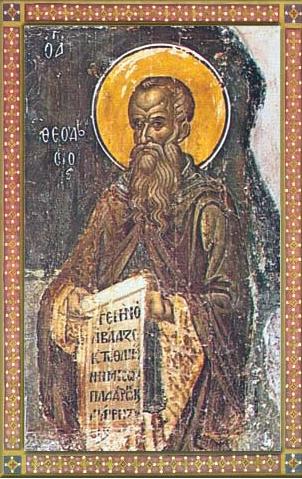
Saint Theodosius was the first founder and organizer of the cenobitic way of monastic life. He was born in the province of Cappadocia in the village of Mogarissus of devout parents. As a child, he visited St. Simeon the Stylite who blessed him and prophesied great and spiritual honors about him. With a thurible [censer] in which he placed unburned charcoal and incense, Theodosius sought out a place where he could settle and establish his monastery and stopped when the charcoal fired up on its own. Here, he settled and began to live the ascetical life. Soon, he gathered around him many monks of various nationalities. He built a church for each nationality so that, at the same time, services and hymns were offered to God in Greek, Armenian, Georgian, etc. But, on the day of Holy Communion, all the brotherhood gathered in the great church in which the Greek language was used. There was a communal table for all, communal property, communal penance, communal labor, communal patience and, not too rare, communal hunger. Theodosius was an exalted model of life to all the monks; an example in labor, prayer, fasting, watchfulness and in all Christian virtues. God granted him the gift of working miracles by which he was able to heal the sick, to appear from a distance, to tame wild beasts, to discern the future and to cause bread and wheat to multiply. Prayer was on his lips day and night. He died peacefully in the Lord in the year 529 A.D., the one-hundred fifth year after his birth.
Saint Theodosios
Saint Theodosios, Metropolitan of Trebizond, was born in the village of Koritsa, near the Kastorian hills. At eighteen years of age he became a monk at Constantinople and went to the Philotheou monastery on Mt. Athos, where he led a strict ascetic life. He was chosen igumen of the monastery in 1375, and afterwards was made Metropolitan of Trebizond because of the holiness of his life. He persuaded John Alexios Komnenos to build the monastery of Dionysiou on Mt. Athos. After a God-pleasing life, he died in Trebizond in 1392.
BLESSED MICHAEL, A FOOL FOR CHRIST
Blessed Michael of Klops was of noble lineage, and he was a relative of Great Prince Dimitrios Donskoi (1363-1389). He took upon himself the exploit of foolishness for Christ to avoid the praise of men. Leaving Moscow dressed in rags, he arrived at the Klops monastery, near Novgorod. No one knew how he got into the locked cell of the hieromonk Makarios, who was going round the cell censing during the Ninth Ode of the Canon. A man in monastic garb sat there beneath a candle, copying out the Acts of the Holy Apostles. After the end of Matins the igumen came with some of the brethren and asked the stranger who he was, and what his name was. But he responded only by repeating the questions, and did not reveal his origin. In church the stranger sang in the choir and read the Epistle, and he also read the Lives of the Saints at meals. All who listened were moved by the beauty and spirituality of his reading. On the Feast of the Transfiguration of the Lord, the Klops monastery was visited by Prince Constantine Dimitrievich (son of Great Prince Dimitrios Donskoi). After Communion he was in the trapeza with the princess, during which time the unknown stranger read from the Book of Job. Hearing the reading, the prince approached the reader and looked him over. Then he bowed down to him, calling his kinsman Michael Maximovich by name. The fool remarked, “Only the Creator knows me, and who I am,” but he confirmed that his name was Michael. St. Michael soon set an example for the brethren in all the monastic efforts. He lived at the Klops monastery for forty-four years, exhausting his body in work, vigils and various deprivations, and he received from the Lord the gift of clairvoyance. He denounced the vices of people, not fearing the powerful of this world. He predicted the birth of Great Prince Ivan III on January 22, 1440, and his capture of Novgorod. He denounced Prince Dimitrios Shemyaka for blinding his brother the Great Prince Basil the Dark (1425-1462). On a sandy spot St. Michael summoned forth a spring of water, having written upon the earth: “I will take the cup of salvation (Ps. 115/116:13), let the well-spring show forth on this spot.” And during a time of famine, the supplies of bread at the monastery granary did not diminish, though they distributed grain abundantly to the hungry. Having indicated beforehand the place of his burial, the saint died on January 11, 1453.