

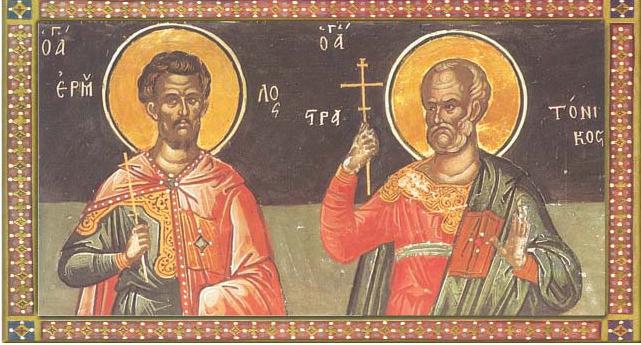
 THE HOLY MARTYRS HERMYLAS AND STRATONICUS
The Emperor Licinius raised up a persecution against Christians. St. Hermylas, a Christian and a deacon in the Church, was captured and led to court. When Hermylas was informed that he was being led away to be tortured, he greatly rejoiced. In vain did the emperor threaten him. Hermylas openly confessed his faith in Christ and responded to all the threats of the emperor saying, “The Lord is with me; I fear not; What can man do against me?” (Psalm 118:6). Following excruciating tortures, Hermylas was thrown into the dungeon. The guard was Stratonicus, secretly a Christian, who sympathized with the suffering of Hermylas with all his heart. When it was reported to the emperor that Stratonicus was also a Christian, the emperor ordered that both of them be drowned in the Danube river. After that, the executioners tied Hermylas and Stratonicus in a net and both were drowned in the Danube. Three days later, their bodies were washed ashore. Christians discovered their bodies and buried them about eighteen miles from Belgrade. These glorious martyrs suffered for Christ and were glorified in the year 315 A.D.
 SAINT JAMES, BISHOP OF NISIBIS
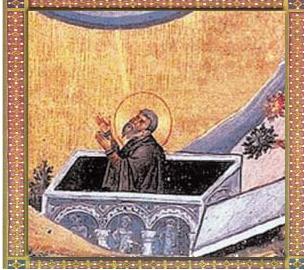
As a hermit, James lived in an open field in the summer and in winter he lived in a cave. On one occasion, he went down to the town of Nisibis to see how the Christian Faith was prospering and to see how Christians live. There, he was elected bishop. He participated in the First Ecumenical Council (Nicaea, 325 A.D.) and protected Orthodoxy against the Arian heresy. It happened once that the infidel Persians with their armies attacked Nisibis. St. James, in a procession with the Cross and banner [Litija] came before the ramparts of the town. Alone he climbed and walked along the rampart not fearing the arrows of the adversary which were aimed at him. Walking along as he did, he prayed to God to preserve the town and the faithful in this manner: “That He [God] would send a plague of flies and mosquitoes on the Persians and by that to cause them to flee from the walls of the town of Nisibis.” However, James did not seek the death of his enemies, nor did he seek whatever kind of catastrophe and defeat rather, one small vexation which would cause them to flee from Nisibis. God heard the prayers of His chosen one and sent a plague of flies and mosquitoes upon the Persians, driving them away. Thereby, the town of Nisibis was spared. St. James lived long and honorably. He died peacefully in old age in the year 350 A.D.
THE VENERABLE MAXIMUS KAPSOKALIVITIS
In the fourteenth century, Maximus led an ascetical life as a monk on Mt. Athos in his own unique way. That is to say, he pretended to be a little crazy and constantly changed his dwelling place. His place of abode consisted of a hut made from branches. He built these huts one after the other and then burned them, for this he was called Kapsokalivitis, i.e., “hut-burner. He was considered insane until the arrival of St. Gregory Sinaites to Mt. Athos, who discovered in Maximus a unique ascetic, a wonder-working intercessor and “an angel in the flesh.” He died in the Lord in the year 1320 A.D.