

Bishop of Belgium, The Orthodox Parish of Saint Catherine in Amsterdam,
ed. Apostoliki Diakonia, Athens 2026, p. 108- 118
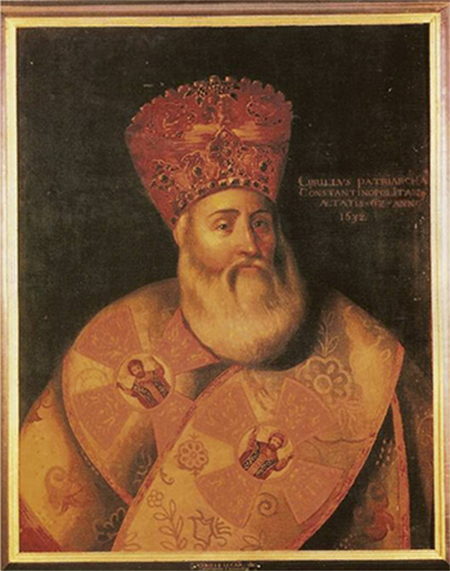 From the fifteenth century onwards, it became increasingly easy for inhabitants of the Low Countries to reach Asia Minor and Constantinople. (1). An early traveller was Joris van der Does (Georgius Dousa), a classicist from Leiden, who visited Constantinople in 1597-1598 and had personal contact with Meletios Pigas, Patriarch of Alexandria and locum tenens of the Ecumenical Throne. Dousa described his experiences in a Latin account addressed to his father, in which he also described the oppressed position of Christians in the Ottoman Empire. (2)
Van der Does’s contact with Patriarch Meletios Pigas may have influenced Kyrillos Loukaris, Pigas’s nephew and later Patriarch of Constantinople (3). Evidence for this is provided by Loukaris various letters to Justius Lipsius (1547-1606), a Flemish man of letters and philosopher and Dousa’s teacher. In 1579, Lipsius was appointed professor of history by the newly founded University of Leiden (4).
From the early seventeenth century, Loukaris also maintained close relations with several Dutch Protestants like Cornelius Haga, ambassador to the Sublime Porte, and theologian David le Leu de Wilhem. These friendships grew into an intensive exchange of ideas about church reform, theology and the Orthodox Church’s position in a time of religious tensions between Catholics and Protestants. Studies were made of the similarities and differences between the various Christian churches and the possibility of their reunification explored. It was also the time of confessions of faith, discussed above in the historical context. Moreover, several attempts were made at the time to reconcile Orthodoxy and Protestantism (5).
Loukaris had been educated in Venice, Padua and Geneva, and developed an aversion to Catholicism, partly because of the Jesuits’ aggressive proselytism. It was precisely for this reason that he was very interested in Protestant theology. This also gave Kyrillos the opportunity to introduce his Protestant correspondents to Orthodoxy, but also to criticize some Roman Catholic doctrines (6). This correspondence also shows how he was opposed to the supremacy of the Pope and therefore got along better with the Protestant churches. His experience with the Union of Brest (1596), which brought parts of the Orthodox world under papal authority, increased his distrust. As Patriarch of Alexandria, he opposed Latin influences and sought rapprochement with Protestants, with whom he saw similarities in theology and church structure.
Loukaris had a clear vision and dared to say openly that the Orthodox Church needed a reform that would bring the Church closer to the people (7). In letters to Johannes Uytenbogaert and David le Leu de Wilhem Kyrillos exchanged a lot of information about the Orthodox Church, its doctrine and church order, as well as ideas about ecclesiastical reform. For this, Loukaris had consulted works by a number of Catholic and Protestant writers and discussed them not only with some Dutch Protestants, but also with high representatives of the Anglican Church (8). The reform Loukaris envisioned was by no means comparable to the reforms carried out in the Western churches. To understand this it is important, according to Richard Calis, to pay attention to the specificity of the context in which Loukaris acted, both in Alexandria and in Constantinople, but also to recognize that the Orthodox Church “inhabited a position in-between these two Christian spheres: steeped, on the one hand, in the world of the European Reformations and embedded, on the other, in the Christian landscape of the early modern Levant”. (9) This dynamic is also reflected in the letters Loukaris addressed to David le Leu de Wilhem.
The fact that Loukaris maintained close contacts with Dutch people throughout his life and visited the Netherlands himself- even though not much information can be found about this – is important information (10). Thanks in part to Dutch support, he had the New Testament translated into modem Greek and printed in 1627, with the intention of arming Orthodox youth against Catholic influence (11). In 1629 he published his Confession of Faith, influenced by Calvinism (12). Kyrillos had a handwritten copy sent to the States-General. Keetje Rozemond informs us that the manuscript has been preserved in their archive (13). The Resolutions state: “Received a letter from the orator Haga written in Constantinople on the 30th of March last year [1629], and along with it a short confession of the Greek faith.” (14) This text led to serious controversy within the Orthodox world and between Protestant and Catholic parties. Ultimately, Loukaris was executed by the Ottoman authorities after his opponents had falsely accused him to the Sultan, claiming that he was preparing a Greek revolution. The Turks imprisoned him in a fortress near the Bosphorus, where he was strangled on 27 June 1638. His remains were thrown into the sea where fishermen found him and subsequently buried him (15).
The aftermath of Loukaris’ Confession led to new formulas of faith within Orthodoxy, such as those of Peter Moghila and the Council of Iasi (1642) (16). The Orthodox Church adopted more Western theological terms, influenced by education at Catholic and Protestant universities. Loukaris is still contested in the Orthodox Church: some see him as a reformer, others as someone who leaned too far towards the West. Although his reform efforts did not aim for the reunification of churches, Loukaris advocated a better-trained Orthodox clergy and more direct access to the Bible. His contacts with Dutch ambassadors played a crucial role in this. That contacts between Greeks and Dutch people multiplied rapidly is evident from the number of names of Greeks that appear in resolutions of the States-General from the early seventeenth century. Among them we also find high-ranking clerics and even bishops (17).
Loukaris was more interested in dialogue and cooperation than in visible church reunification. He himself had already realised that the time was not ripe for that. The collaboration between Loukaris and prominent Dutchmen ensured that interest in Orthodoxy continued for a long time in the Netherlands (18). This is evidenced not only by the prophetic words of historian Nicolaas Christiaan Kist, but also by the many scientific studies and articles dedicated to Kyrillos Loukaris (19).
Shortly after his martyrdom, Patriarch Kyrillos Loukaris was ho-noured as a saint and martyr, after which, as tradition demands, a liturgical service was soon written for him. On 6 October 2009, he was officially declared a saint by decision of the Holy Synod of the Patriarchate of Alexandria.
Patriarch Kyrillos Loukaris’ supporters in Leiden
The first half of the seventeenth century was a particularly turbulent time for the Orthodox Church. Kyrillos Loukaris’ sad story demonstrates how Orthodox Christians found themselves caught in the middle of the tension between Roman Catholics and Protestants. The majority of the Greeks were embittered by the Westerners’ unbrotherly behaviour and wanted nothing more to do with them. The problem was that Orthodox who yearned for higher education could obtain it only at Western universities and seminaries (20). There too, the struggle between Protestants and Catholics continued. The aim was ultimately to attract a maximum number of followers, among whom would perhaps be the future leaders of the Ecumenical Patriarchate. However, most Greek students in the West were wary and remained loyal to their Orthodox identity. Their professors’ propaganda provided insight enabling their students to arm themselves against it. There was also, however, a minority that lost touch, intellectually speaking, with its own tradition, for example borrowing arguments from the Protestants in their disputes with the Roman Catholic Church and, conversely, the teachings of the Jesuits to combat Protestants (21).
That the Protestant movement did not end with Kyrillos” death is evident from the synods in Constantinople (1638), Iasi (1642), Jerusalem (1672) and again in Constantinople (1691). It is also clear that the Reformed tendency found many sympathisers, even if Kyrillos’ successors did not agree with his views. Among those who supported Loukaris one can mention: Ecumenical Patriarch Neofytos III, Patriarchs Parthenios the Younger and Theophanis of Jerusalem, Metropolitan Sophronios of Athens, Metropolitan Daniel of Corinth and Archimandrite Benediktos of the Athonite Vatopedi Monastery. Among those who remained loyal to him were also priest-monks and monks like Maximos Kallipolitis, the translator of the Bible and of Kyrillos Loukaris’ Confession of Faith, Nikodimos Metaxas, Evgenios Aitolos and John Karyofyllos (22).
The ties with the Netherlands also remained. That is why, after Loukaris’ death, three of his followers enrolled at the University of Leiden. These were Meletios Pantogalos, Metropolitan of Ephesus and Exarch of Asia, Nathanael Konopios, Grand Vicar-General of the Ecumenical Patriarchate, and Archimandrite Hierotheos Avvatios, Abbot from Kefalonia (23). They may have had contacts in the Netherlands, but what brought them to Leiden and what was their intention? And did they come together or were these individual decisions? In the Bibliographische Mededeelingen of 1883 we read that Meletios Pantogalos and Hierotheos Avvatios were indeed in Leiden. The author of this work, Christiaan Sepp, based his work on resolutions of the States-General and on documents from the correspondence between the States-General and the theological faculty of Leiden: “We know as little about what drove them there as any further details concerning their persons. (…) Some professors wished to make use of the presence of these persons experienced in the modem Greek language, so as to have them produce a translation of the credal and liturgical writings of the Dutch Reformed Church, to have them put it to press at the expense of the States and distributed in their homeland by the said Greeks.” (24) The Resolutions of the States-General also inform us that Meletios could count on an allowance of six hundred guilders per year during his stay in Leiden, rising to eight hundred upon his return to Constantinople. It also appears that Hierotheos Avvatios was asked to translate theological and liturgical texts, a work he also completed (25). Meletios and Hierotheos would return to Greece in May 1645, with Meletios dying unexpectedly on the homeward journey (26). Nathanael Konopios probably arrived only after Meletios and Hierotheos had left. The States-General also awarded him the same amount, because “he was the one who had to witness Kyrillos Loukaris’ cruel capture and death and with his permission took refuge in England and our fatherland. (…) Here he enrolled at Leiden. A translation into his native language of Calvin’s Institutiones was undertaken by him, but not completed, or at least not put to press, either because he lacked the courage to persevere or because he lacked effective support.” (27)
These persons’ stay in the Netherlands is an important fact in the early contacts between the Orthodox and Protestant churches. What brought them together, however, was not so much a search for the restoration of unity between the two churches, but rather a shared aversion to the Roman Church. Their stay is at the same time the first clear indication of the presence of Orthodox clerics in the Netherlands (28).
Notes
(1) Travel reports were left by Ghilbert de Lannoy, door Bertrandon de la Broquiere, as well as Ogier Ghislijn van Busbeke, Flemish diplomats and scholars from the fifteenth century. See: A. H. de Groot, De betekenis van de Nederlandse ambassade bij de Verheven Porte voor de studie van het Turks in de 17e en 18e eeuw (Leiden: Brill, 1979).
(2) “De itinere suo Constantinopolitano epistola.” This work was also translated later into Dutch as: Adriaan van Nispen, Verscheyde Voyagien, ofte reysen, gedaen door Jr Joris Van der Does na Constantinopelen (…) alle by een versamelt door een lief-hebber der selver (Dordrecht, 1652).
(3) Χρυσοστόμου Α. Παπαδοπούλου, Ιστορία της Εκκλησίας Αλεξανδρείας (62- 1934), (Άθήναι: Αποστολική Διακονία 1985), 659.
(4) Hesseling, Uit Byzantium en Hellas, 156.
(5) Bruno Naarden, “Nicolaas Witsen en Tartarye,” accessed 23 July, 2024, https://resources.huygens.knaw.nl/retroboeken/witsen/dutch_intro.pdf.
(6) Neale published a long letter from Kyrillos to Johannes Uytenbogaert, then a preacher in The Hague: Neale, A History of the Holy Eastern Church, 369-383.
(7) Hans van der Sloot, Ingrid van der Vlis, Cornelis Haga, 1578-1654. Diplomaat & pionier in Istanbul (Amsterdam: Uitgeverij Boom, 2012) 196
(8) Richard Calis, “The Impossible Reformation: Protestant Europe and the Greek Orthodox Church’, Past & Present, 259 (2023), 43-44. Loukaris’ letters to Dutch Protestants demonstrate that he was deeply interested in the new ideas about the ideal Christian way of life that emerged in the aftermath of the European Reformations.
(9) Calis, “The Impossible Reformation,” 45-47.
(10) Kyrillos Loukaris (1752-1638); for an extensive biography see: Neale, Α History of the Holy Eastern Church, 356-404. Gunnar Hering, Oekumenisches Patriarchal und Europaische Politik 1620-1638 (Wiesbaden: F. Steiner, 1968). See also: Dr. Mohnike, “Des griechischen Patriarchen Cyrillus Lukaris zu Konstantinopel Unionsverhandlungen mit der reformierten Kirche zu Genf,” Theologische Studien und Kritiken 5 (1832), 560-576. See also: Hesseling, Uit Byzantium en Hellas, 123 e.v.
(11) See letter from Haga to the States-General of 13 November 1627: Heeringa, Nanninga, Bronnen tot de Geschiedenis van den Levantische Handel (deel I), 368-369.
(12) Kyrillos Loukaris first wrote his confession of faith in Latin, only later, at the request of his Calvinist friends, translating it into Greek. See: Emile Legrand, Bibliographie hellenique, XVIIe s., Vol. I (Paris: Picard, 1894), 268.
(13) Keetje Rozemond, “De eerste uitgave van de belijdenis van Cyrillus Lucaris,” Nederlands Archief voor Kerkgeschiedenis 51 (1971): 204.
(14) Resolution of the States-General of 28 May 1629. General State Archives.
(15) van der Sloot, van der Vlis, Cornelis Haga, 199.
(16) Petrus Moghila (1596 -1646) was a Moldavian, educated in Polish. He became a monk and superior of the famous Monastery of the Caves (Pechersk Lavra) in Kyiv. In 1633 he was elected Metropolitan of Kyiv, an election confirmed by Ecumenical Patriarch Kyrillos Loukaris. See also: Keetje Rozemond, “De Confessio Orthodoxa van Petrus Mogilas,” Nederlands Archief voor Kerkgeschiedenis 45 (1963): 193-207.
(17) In the Resolutiën van Staten-Generaal, Deel 14 (1607-1609, GS 131) OR (‘s Gravenhage: Martinus Nijhoff, 1971), 784, are mentioned: Kosmas Morfis, Archbishop of Corinth and Exarch of the Peloponnese (3.1.1609); Chrysanthos Laskaris, Archbishop of Lakedemonia (28.9.1609); Joseph, Archbishop of Macedonia (2.3.1618), the Greek Deacon Silvester (24.7.1620) and others.
(18) Hesseling, Uit Byzantium en Hellas, 167.
(19) Kist rightly wrote that “his history is worthy of closer investigation (…) and that there are still many sources and resources available for researching his history.” See: Nicolaas Christiaan Kist, “Grieksche patriarch, Cyrillus Lucaris, en de Je- suiten,” in Archiefvoor kerkelijke geschiedenis, inzonderheid van Nederland 13 (1842): 422.
(20) Seminaries in Rome, Venice, and Padua founded by philhellenes were open to Greek students. See: Hesseling, Uit Byzantium en Hellas, 123.
(21) Nicolas Zernov, Eastern Christendom. A study of the Origin and Development of the Eastern Orthodox Church (New York: Putnam, 1961), 139.
(22) See: Hering, Oekumenisches Patriarchat und Europaische Politik, 162-165.
(23) See: Album Studiosorum Academiae Lugduno Batavae, 355 en 359. Listed here for the 1644 academic year: Meletius Pantogalus, Cretenzis, Ecclesiae Ephesinae Metropolita, 50, Hon. ergo; Hierothius Abbatius, Cephaloniensis, in insula Cephalonia Archimandrita, 45, Hon. ergo; and for the academic year 1645: Nathanael Conopius, Graecus, Protosyncellus Patriarcheus, Baccal. S. Theologiae, 35, Hon. Gr.
(24) Christiaan Sepp, Bibliographische Mededeelingen (Leiden: Brill, 1883), 230- 231.
(25) Sepp, Bibliographische Mededeelingen, 232.
(26) Piet van Beek, Klein werk: de Opuscula Hebraea Graeca Latina et Gallica, prosaica et metrica van Anna Maria van Schurman (1607-1678), (Stellenbosch: Stellenbosch University, 1997), 259.
(27) Sepp. Bibliographische Mededeelingen, 231-232.
(28) See: Μεγάλη Ελληνική Εγκυκλοπαίδεια, Τόμος Γ (Άθήναι: Πυρσός-Δρανδάκης, 1928-1932).