

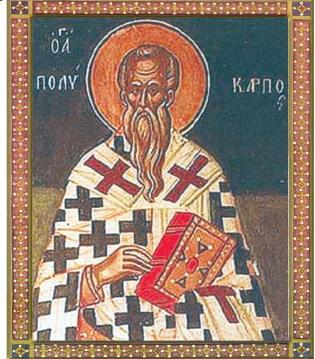
 THE HOLY PRIESTLY-MARTYR POLYCARP, BISHOP OF SMYRNA
Saint Polycarp, this great apostolic man, was born a pagan. St. John the Theologian converted him to the Faith of Christ and baptized him. In his childhood, Polycarp became an orphan and according to a vision in a dream Callista, a noble widow, took him as her own son, raised and educated him. From his childhood Polycarp was devout and compassionate. He strove to emulate the life of St. Bucolus, then the Bishop of Smyrna, as well as the holy Apostles John and Paul, whom he knew and heard. St. Bucolus ordained him a presbyter and before his death, Bucolus designated him as his successor in Smyrna. The apostolic bishops, who gathered at the funeral of Bucolus, consecrated Polycarp as bishop. From the very beginning, Polycarp was gifted with the power of working miracles. He expelled an evil spirit from the servant of a prince and through prayer stopped a terrible fire in Smyrna. Upon seeing this, many pagans regarded Polycarp as one of the gods. He brought down rain in times of drought, healed illnesses, discerned, prophesized and so forth. He suffered during the reign of Emperor Marcus Aurelius. Three days before his death, St. Polycarp prophesized: “In three days, I will be burned in fire for the sake of the Lord Jesus Christ!” And on the third day when the soldiers arrested him and brought him to trial, he cried out: “Let this be the will of the Lord my God.” When the judge counseled him to deny Christ and to acknowledge the Roman gods, Polycarp said: “I cannot exchange the better for the worse!” The Jews especially hated Polycarp and endeavored to have Polycarp burned alive. When they placed him bound at the stake, he prayed to God for a long while. He was very old, grey and radiant as an angel. The people witnessed how the flame encircled him but did not touch him. Frightened by such a phenomenon, the pagan judges ordered the executioner to pierce him with a lance through the fire. When he was pierced, so much blood flowed from him that the entire fire was extinguished, and his body remained whole and unburned. At the persuasion of the Jews, the judge ordered Polycarp’s lifeless body be incinerated according to the custom of the Hellenes. So the evil ones burned the dead body of the lifeless one whom they could not burn while alive. St. Polycarp suffered on Great and Holy Saturday in the year 167 A.D.
Saint Polycarp of Bryansk
In the world, he was Prince Peter Ivanovich Boryatinsky, a descendant of St. Michael, Prince of Chernigov. This supposition has been put forward because Boryatinsky is connected with the destiny of the Bryansk Savior Transfiguration monastery. The name of Prince Peter Boryatinsky is often encountered in documents of the sixteenth century. Thus, he was among those sent off to wage war against the Swedish king at the river Sestra. In 1576, he was named voevod at Tula. In 1580, Boryatinsky, having been appointed voevod at Kholm, was captured by the Lithuanians under a siege headed by Panin. Upon his release from captivity under Boris Godinov, Boryatinsky returned home in disgrace. In 1591 he was named voevod at Tiumen, but after several years he left the world, settled at Bryansk and received monastic tonsure with the name Polycarp. From his means the monk built a monastery of the Transfiguration of the Lord and established in it a Rule of strict ascetical life. St. Polycarp was the first Superior of this monastery. He died and was buried there in 1620 or 1621.
Saint John
Saint John, disciple of St. Limnaios, lived in Syria in the fifth century, and chose for himself the ascetic struggle of “a shelterless life.” He settled on a hill, closed off from the wind on all sides, and lived there for twenty-five years. He ate only bread and salt, and he exhausted his body under heavy chains. When one of the nearby ascetics planted an almond tree on the hill so that St. John could enjoy its shade and get out of the vicious heat, the saint told him to cut it down. This was done in order to deny his body any respite. St. Moses, imitating St. John, settled on a high mountain near the village of Rama.Sts. Antiochos and Antoninos also pursued asceticism with him. They continued with their ascetic deed until they reached a great age, offering an example of spiritual strength, and surmounting every obstacle. St. Zebinas pursued ascetic life on the same mountain. He reached extreme old age, but he never sat down during his Rule of prayer, though sometimes he leaned on his staff. The neighboring inhabitants venerated St. Zebinas, and they received great help in their sorrows and needs through his prayers.St. Polychronios, a disciple of St. Zebinas, imitated the life of his Elder, spending both day and night in fasting and vigil. St. Polychronios had no chains, but during prayer he put a heavy oaken root upon his shoulders, which he himself had dug up from the earth. By his prayer St. Polychronios asked God to send rain during a drought, and he filled up a stone vessel with oil for the needy. With St. Polychronios lived his disciple St. Moses. Emulating his Elder in everything, St. Moses was the very model of austere ascetical life.Another disciple, St. Damian, withdrew to a monastery named Ieros and lived there in asceticism. In his cell he had only a small box of lentils from which he ate. All these monastic Fathers died in Syria in the fifth century.
Saint Alexander
Saint Alexander, Founder of the Monastery of the “Unsleeping Ones,” was born in Asia and received his education at Constantinople. He spent some time in military service but, sensing a calling to other service, he left the world and accepted monastic tonsure in one of the desert monasteries near Antioch under the guidance of Igumen Elias. Having advanced through all the degrees of monastic obedience, he received a blessing from the igumen to dwell in the wilderness. The saint lived an ascetical life in the wilderness, taking only the Holy Gospel with him. Afterwards, the Lord summoned him to preach to pagans. He converted to the faith the local city-head Rabbul, who afterwards prospered in the service of the Church, attaining the rank of bishop and for thirty years he occupied the bishop’s cathedra in the city of Edessa. Finally, St. Alexander settled not far from the Euphrates River. Monks gathered around him, attracted by the loftiness of his prayerful asceticism and spiritual experience. A monastery of 400 monks eventually sprang up there. Then the holy igumen in his prayerful zeal decided to offer never-ceasing praise to the Lord at the monastery both by day and by night. For three years the holy abba prayed that God might reveal to him whether it was pleasing to Him to establish such a monastic rule. He received an answer by divine revelation. All the monks were divided into twenty-four watches of prayer. Changing shifts each hour, two choirs sang the holy Psalms both day and night, except when divine services were celebrated in church. Hence the name “Monastery of Unsleeping Ones,” since the ascetics offered unceasing praise to God. St. Alexander guided the monastery on the Euphrates for twelve years. Thereafter, having left the experienced Elder Trophimos as igumen, he set off with some chosen brethren through the cities bordering on Persia, to preach the Gospel. Having arrived at Constantinople, capital of the Byzantine Empire, he also established a monastery there with his Rule of unceasing praise. The abba died at a great old age after fifty years of monastic struggles. His death occurred in the year 430.
Saint Gorgonia
Saint Gorgonia, The sister of St. Gregory the Theologian, she was distinguished for her great virtue, piety, meekness, sagacity, and toil. Her house was a haven for the poor. The mother of five children, she died around the year 372 at the age of thirty-nine. Her last words were, “In peace I will both lie down and sleep” (Psalm 4:8).
Saint Moses of White Lake
Saint Moses of White Lake was an ascetic at the Holy Trinity monastery at White Lake at the end of the fifteenth century, and the beginning of the sixteenth. The Trinity Ustishekhansk in which St. Moses practised asceticism, was transferred by him from the mouth of the river Sheksna to the environs of White Lake in about the year 1480. St. Moses was distinguished by the gift of clairvoyance.
THE VENERABLE DAMIAN
Saint Damian, a monk of the Monastery of Esphigmenou on Mt. Athos, was a contemporary and companion of the great Cosmos of Zographou. He lived a life of asceticism on Mount Samareia between Esphigmenou and Hilendar. He died peacefully in the year 1280 A.D. When he died, a pleasant and sweet-smelling aroma emitted from his body for forty days.