

 SAINT BARTHOLOMEW, THE APOSTLE
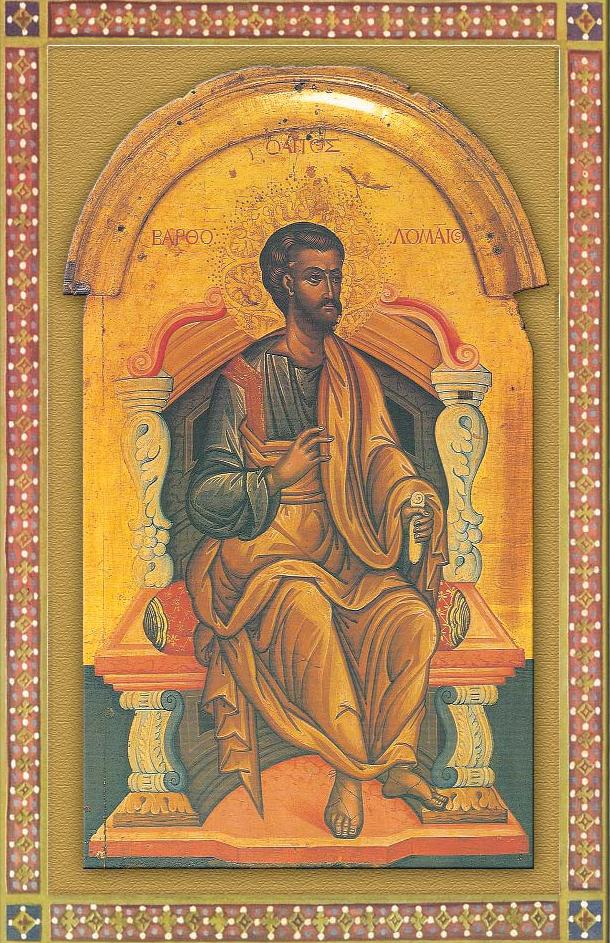
Bartholomew was one of the Twelve Great Apostles. In all probability, it appears that Bartholomew and Nathaniel are one and the same person. He was a companion of the Apostle Philip and Philip’s sister, the virgin Mariamna and, for some time, a companion of St. John the Theologian. Bartholomew preached the Gospel first throughout Asia and, after that, in India and finally in Armenia where he died a martyr’s death. In Hierapolis, these holy apostles by prayer, caused the death of a large serpent which the heathens kept in their temple and worshipped. In this same city and, by prayer, they restored sight to Stachius who was blind for forty years. It was here that a mob rose up against them and they crucified Philip and Bartholomew (Bartholomew was crucified upside down). At this time, an earthquake occurred in which the evil judges and may people perished. Feeling that this was a punishment from God, many ran to remove the apostles from the crosses but Philip was already dead while Bartholomew was still alive. After this, Bartholomew went to India where he preached and translated the Gospel of St. Matthew into the Indian language. Following this, he entered Armenia where he cured the daughter of the king from insanity. But the envious brother of King Astyages seized God’s apostle, crucified him on a cross, skinned him and finally beheaded him in Armenian Albanopolis [Derbend]. Christians honorably buried his body in a lead sarcophagus. Because many miracles occurred over his relics, the pagans took the sarcophagus and tossed it into the sea. But the water carried the sarcophagus to the Island of Lipara where Bishop Agathon, through a revelation in a dream, met and buried it in the church. St. Bartholomew, attired in a white garment, appeared in church to Venerable Joseph, the Hymnographer, blessed him with the Gospel that he may be able to sing spiritual hymns saying: “Let heavenly waters of wisdom flow from your tongue!” He also appeared to Emperor Anastasius (491-518 A.D.) and told him that he would protect the newly established town of Dara. Later, the relics of this great apostle were translated to Benevento and then to Rome. Great and awesome miracles have occurred over these relics.
 SAINT BARNABAS, THE APOSTLE
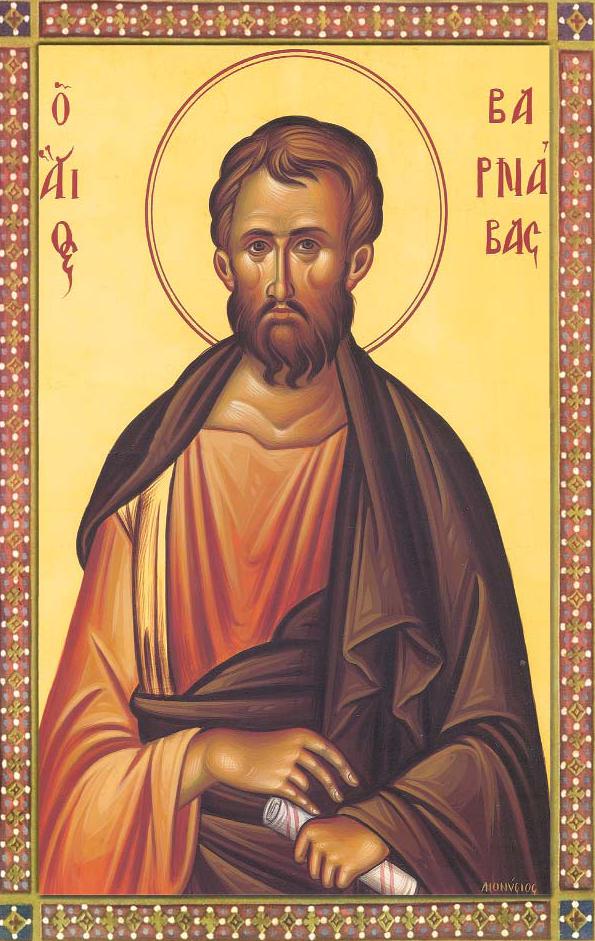
Barnabas was one of the Seventy Apostles. He was born in Cyprus of wealthy parents from the tribe of Levi and studied together with Saul under Gamaliel. At first, he was called Joseph but the apostles then called him Barnabas, Son of Consolation, because he was exceptionally capable of comforting the souls of the people. After Saul’s conversion, Barnabas was the first to introduce Saul to the apostles and after that, with Paul [Saul] and Mark he preached the Gospel in Antioch and throughout other places. In all probability, he was the first to preach in Rome and Milan. He suffered on the island of Cyprus at the hands of the Jews and was buried by Mark beyond the western gate of the town of Salamis with the Gospel of St. Matthew on his chest which he, by his own hand, had copied. His grave remained unknown for several hundred years and since many received healing from sickness on this spot, this place was called: “the place of health.” At the time of Emperor Zeno and the Chalcedon Council [451 A.D.], the apostle appeared to Archbishop Anthemius of Cyprus on three successive nights in a dream and revealed to him the location of Barnabas’ grave. That appearance of the apostle occurred exactly at the time when Peter, the power-hungry Patriarch of Antioch, sought that the church in Cyprus be under the jurisdiction of the throne of Antioch. After the appearance and discovery of the miraculous relics of the holy Apostle Barnabas, it was established that the church in Cyprus, as an Apostolic Church, should always be independent. Thus, the autocephaly of the Church in Cyprus was established.
THE COMMEMORATION OF THE HOLY ICON AXION ESTIN, [DOSTOJNO JEST – IT IS TRULY MEET TO BLESS YOU]
AND THE MIRACLE THAT OCCURRED BEFORE IT DURING THE REIGN OF PATRIARCH NICHOLAS CHRYSOVERGES (983-996 A.D.)
The miracle consists of this: One night a monk was reading the Canon to the Holy Birth-Giver of God and was singing “More honorable than the Cherubim” in his cell in the monastery of the Pantocrator, now called “Axion Estin” after the icon. His elder had gone to Karyes. Suddenly a man appeared in church and began to sing: “Truly it is Meet.” That hymn so far was unknown in the church. The monk upon hearing this hymn, became excited not only because of its contents but also because of the beautiful heavenly singing. “Among us, we sing it in this manner,” said the elder to the monk. The monk wanted to have this hymn written down and brought a tablet on which the stranger wrote down this hymn with his finger as though upon wax. Suddenly he vanished. That stranger was the Archangel Gabriel. This tablet was taken to Constantinople and the hymn remains even today in the Church