

THE NATIVITY OF SAINT JOHN THE FORERUNNER AND BAPTIZER OF THE LORD
Six months before his appearance in Nazareth to the All-holy Virgin Mary, the great archangel of God, Gabriel appeared to Zacharias the high priest in the Temple at Jerusalem. Before he announced the miraculous conception to the unwed virgin [Mary], the archangel announced the miraculous conception to the childless old woman [Elizabeth]. Zacharias did not immediately believe the words of the herald of God and this is why his tongue was tied with dumbness and remained as such until eight days after the birth of John. On that day, the relatives of Zacharias and Elizabeth gathered for the young child’s circumcision and for the sake of giving him a name. When they asked the father what name he wishes to give to his son and being dumb, he wrote on a tablet: “John.” At that moment his tongue became loosed and he began to speak. The home of Zacharias was on the heights between Bethlehem and Hebron. The news of the appearance of the angel of God to Zacharias was spread throughout all of Israel, as well as of his dumbness and the loosening of his tongue at thee moment when he wrote the name “John.” The news concerning this even reached Herod. Therefore, when Herod sent soldiers to slay the children throughout Bethlehem, he directed men to the hilly dwelling place of the family of Zacharias to kill John also. However, Elizabeth promptly hid the child. Enraged, at this King Herod sent his executioners to Zacharias in the Temple to slay him (for it happened that it was Zacharias’ turn again to serve in the Temple of Jerusalem). Zacharias was slain between the court and the temple and his blood coagulated and petrified on the stone pavers and remained a perpetual witness against Herod. Elizabeth hid with the child in a cave where she died soon after. The young child John remained in the wilderness alone under the care of God and God’s angels.
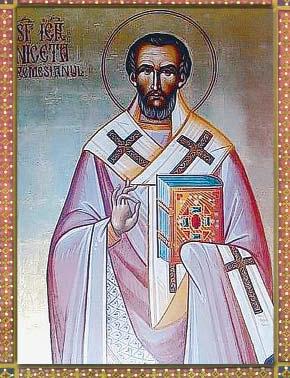 SAINT NICETAS, BISHOP OF REMESIANA
Nicetas was a friend and the same age as St. Paulinus of Nola (January 23). It appears that he was a Slav and, as such, preached the Gospel among the Slavs in the region of Nish and Pirot. The kind of change that St. Nicetas did among the Slavs is best shown in the hymn which St. Paulinus composed about St. Nicetas: “O what a change! And how fortunate!” Until then the impassible and bloody mountains concealing robbers now converted into monks; cadets of peace. Where once the habits of wild beasts, there is now the feature of angels. The righteous one hides in a cave where earlier, the evildoer dwelled. The episcopal see of Nicetas was Remesiana which some understand to be Pirot. Along with his missionary service, St. Nicetas also wrote several books such as the six books about Faith and a book about a fallen maiden (which aroused many to repentance). Saint Nicetas reposed in the Lord in the fifth century.
THE HOLY MARTYRS ORENTIUS, PHARNACIUS, EROS, FIRMUS, FIRMINUS, CYRIACUS AND LONGINUS
They were all brothers and Roman soldiers during the reign of Emperor Maximian. When the Romans were waging war against the Scythians beyond the Danube river, St. Orentius came forth to battle with Marathom, the Scythian Goliath, and slew him. Because of this, the entire Roman army offered sacrifices to the gods but Orentius, with his brothers, declared that they were Christians and could not offer sacrifices to the deaf and dumb idols. Regardless of their military merits, they were condemned to exile to the Caspian region however, along the way, all seven, one after the other, died from hunger and sufferings and took up habitation in the Kingdom of Christ.