

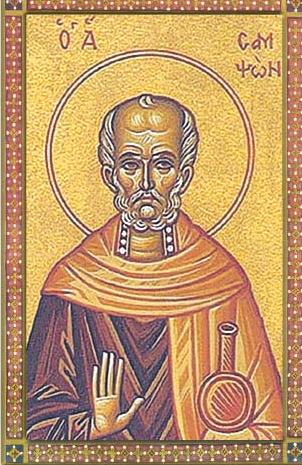
 SAINT SAMPSON, THE HOSPITABLE ONE WHO RECEIVED STRANGERS
Sampson was born of wealthy and eminent parents in old Rome where he studied all the secular sciences of that time and dedicated himself particularly to the science of medicine. Sampson was compassionate and an unmercenary and administered cures to the sick, both body and soul, counseling everyone to fulfill the requirements of the Christian Faith. Afterward he moved to Constantinople where he lived in a small house from which he dispensed alms, comfort, counsel, hope and medicine to all just as the sun disperses its rays of light and, in general, gave help to the helpless, both spiritually and physically. The patriarch heard of the great virtues of this man and ordained him a priest. At that time, Emperor Justinian the Great became ill and his illness, according to the conviction of all physicians, was incurable. The emperor prayed to God with great fervency and God revealed in a dream to him that Sampson would heal him. And indeed, when the emperor learned of Sampson, he invited him to his court and just as the elder placed his hand on the ailing place, the emperor recovered. When the emperor offered him enormous wealth for this, Sampson thanked him and did not want to accept anything saying to him: “O Emperor, even I had gold and silver and other goods, but I left all for the sake of Christ in order to gain eternal heavenly goods.” But when the emperor insisted on doing something for him, holy Sampson implored the emperor to build him a home [hospice] for the poor. In this home Sampson served the poor as a parent serves his children. Mercy toward the poor and the helpless was natural to him. Finally, this saintly man, completely filled with heavenly power and goodness, reposed peacefully on June 27, 530 A.D. and was interred in the church of his relative, the holy martyr Mocius. After his death, Sampson appeared many times to those who called upon him for assistance.
SAINT SEVERUS, THE PRESBYTER
Severus lived in central Italy and was a man of extraordinary sanctity. Once he was summoned to hear the confession of and to administer Holy Communion to a man who was dying but because of working in his vineyard, he was late. The news reached him that the sick man had died. Completely frightened as though he had killed the man, Severus began to weep bitterly over the deceased. By his fervent prayer, God restored life to the dead man. Then Severus heard his confession, gave him Holy Communion and prepared him for a Christian departure from this world. On the eighth day, the man again died.
SAINT JOANNA, THE MYRRH-BEARER
Joanna was the wife of Chuza, Herod’s steward: “Joanna the wife of Chuza, Herod’s steward” (St. Luke 8:3). When Herod beheaded John the Baptist he disposed of his head in an unclean place. Joanna removed the head of the Baptist and buried it honorably on the Mount of Olives on Herod’s estate. Later, during the reign of Constantine the Great, the head of John the Baptist was discovered. St. Joanna is also remembered as being present both at the suffering and at the resurrection of the Lord. She died peacefully.