

 THE HOLY MARTYRS CYRUS AND JOHN
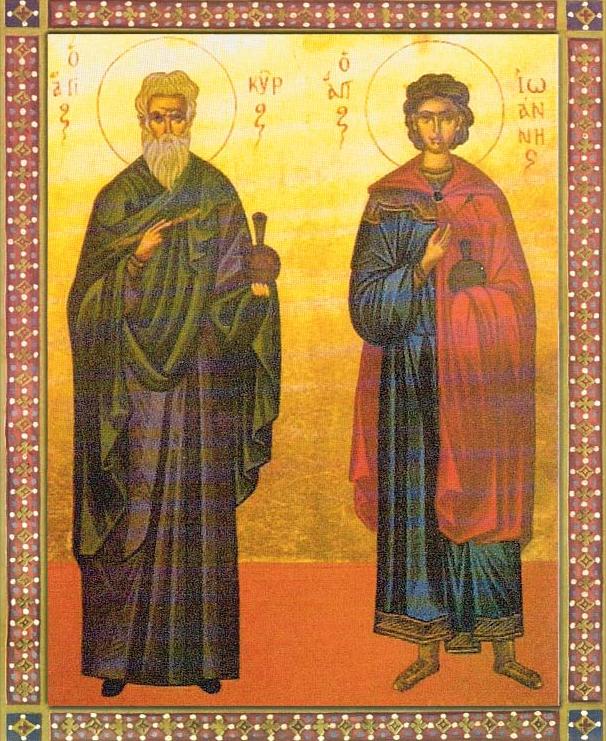
These holy martyrs are celebrated on January 31. On that date, their lives and sufferings are chronicled. June 28 commemorates the translation of their relics from Canopus to Menuthis and the numerous miracles which occurred over their relics. St. Cyril, Patriarch of Alexandria, prayed fervently to God to destroy the idolatrous impurity in the town of Menuthis where a pagan temple was located and where the power of the demons ruled. An angel of God appeared to the patriarch and told him that Menuthis would be cleansed of its impurity if he translated the relics of Saints Cyrus and John to that town. The patriarch did this immediately. He translated the relics of the martyrs to Menuthis and built a church there in honor of Saints Cyrus and John. Ammonius, the son of Julian the mayor of Alexandria, was healed of scorfula; a Theodore healed of blindness; Isidore of Menuthis was cured of a decaying disease of the liver; the wife of Theodore from poisoning, a Eugenia of dropsy as well as many other people were healed of various diseases and torments by the relics of these saints. This all occurred in the year 412 A.D.
VENERABLE SENNUPHIUS, “THE STANDARD-BEARER”
Sennuphius was a great ascetic and miracle-worker of the Egyptian desert. He was a contemporary of Patriarch Theophilus and Emperor Theodosius the Great. He is called the “Standard-bearer” because by his prayers he once helped Emperor Theodosius to gain a victory over the army of his adversaries. When the emperor summoned Sennuphius to Constantinople, Sennuphius replied that he was unable to do so but sent him his tattered monastic habit and staff. Setting out to battle the emperor donned Sennuphius’ monastic habit and carried the staff and returned victorious from battle.
VENERABLE PAUL, THE PHYSICIAN
Paul was a Corinthian by birth. Completing his schooling, Paul withdrew to a monastery and was tonsured a monk. He had a difficult struggle with the impure spirit of fornication. However, when with the power of the cross he drove the impure spirit of fornication away from himself, that spirit created a malicious falsehood, i.e., [the spirit] gave approval to a depraved woman to say that she had given birth to a child by Paul. The heretics then dragged him from the monastery, placed the child in his arms and forced him to walk throughout the town for the people to spit on him. The baby was only a few days old. St. Paul prayed fervently to God and said to the people: “Behold, let the child himself say who is his father.” The child stretched out its hand from the swaddling clothes and pointed to a blacksmith and said: “That man is my father and not Paul the monk!” The adversaries of Paul became ashamed and God granted great healing powers to Paul so that when he placed his hand on the sick, they became whole. Paul reposed peacefully in old age pleasing God by his life on earth. He lived in the seventh century.