

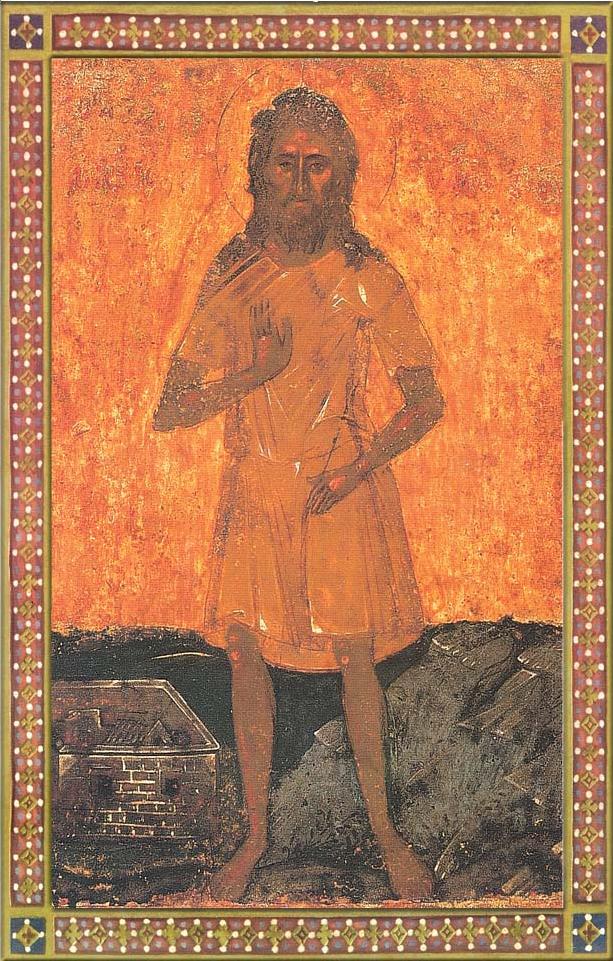
 SAINT ALEXIOS, THE “MAN OF GOD”
The rare title, “Man of God,” was bestowed on St. Alexios for the manner in which he gave himself over to Jesus Christ, forsaking a bride even at the altar in order to fulfill to the letter the admonition read to him while he was contemplating enlistment in the service of the Lord. He kept his true identity a secret for an entire lifetime rather than run the risk of betraying the Master through his own emotions and there is no telling how much mental anguish he suffered in silence for the sake of his commitment. When he felt the call he answered with a hesitation for which he judged himself too harshly and which he bore in mute secrecy. Alexios was born in 380 AD in the eternal city of Rome during the reign of Theodosios the Great and was raised in a royal household by his parents, Ephemios and Aglaia, who discerned a predilection for the Church in their son, a religious fervour they could not share and which they sought to discourage for fear they would lose him. They lost no time in arranging for his marriage and in impressing upon him the debt he owed to his parents, for which he should respect their wishes in all things. He had reluctantly suppressed the call he felt to the Lord’s service and had agreed to the marriage when he had a vision one day of St. Paul, who said he should answer the call to God at all costs, reading to him the passage in Matthew which says: “He that loveth father or mother more than me is not worthy of me.” The bewildered Alexios was torn between his sense of duty to his parents and that urging to serve the Lord, and swayed between both, at long last deciding to go through with what he had promised his family. The feeling that he should go the other way gnawed at him even as he stood at the altar, and when the ceremony had been completed he looked upon the Cross of Jesus and without a word walked away from bride, family and friends to do what he had to do. He stepped into the anonymity of a Syrian monastery where for the next eighteen years he assumed another identity, and never looked back at Rome. Having made a choice they had opposed, he suspected his parents had disinherited him and that his bride had had the marriage annulled, but this was not the case. As a matter of fact, the bride had gone to live with his parents in the fond hope that Alexios would someday return, and the parents spared no expense in trying to locate their son, but after eighteen years with no word from him they presumed him to be dead. In his eighteen years in the monastery, Alexios was transformed into a respected holy man whose solemn dedication to Jesus was the subject of many discussions among not only the monks but the community which he served. Unlike other monks, he was a man of few words and left the preaching and sermonising to other brother monks while he concentrated on writing on many issues concerning the faith. The vision that he had had many years before of St. Paul still haunted him and he had a burning desire to go to Tarsus, Paul’s birthplace. He boarded a boat bound for the short trip up the coast, but while at sea a violent storm arose and blew the vessel miles off course also leaving her a derelict at the mercy of the wind and tides. They were finally picked up by a ship bound for Rome and Alexios found himself back in the city of his birth. Nostalgia seized him and he went to the family estate, primarily to get a glimpse of his folks, but when they failed to recognise him he felt compelled to remain and was given the task of spiritual counsellor, not only to the estate, but to the neighbouring families as well. The abandoned bride was still living with the parents and she also failed to recognise him, for which he was grateful, for he found contentment in being able to serve the Lord while not revealing his true identity, which he considered would be a disservice to the Saviour after all the years of anonymity. He went about his duties with grace acquired and enjoyed the respect of families for miles around. When he felt death drawing near, Alexios wrote a letter to his family in which he expressed his love for them, which he could not do in life. The letter was read posthumously not only by his family but by the bishop of Rome, who had him interred in the chapel of St. Peter’s. He died for Christ on 17 March 440AD, after thirty-four years of celibacy and anonymity.
The Martyr Marinus
He was a soldier, and not only refused to offer sacrifice to idols, but took things sacrificed by others and trod them underfoot. For this he was tortured and beheaded in the third century. A senator, Asterius, clad in costly white raiment, was watching the sufferings of St Marinus, and he became so fired with enthusiasm for the Faith of the Christ who gave such courage to His followers that he took the body of the martyr onto his back, bore it away and buried it. Seeing this, the unbelievers killed him also as a Christian.
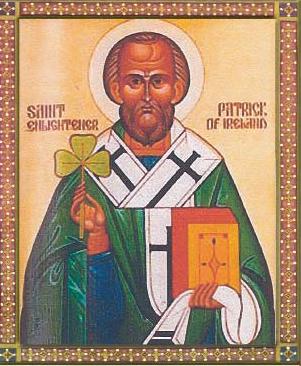 SAINT PATRICK
St Patrick, the Apostle of the Irish, was seized from his native Britain by Irish marauders when he was sixteen years old. Though born the son of a deacon and grandson of a priest about 373 AD, it was not until his captivity that he sought out the Lord with his whole heart. In his Confession, the testament he wrote towards the end of his life, he says, “After I came to Ireland – every day I had to tend sheep and many times a day I prayed, the love of God and His fear came to me more and more, and my faith was strengthened. And my spirit was so moved that in a single day I would say as many as a hundred prayers, and almost as many at night, and this even when I was staying in the woods and on the mountain. And I would rise for prayer before daylight, through snow, through frost, through rain, and I felt no harm”. After six years of slavery, he was guided by God to make his escape from Ireland, and afterwards struggled in the monastic life at Auxerre in Gaul, under the guidance of the holy Bishop Germanus. Many years later he was ordained Bishop and sent back to Ireland around 432 AD, to convert the Irish to Christ. His arduous labours bore so much fruit that within seven years, three Bishops were sent from Gaul to help him shepherd his flock, “My brethren and sons whom I have baptised in the Lord – so many thousands of people”, he says in his Confession. His apostolic work was not accomplished without much “weariness and painfulness”, long journeys through difficult country, and many perils; he says his very life was in danger twelve times. When he came to Ireland as its enlightener, it was a pagan country, and when he ended his earthly life around 461 AD, some thirty years later, the Faith of Christ was established in every corner of Ireland.