

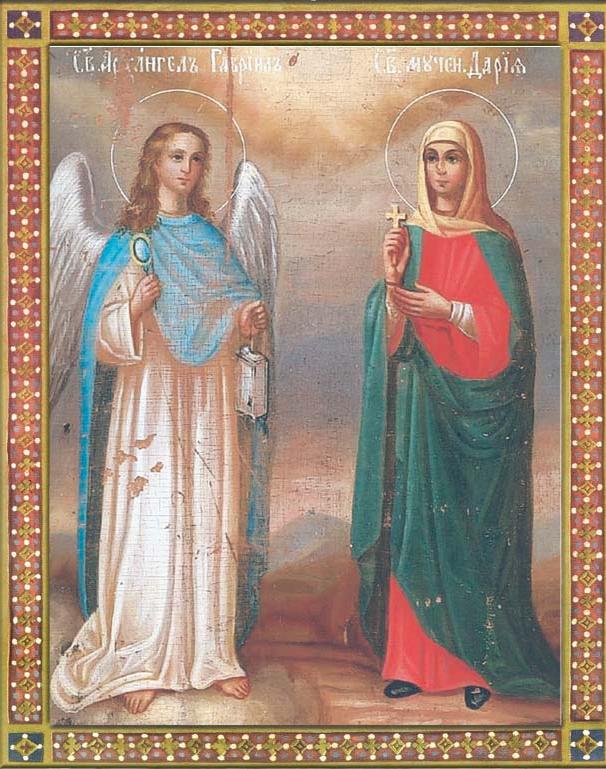
 The Martyrs Chrysanthos and Daria and with them the Martyrs Claudius the Tribune with his wife Hilaria and their sons Jason and Maurus, and Diodoros the Presbyter and Marianus the Deacon
St. Chrysanthos came from a pagan family who had moved to Rome from Alexandria. He received a fine education, and among the books he read were those in which pagans discussed Christianity. The young man, however, wanted to read books written by Christians themselves. He finally managed to find a copy of the New Testament, which enlightened his rational soul. Seeking someone to instruct him in the Holy Scriptures, he found the presbyter Carpophoros hiding from persecution, and received holy Baptism from him. After this, he began to preach the Gospel. Chrysanthos’ father tried to turn his son from Christianity, and finally married him to Daria, a priestess of Minerva. St. Chrysanthos managed to convert his wife to Christ, and the young couple mutually agreed to lead celibate lives. After the death of the father, they began to live in separate houses. St. Chrysanthos converted several young men to Christ, and many pious women gathered around St. Daria.The people of Rome complained to the eparch Celerinus that Sts. Chrysanthos and Daria were preaching celibacy and attracting too many young men and women to monasticism. St. Chrysanthos was sent to the tribune Claudius for torture.The torments, however, did not shake the bravery of the young martyr, since the power of God clearly aided him. Struck by this, the tribune Claudius himself came to believe in Christ and accepted holy Baptism together with his wife Hilaria, their sons Jason and Maurus, and all his household and soldiers. When news of this reached the emperor Numerian (283-284), he commanded them all to be executed. The Martyr Claudius was drowned in the sea, and his sons and soldiers were beheaded. Christians buried the bodies of the holy martyrs in a nearby cave, and St. Hilaria constantly went there to pray. Once, they followed her and led her off for torture. The saint asked that they give her a few moments to pray, and as soon as she finished, she gave up her soul to God. A servant buried the saint in the cave beside her sons. The torturers sent St. Daria to a brothel, where she was protected by a lion sent by God. A certain man who tried to defile the saint was knocked to the ground and pinned down by the lion, but the lion did not kill him. The martyr preached to them about Christ and set them to the path of salvation.They threw St. Chrysanthos into a foul-smelling pit, into which all the filth of the city flowed. But a heavenly light shone on him, and the pit was filled with a sweet fragrance. Then the emperor Numerian ordered Sts. Chrysanthos and Daria to be turned over to the executioners. After many cruel tortures, the martyrs were buried alive in the ground. In a cave near the place of execution, Christians began to gather to honor the anniversary of the saints’ martyrdom. They celebrated Church services and partook of the Holy Mysteries. Learning of this, the pagan authorities sealed the entrance to the cave, and those within received the crown of martyrdom. Two of these martyrs are known by name: the Presbyter Diodoros and the Deacon Marianus.
Saint Innocent of Komel and Vologda
Saint Innocent of Komel and Vologda was born at Moscow, and was descended from the Moscow princely family of Okhlyabinin. He became a monk in the monastery of St. Cyril of White Lake, and was put under the guidance of St. Neilos of Sora. Sts. Innocent and Neilos wandered through the East visiting Palestine, Constantinople, and spent several years at the monasteries of Mt. Athos. Having returned to Rus, the saints did not return to their original St. Cyril of White Lake monastery, but to solitary cells for monastic seclusion. Out of love for wilderness-life they then withdrew into the impassable forest at the River Sora, some fifteen versts from the monastery. Here they set up a cross, dug a well, and built separate cells, after the manner of the skete monasteries. A church was built on a marshy spot, and there the hermits led strict lives.Foreseeing his own demise, St. Neilos sent St. Innocent to the River Nurma and predicted to him: “God is sending you there, and yours shall be a cenobitic monastery; after my death, my wilderness monastery will remain as it was during my life, with the brothers living separately each in his own cell.”Upon the death of St. Neilos, his holy disciple withdrew into the Vologda hinterland and in 1491 he built a cell at the River Eda, which flows into the River Nurma. In a short while disciples began to gather to him. Following the final command of his teacher, St. Innocent did not seek any donations for it. St. Innocent labored for thirty years at building his monastery. He left behind an instruction for the brethren, based on the works of the holy Fathers, particularly the writings of St. Neilos of Sora. St. Innocent bade them first of all to avoid wrangling and disputes and asked them to preserve love for Christ and spiritual peace. The saint forbid young and beardless monks to be accepted and tonsured at his monastery, and he forbid women to enter the monastery. A monk who left the monastery lost his right to a cell, and if he returned, then he could occupy it only with the consent of the igumen and the brethren. The monk asked that a future church be consecrated in the name of St. John the Forerunner, and Baptizer of the Lord, in commemoration of the Third Finding of his Venerable Head, because St. John is a patron for all monks and wilderness dwellers (later, the monastery was called Transfiguration after its chief temple). St. Innocent died on 1521. In accordance with his last wish, he was buried in a corner of the monastery near a marsh. A stone was placed on his grave inscribed with the year, month and day of his repose.
The Martyr Pancharios
The Martyr Pancharios was a friend of the emperor Diocletian. He abandoned Christianity and became a pagan. His mother and sister sent him a letter in which they urged the apostate to fear God and the dread Last Judgement. Having repented, St. Pancharios openly confessed his faith before the emperor, for which he suffered torture at Rome. Then he was sent to Nicomedia and beheaded in 303.
The Smolensk “Tenderness” Icon of the Mother of God
The Smolensk “Tenderness” Icon of the Mother of God manifested itself in the year 1103 at Smolensk. There is another Smolensk “Tenderness” Icon from the vicinity of Okopa (down from Smolensk). This icon was in the encampment of the Russian armies of the military commander Shein, restraining the Polish besiegers from destroying Smolensk for twenty months (1611-1613).