

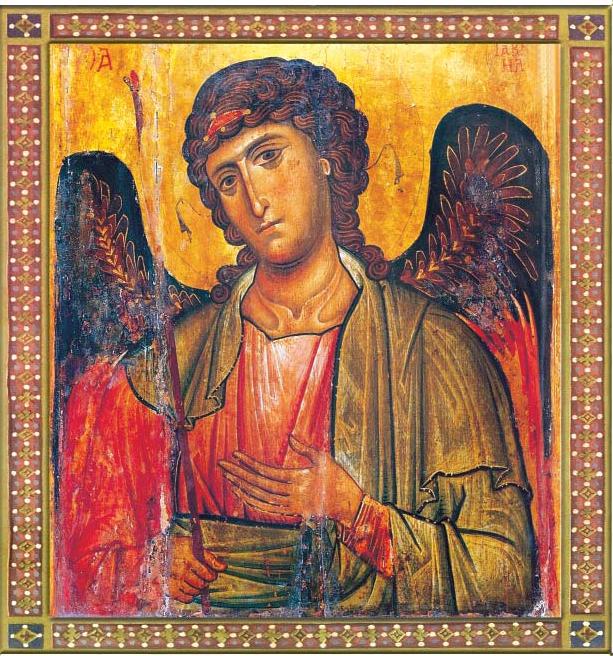
 Synaxis of the Holy Archangel Gabriel
The Archangel Gabriel was chosen by the Lord to announce to the Virgin Mary about the Incarnation of the Son of God from Her, to the great rejoicing of all mankind. Therefore, on the day after the Feast of the Annunciation, the day on which the All-Pure Virgin is glorified, we give thanks to the Lord and we venerate His messenger Gabriel, who contributed to the mystery of our salvation. Gabriel, the holy Archistrategos (Leader of the Heavenly Hosts), is a faithful servant of the Almighty God. He announced the future Incarnation of the Son of God to those of the Old Testament; he inspired the Prophet Moses to write the Pentateuch (first five books of the Old Testament), he announced the coming tribulations of the Chosen People to the Prophet Daniel (Dan. 8:16, 9:21-24); he appeared to St. Anna with the news that she would give birth to the Virgin Mary. The holy Archangel Gabriel remained with the Holy Virgin Mary when She was a child in the Temple of Jerusalem, and watched over Her throughout Her earthly life. He appeared to the Priest Zachariah, foretelling the birth of the Forerunner of the Lord, St. John the Baptist. The Lord sent him to St. Joseph the Betrothed in a dream, to reveal to him the mystery of the Incarnation of the Son of God from the All-Pure Virgin Mary, and warned him of the wicked intentions of Herod, ordering him to flee into Egypt with the divine Infant and His Mother. When the Lord prayed in the Garden of Gethsemane before His Passion, the Archangel Gabriel, whose very name signifies “Man of God” (Lk. 22:43), was sent from Heaven to strengthen Him.The Myrrh-Bearing Women heard from the Archangel the joyous news of Christ’s Resurrection (Mt 28:1-7, Mk 16:1-8).Mindful of the manifold appearances of the holy Archangel Gabriel and of his zealous fulfilling of God’s will, and confessing his intercession for Christians before the Lord, the Orthodox Church calls upon its children to pray to the great Archangel with faith and love.The Synaxis of the Holy Archangel Gabriel is also celebrated on July 13. All the angels are commemorated on November 8.
Hieromartyr Irenaeus
Hieromartyr Irenaeus suffered during the persecution against Christians under the Roman emperors Diocletian and Maximian (284-305).He was a presbyter, and he and his wife raised their children in Christian piety. St. Irenaeus was greatly respected for his education and strict manner of life.He was later made Bishop of Sirmium in Pannonia (modern Hungary). Because of his fervent preaching of the Gospel he was arrested and brought before an official named Probus. Refusing to deny Christ and offer sacrifice to the pagan gods, the saint was handed over for torture. Witnessing his torments were the saint’s parents, relatives and friends, who attempted to persuade him to submit, but the martyr remained steadfast.After cruel tortures, the holy confessor spent a long time in prison. Probus tried to persuade the martyr, urging him to spare his life for the sake of his sons. St. Irenaeus replied, “My sons believe in God, Who will care for them. As for me, nothing will force me to renounce my Christ.” The governor ordered the saint to be thrown into a river. They led the martyr on the bridge crossing the River Sava, where he knelt and prayed to the Lord for his flock. Then they beheaded the Hieromartyr Irenaeus, and threw his body into the river.
The Holy Martyrs Presbyters Bathusius and Vercus
The Holy Martyrs Presbyters Bathusius and Vercus with two sons and two daughters, the Monk Arpilus, and the Laymen: Abibus, Agnus, Reas, Igathrax, Iscous, Silas, Signicus, Sonerilas, Suimbalus, Thermus, Phillus, and the Women Martyrs: Anna, Alla, Larissa, Monco, Mamika, Virko, Animais (Animaida), and the anonymous martyr with them; also the Gothic Queen Gaatha and the Princess Duclida suffered around the year 375 under Jungerich, a persecutor of Christians. Ancient synaxaria of the Gothic Church recount the martyrdom of twenty-six Christians in the time of the emperors Valentinian, Valens, and Gratian. The historian Sozomen says that King Athanaric was enraged to see his subjects embracing Christianity because of the preaching of the Arian bishop Ulfilas. So, he ordered many of them to be tortured and executed, often without a trial. King Athanaric’s ministers placed a statue in a chariot and paraded it before the tents which Christians used for church services. Those who worshiped the idol and offered sacrifice were spared, the rest were burned alive in the tent. Jungerich gave orders to burn down a church during divine services. In the fiery inferno 308 people perished, of whom only twenty-one are known by name. There was also an anonymous man who came to the tent and confessed Christ. He was martyred with the others. Different manuscripts give variants of their names. In the reign of Valentinian and Theodosios (383-392), the Gothic king’s widow Gaatha (who was an Orthodox Christian) and her daughter Duclida gathered up the relics of the holy martyrs and brought them to Syria with the help of some priests and a layman named Thyellas. Gaatha later returned to her native land, where she was stoned and died as a martyr, along with her son Agathon. The relics of the holy martyrs were left to Duclida, who went to Cyzicus in Asia Minor and gave some of the relics for the founding of a church. St. Duclida died in peace.
SAINT MALCHUS
Saint Malchus was the only son of a farmer, and lived near Antioch, Syria. Upon attaining the age of maturity, his parents had arranged a marriage for him, but Malchus secretly left home and received monastic tonsure in one of the monasteries, where he fulfilled various obediences for many years. Upon learning of the death of his father, he wished to visit his mother. The igumen of the monastery would not bless him to go, but Malchus disobeyed him. He joined a group of pilgrims, and set out for his native district. Along the way, Saracens attacked them, and enslaved them. Malchus’ s master compelled him to marry one of his slaves. With the consent of his wife, St. Malchus kept his vow of chastity, and eventually converted her to Christianity. One day, St. Malchus and his wife ran away. The master pursued them, but they hid in a cave, which proved to be the den of a lioness. The lioness did not harm the fugitives, but killed one of the pursuers who tried to enter the cave and capture them. St. Malchus sent his wife to a women’s monastery as she requested, while he returned to his own monastery. By then the igumen was no longer alive, and St. Malchus never left the monastery again. For the edification of monks he often recounted his trials, which were the result of his disobedience. St. Malchus labored in asceticism in the monastery until the end of his life. He died in peace in the fourth century.
SAINT BASIL THE NEW
Saint Basil the New left the world in his youth, and struggled in a desolate place. Once, courtiers of the Byzantine Emperor were passing by and saw him dressed in rags, and were alarmed by his strange appearance. Suspicious of the holy ascetic, they captured him and brought him to the city, where the patrician Samon questioned him. When asked who he was, the saint merely said that he was a stranger in the land.They subjected the monk to terrible tortures, but he endured it in silence, not wishing to reveal the details of his ascetic life to them. Samon lost his patience and asked St. Basil, “Impious one, how long will you hide, who are you, and from where do you come?” The saint replied, “It is more appropriate to call impious those who, like yourself, lead a life of impurity.” After his public humiliation, Samon ordered his men to hang the saint upside down with his hands and feet tied. These torments were so cruel that those witnessing them murmured against Samon.When they released the holy ascetic after three days of torture, they found him alive and unharmed. Samon attributed this miracle to sorcery and had St. Basil thrown to a lion. However, the lion did not touch the saint, and lay peacefully at his feet. Samon ordered St. Basil to be drowned in the sea, but two dolphins brought him to shore. The saint went into the city, where he met a sick man named John, who was suffering from fever. St. Basil healed the sick man in the name of the Savior, and accepted John’s invitation to stay in his home.Numerous believers came to the saint for advice and guidance, and also to receive healing from sickness through his prayers. St. Basil, endowed with the gift of discernment, guided sinners on the path of repentance, and he could predict future events. Among those who visited St. Basil was a certain Gregory, who became his disciple and later wrote a detailed Life of his teacher. Gregory once found an expensive sash at an inn, which had been dropped by the inn-keeper’s daughter. He hid it on his person, intending to sell it and give the money to the poor. On the way home, he lost the sash and some other things. St. Basil admonished him in a dream, showed him a broken pot and said, “If anyone steals such a worthless thing, they will be chastized four times over. You hid a valuable sash, and you will be condemned as a thief. You should return what you found.” After the death of St. Theodora, who had attended St. Basil, Gregory very much wanted to learn about her life beyond the grave, and he often asked the holy ascetic to reveal this to him. Through the saint’s prayers, Gregory saw St. Theodora in a dream. She told him how her soul underwent tribulations after death, and how the power of the prayers of St. Basil had helped her. St. Basil died in about the year 944 at the age of 110.