

Saint Hilarion the New
Saint Hilarion the New, Igumen of Peleke Monastery, from his youth, he devoted himself to the service of God and spent many years as a hermit. Because of his holy and blameless life he was ordained to the holy priesthood, and later he was made igumen of the Pelekete monastery (near the Dardanelles). St. Hilarion was granted gifts of clairvoyance and wonderworking by the Lord. Through prayer he brought down rain during a drought, and like the Prophet Elisha he separated the waters of a river, he drove harmful beasts from the fields, he filled the nets of fishermen when they had no success in fishing, and he did many other miracles. In addition to these things, he was able to heal the sick and cast out demons. St. Hilarion suffered on Great and Holy Thursday in the year 754, when the military commnander Lakhanodrakon suddenly descended upon the Pelekete monastery in pursuit of icon-venerators, boldly forcing his way into the church, disrupting the service and throwing the Holy Gifts upon the ground. Forty-two monks were arrested, slapped into chains, sent to the Edessa district and murdered. The remaining monks were horribly mutilated, they beat them, they burned their beards with fire, they smeared their faces with tar and cut off the noses of some of the confessors. St. Hilarion died for the veneration of icons during this persecution. St. Hilarion left behind spiritual works containing moral directives for spiritual effort. St. Joseph of Volokolamsk was well acquainted with the work of St. Hilarion, and he also wrote about the significance of monastic struggles in his own theological works.
SAINT STEPHEN THE CONFESSOR
St. Stephen the Confessor, Igumen of Triglia Monastery, suffered under the iconoclast emperor Leo the Armenian (813-820). From a young age, the holy ascetic dedicated his life to God and received monastic tonsure. He later became head of the Triglia monastery near Constantinople. When persecution again began against holy icons, the saintly igumen was summoned for questioning, and they tried to force him to sign a document rejecting the veneration of icons. St. Stephen steadfastly refused to betray Orthodoxy and he boldly denounced the emperor for his impiety. They subjected the saint to cruel torments, after which they sent him to prison in the year 815. Weakened and sick, the holy Confessor Stephen soon died in prison from his sufferings.
Martyr Eustratios of the Caves
Martyr Eustratios of the Caves was born in the eleventh century at Kiev into a wealthy family. As an adult, he received monastic tonsure at the Kiev Caves monastery, after giving away all his possesions to the poor. St. Eustratios humbly underwent obediences at the monastery, strictly fulfilling the rule of prayer and passing his days in fasting and vigilance. In 1096 the Polovetsians captured Kiev and ravaged the monastery of the Caves, doing away with many of the monks. St. Eustratios was taken into captivity, and was sold into slavery with thirty monastic laborers and twenty inhabitants of Kiev to a certain Jew living in Korsun. The impious Jew tried to make the captives to deny Christ, threatening to kill those who refused by starving them. St. Eustratios encouraged and exhorted his brother Christians, “Brothers! Let none of us who are baptized and believe in Christ betray the vows made at Baptism. Christ has regenerated us through water and the Spirit. He has freed us from the curse of the Law by His Blood, and He has made us heirs of His Kingdom. If we live, we shall live for the Lord. If we die, we shall die in the Lord and inherit eternal life.” Inspired by the saint’s words, the captives resolved to die of starvation, rather than renounce Christ, Who is the food and drink of Eternal Life. Exhausted by hunger and thirst, some captives perished after three days, some after four days, and some after seven days. St. Eustratios remained alive for fourteen days, since he was accustomed to fasting from his youth. Suffering from hunger, he still did not touch food nor water. The impious Jew, seeing that he had lost the money he had paid for the captives, decided to take revenge on the holy monk. The radiant Feast of the Resurrection of Christ drew near, and the Jewish slave owner was celebrating the Jewish Passover with his companions. He decided to crucify St. Eustratios. The cruel tormentors mocked the saint, offering to let him share their Passover meal. The Martyr replied, “The Lord has now bestown a great grace upon me. He has permitted me to suffer on a cross for His Name just as He suffered.” The saint also predicted a horrible death for the Jew. Hearing this, the enraged Jew grabbed a spear and stabbed St. Eustratios on the cross. The martyr’s body was taken down from the cross and thrown into the sea. Christian believers long searched for the holy relics of the martyr, but were not able to find them. But through the Providence of God the incorrupt relics were found in a cave and worked many miracles. Later, they were transferred to the Near Caves of the Kiev Caves monastery. The prediction of the holy Martyr Eustratios that his blood would be avenged was fulfilled soon after his death. The Byzantine Emperor issued a decree expelling all Jews from Korsun, depriving them of their property, and putting their elders to death for torturing Christians. The Jew who crucified St. Eustratios was hanged on a tree, receiving just punishment for his wickedness.
 SAINT HILARION OF GDOV
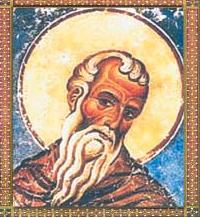
St. Hilarion of Gdov and Pskov Lake, was a disciple of St. Euphrosynos of Pskov. In 1460 on the banks of the River Zhelcha, not far from Gdov, he founded the Ozersk [Lake] Monastery of the Protection of the Mother of God. The monastery bordered the territory of the Livonian Knights, and the monks constantly suffered the incursions of that military order. Despite harsh conditions and insufficient means, St. Hilarion maintained a high level of pious and ascetic life at the monastery, and made great efforts to adorn and build up the monastery. St. Hilarion reposed on March 28, 1476 and was buried in the church of the Protection of the Most Holy Theotokos in the monastery he founded. Afterwards, a church was built at the monastery in honor of the Nativity of Christ. The left chapel was dedicated to the founder of the Gdov monastery. St. Hilarion of Gdov is also commemorated on October 21, on the Feast of his heavenly patron and namesake.
Martyrs Jonah and Barachisius
The Martyrs Jonah and Barachisius and those with them: The brothers Jonah and Barachisius were Christians. They lived in the village of Yasa in Persia during the time of the emperor Sapor (310-331), a fierce persecutor of Christians. Learning that Christians were being tortured in the city of Baravokh, they went there to the prison and found Zanithas, Lazarus, Maruthas, Narses, Elias, Marinus, Habib, Sivsithina and Sabbas. They encouraged them to adhere to the Christian Faith to the very end. The holy brothers were arrested and brought to trial before the Persian princes Masdrath, Siroth and Marmis, who urged them to worship the sun, fire, and water. The holy martyrs firmly confessed their faith in Christ and refused to assent to the demands of the pagans. Therefore, they were subjected to fierce torments. St. Jonah suffered first. They tied the martyr to a tree and they beat him for a long time. Then they dragged him across the ice of a frozen lake, they cut off his fingers and toes, they cut out his tongue, they peeled the skin from his head, and finally they sawed his body in half and threw it in a ditch. They placed red-hot shackles on the wrists of St. Barachisius, poured molten tin in his nose, ears and mouth, and they raked him with sharp instruments, after they tied him to a turning wheel. The holy martyr surrendered his soul to God after they poured boiling tar in his mouth. The bodies of the holy martyrs Jonah, Barachisius and the other martyrs were buried by a pious Christian named Habdisotes.
Martyr Boyan, Prince of Bulgaria
The Martyr Boyan, Prince of Bulgaria, suffered for Christ around the year 830. When his pagan brother Malomir [Vladimir] ascended the Bulgarian throne, Prince Boyan asked him to free the learned Christian Kinamon, who had been in prison for a long time for refusing to participate in pagan sacrifices under Prince Obrit (Krutogon), Prince Malomir’s predecessor. Malomir consented and gave Kinamon to Prince Boyan as a slave. Boyan spoke to Kinamon about Christianity, telling him of the errors of paganism and that belief in Christ is necessary for salvation. At the end of their conversation he told the prince, “Without Jesus Christ there is no light for the mind, no life for the soul. He alone is the Teacher of mankind and our Savior. By His death, He has reconciled fallen mankind with God. If you do not wish to perish, believe in the Lord Jesus.” Prince Boyan recognized the truth of his words, and was inspired to ask for Baptism.The newly-converted prince was filled with a love of prayer, fasting and contemplation of God. Malomir, learning about the conversion of his brother to Christianity, demanded that he renounce the Christian Faith and return to paganism. Instead, the holy Prince Boyan answered, “I despise the pagan idols and I revere Christ, the true God. No one shall separate me from the love of Christ.” Malomir, hearing his brother’s reply, sentenced him to death. Before his martyric death, the holy martyr-prince declared: “The faith for which I now die will spread throughout the Bulgarian land. You vainly imagine that you will stop it by killing me. Temples to the true God will be built, and priests will offer Him true worship. The idols and their foul sacrifices, however, will vanish.” Then he said to his brother Malomir, “You will gain nothing from your cruelty, and death will soon overtake you.” The holy martyr was killed by the sword, and his predictions to his brother were the first to be fulfilled. Malomir soon died, and since he had no heir, his elder brother Presian (836-852) succeeded to the throne. Prince Presian’s son, the holy Prince Boris, in holy Baptism Michael later Christianized the Bulgarian nation. Thus the prophecy of the holy Martyr Prince Boyan was fulfilled.
SAINT Hesychius of Jerusalem
A priest and a profound theologian, he was a disciple of St Gregory the Theologian and a contemporary of St Euthymius the Great. He entered peacefully into rest in about 451.