

 THE VENERABLE THEODORE THE SANCTIFIED
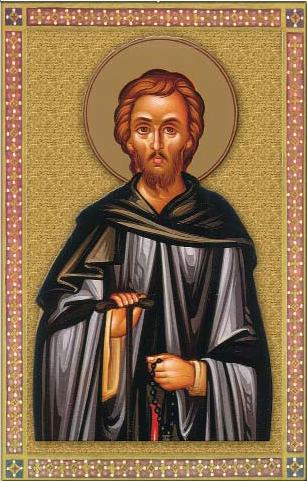
Theodore was a disciple of St. Pachomius. He was born and raised as a pagan but as a young man came to the knowledge of the True Faith and was baptized. Learning about St. Pachomius, he secretly fled from his parent’s home to Pachomius’ monastery. St. Pachomius tonsured him a monk and admired him because of his unique zeal and obedience. When his mother arrived to ask him to come home, Theodore did not even want to appear before her but prayed that God would enlighten her with the truth. Indeed, not only did her son not return home, but she herself did not return home. Seeing a convent not far away which was under the spiritual direction of Pachomius’ sister, she entered the convent and was tonsured a nun. After a period of time Paphnutius, Theodore’s brother, also came to the monastery and was tonsured a monk. In time the bishop of Panopolis called St. Pachomius to establish a monastery for those who desired the monastic life. Pachomius took Theodore with him and entrusted him with the duty of establishing this new monastery. After the death of Pachomius, Theodore became the abbot of all Pachomius’ monasteries and lived to a ripe old age. Theodore lived a life pleasing to God, directing the many monks on the road to salvation. He died peacefully and took up habitation in the kingdom of Eternal Light in the year 368 A.D.
THE BLESSED VIRGIN MUSA
St. Gregory the Dialogues speaks about her: she was only nine years old when, on two occasions, the All-Holy Birth-giver of God, surrounded by radiant virgins, appeared to her. When Musa expressed her desire to also be in such a radiant company of the Queen of Heaven, the Birth-giver of God said to her that, in one month, she would return to her and take her. She also instructed Musa how to live for these next thirty days. On the twenty-fifth day, Musa took to her bed. On the thirtieth day, the Holy Most-pure One appeared again calling to her in a soft voice to which Musa answered: “Behold, I am coming O Lady, behold I am coming!”, and she gave up her spirit. Musa was translated from this life into life eternal in the fifth century.
SAINT NICHOLAS MYSTICUS, PATRIARCH OF CONSTANTINOPLE
Nicholas was famous because of the unusual severity of his life. When Emperor Leo the Wise married for the fourth time, the patriarch refused him entrance into the church and defrocked the priest who performed the marriage. As a result of that, the emperor deposed the patriarch and banished him to a monastery. The delegates of the Roman Pope Sergius II approved of the emperor’s fourth marriage. When the emperor died, Nicholas was again restored to the patriarchal throne and called an assembly in the year 925 A.D., at which a fourth marriage for a Christian, in general, was forbidden. He died in the year 930 A.D. Nicholas is often surnamed Mysticus [The Mystic] and was a member of the emperor’s secret council. At first, this saint was a high ranking courtier after which he left the vanity of the world and was tonsured a monk. He died peacefully in the year 930 A.D.
THE NEO-MARTYR NICHOLAS
Nicholas was born in Epira. He was tortured by the Turks for the Faith of Christ and beheaded in Trikkala in 1617 A.D. A reliquary containing the head of this martyr is preserved today in one of the Meteora monasteries in Thessaly. He performs many miracles, heals the gravest diseases and is especially known to repel grasshoppers from fields.
THE VENERABLE MARTYRS OF THE MONASTERY OF ST. SABAS THE SANCTIFIED
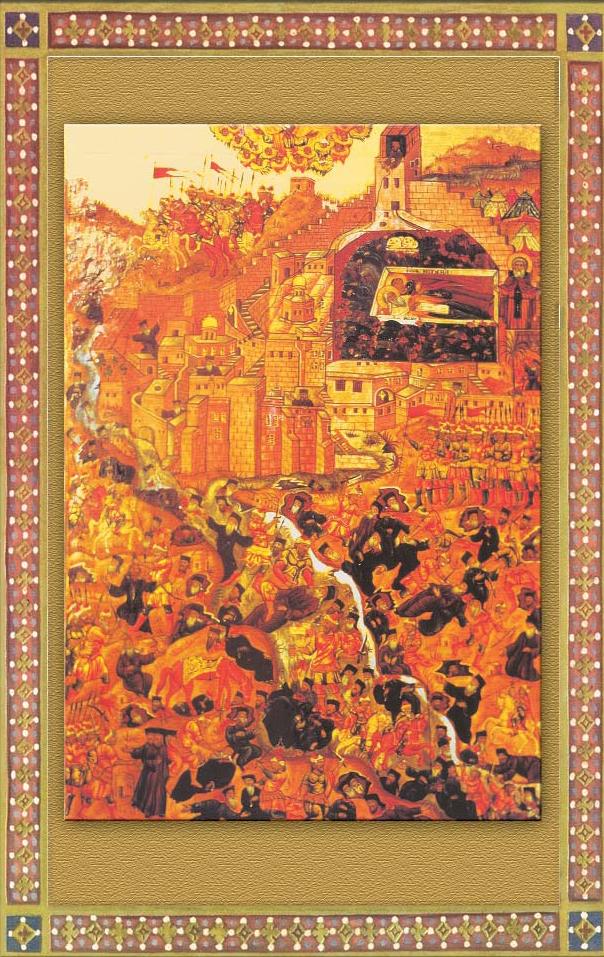
During the reign of Emperor Heraclius, about the year 610 A.D., forty-four monks from the monastery of St. Sabas the Sanctified near Jerusalem suffered for the Faith of Christ. Their heroism and sufferings were recorded by the eyewitness, St. Antiochus (December 24).