

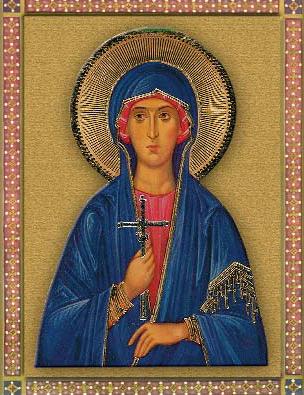
 THE HOLY MARTYRS HESPERUS, ZOE, CYRIAC AND THEODULUS
During the reign of Emperor Hardrian (117-138 A.D.), a pagan named Catallus purchased as slaves Hesperus, his wife Zoe and their sons Cyriac and Theodulus. Since they were steadfast Christians, they would not taste anything of the sacrifices to the idols and, that which was offered to them, they tossed to the dogs and they themselves hungered but endured. Learning of this, Catallus became enraged and began to cruelly torture his slaves. At first he tortured the children, but the children remained unwavering in the Faith and, even more, sought harsher torture from their persecutors. Finally, all four were thrown into a fiery furnace where, after prayers of thanksgiving, they gave up their souls to the Lord. Their bodies remained intact and were not consumed by the fire.
SAINT ATHANASIUS THE GREAT, ARCHBISHOP OF ALEXANDRIA
On this day the translation of the relics of St. Athanasius, as well as the miracles performed by his relics, is commemorated. The life and work of this great saint is recorded on January 18.
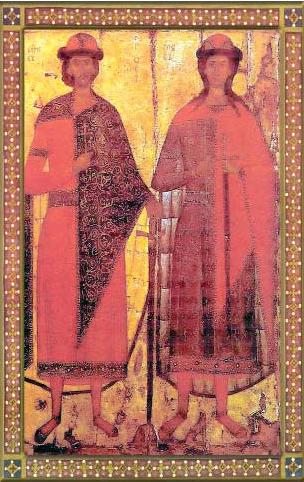 THE HOLY MARTYRS, SAINT BORIS AND SAINT GLEB
Boris and Gleb were the sons of the great Prince Vladimir, the baptizer of the Russian people. Until his baptism, Vladimir had numerous wives and many children by them. Boris and Gleb were brothers of the same mother. Before his death Vladimir divided up the State among all of his sons. But, Svyatpolk his eldest son, the Prince of Kiev, also desired to usurp the portions intended for Boris and Gleb. That is why he dispatched men to murder Boris who was in one place and to murder Gleb who was in another place. Both brothers were exceptionally pious and, in all things, pleasing to God. They encountered death with prayer and the uplifting of their hearts to God. Their bodies remained uncorrupt and fragrant. Boris and Gleb were buried in Vishgorod where, even today, a blessed power comes from their bodies, which heals men from various diseases and sufferings.
SAINT MICHAEL (BORIS), THE BULGARIAN TSAR
Boris was born and educated as a pagan and was baptized under the influence of his uncle Bojan and his sister. At baptism, he was given the name Michael. Patriarch Photius sent him priests who gradually baptized all the Bulgarian people. Many Bulgarian noblemen opposed this new Faith but the new Faith conquered and the Cross glistened on many churches built by the devout Tsar Michael. The Faith among the Bulgarians, as among the Serbs, was especially established by the Five Followers, the disciples of St. Cyril and St. Methodius, who preached to the people the knowledge of Christ in the vernacular: the Slavonic language.
In his old age Michael retreated to a monastery and was tonsured a monk. When his son Vladimir began to destroy his father’s work and to exterminate Christianity, Michael again donned his military uniform, girded himself with a sword, ousted Vladimir from the throne and installed Simeon, his younger son, as Tsar. After that, he again clothed himself in the monastic habit and retreated in silence where, in mortification and prayer, he completed his earthly life “in the good faith; in the correct confession of our Lord Jesus Christ; great, honorable and devout,” and took up habitation in the heavenly life on May 2, 906 A.D.