

COMMEMORATION OF THE FIRST ECUMENICAL COUNCIL
The commemoration and praise of the Holy Fathers of the First Ecumenical Council is held on the Sunday before Pentecost or on the Seventh Sunday after Easter. This Council was held in Nicaea in the year 325 A.D. during the reign of the saintly Emperor Constantine the Great. This Council was convened to eliminate the confusion which Arius, a priest of Alexandria, had created by his false teaching. Namely, he spread the teaching that Christ was created in time by God and that He is not the pre-eternal Son of God, equal in being [essence] with God the Father. Three hundred and eighteen Holy Fathers participated in this Council. The Council condemned the teaching of Arius and Arius, since he refused to repent, was anathematized. The Council finally confirmed the Symbol of Faith [The Creed], which was later augmented at the Second Ecumenical Council [381 A.D.]. Many distinguished saints were present at the First Ecumenical Council among whom the most notable were: St. Nicholas of Myra in Lycia, St. Spyridon, St. Athanasius, St. Acillus, St. Paphnutius, St. James of Nisibis, Macarius of Jerusalem, Alexander of Alexandria, Eustathius of Antioch, Eusebius of Caesarea, Metrophanes of Constantinople, John of Persia, Aristarchus of Armenia and many others from the East. From the West, the following were present: Hosius of Cordova, Theophilus the Goth, Cecilianus of Carthage and others. The most important work of this Council was the confirmation of the Symbol of Faith [The Creed]. The Council also established the time of the celebration of the Feast of the Resurrection of Christ [Pascha] and issued twenty various canons.
 THE HOLY FEMALE MARTYR THEODOSIA OF TYRE
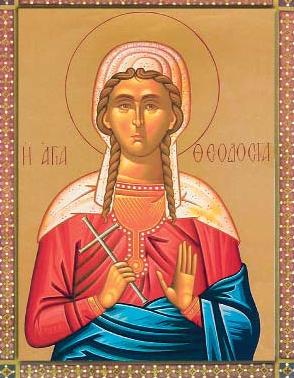
Once, during the reign of Emperor Maximian, many Christians stood bound before the praetor in Palestinian Caesarea. The pious virgin Theodosia approached, comforted and encouraged them in their martyrdom. Upon hearing what she was saying, the soldiers also led her before the judge. The enraged judge ordered that a stone be hung around her neck and tossed her into the depths of the sea. But angels of God carried her to the shore alive. When she, again, appeared before the judge, he ordered her beheaded. The following night, Theodosia appeared to her parents completely encompassed in a great heavenly light, surrounded by many other virgins who were also saved and said: “Do you see how great is the glory and grace of my Christ which you wanted to deprive me of?” She said that to her parents because they tried to persuade her from confessing Christ and martyrdom. Theodosia suffered honorably and was glorified in the year 308 A.D.
 THE VENERABLE FEMALE MARTYR THEODOSIA
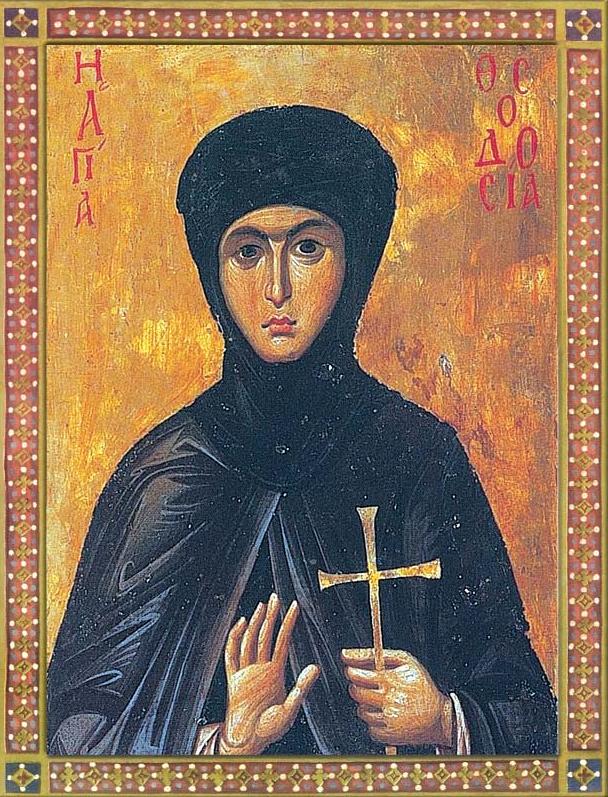
Theodosia was born as the result of the prayers of her mother to the holy martyr Anastasia who appeared to her and said that she will give birth. Her parents dedicated her to God and at an early age presented her to a convent. After the death of her parents, Thedosia inherited a vast estate, and from that estate, she ordered three icons from a goldsmith: The Savior, The Mother of God [The Theotokos] and St. Anastasia. The rest she distributed to the poor. She suffered in the year 730 A.D. during the reign of the evil Emperor Leo the Isaurian, the iconoclast, and received a two-fold wreath: virginity and martyrdom.
SAINT ALEXANDER, BISHOP OF ALEXANDRIA
Alexander was the first to take up the fight against Arius. He died in the year 326 A.D.
SAINT JOHN USTJUZSKI, FOOL FOR CHRIST AND MIRACLE-WORKER
THE HOLY MARTYR JOHN [NAN] OF THESSALONICA
John suffered for the Faith at the hands of the Turks in Smyrna in 1802 A.D.
THE HOLY MARTYR ANDREW OF CHIOS
Andrew suffered for the Faith at the hands of the Turks in Constantinople in the year 1465 A.D.
THE FALL OF THE CITY OF CONSTANTINOPLE
Because of the sins of men, God permitted a bitter calamity to fall upon the capital of Christianity. On May 29, 1453 A.D., Sultan Muhammed II conquered Constantinople and executed Emperor Constantine XI.