

THE HOLY MARTYRS TERENTIUS (TERENCE), AFRICANUS, MAXIMUS, [POMPILIUS] POMPEIUS AND THIRTY-SIX OTHERS WITH THEM
They all suffered for Christ and were crowned with the wreaths of glory during the reign of Emperor Decius. By order of the emperor, the governor of Africa announced to the people that everyone must offer sacrifices to the idols. To those who resisted, the governor threatened with cruel tortures. Upon hearing about these threats many fell away from the Faith and worshipped the idols. However these forty remained unwavering in their faith and were exposed to torture. St. Terentius (Terence) encouraged his companions saying: “Brothers, let us be on guard that we do not deny Christ our God, lest He deny us before His Heavenly Father and Holy Angels.” The governor divided them into two groups. Thirty-six of them, after flogging, scrapping of the skin and pouring salt into their open wounds, were all beheaded. The first four they cast into prison with heavy iron chains around their necks, their hands and their feet. An angel of God appeared in the prison, touched the chains of the shackled and the chains fell off. After that, the angel prepared a bountiful table for them and fed them. Once again, they were brought out and tortured and, again, they were imprisoned. Then the governor ordered the soothsayers to gather as many poisonous, loathsome creatures as possible, such as snakes and scorpions and to lock them up in the same cell with the martyrs. The loathsome creatures did not want to touch those chosen by God but rather lay compressed in the corner where they remained for three days. On the third day, when the door of the cell was opened, the repulsive creatures rushed out and bit the soothsayers. Finally, the governor pronounced the death penalty upon the four martyrs. When they were brought out to be beheaded, they rejoicefully chanted Psalms and praised God, Who made them worthy of a martyr’s death. They suffered honorably in the year 250 A.D., and were found worthy of the Kingdom.
THE SIX-THOUSAND MARTYRS IN GEORGIA
In the wilderness of David-Garejeli in Georgia, there were twelve monasteries in which many monks practiced and lived the ascetical life for centuries. In 1615 A.D., the great king of Persia, Shah Abbas I, attacked Georgia, devasted it and beheaded many Christians. Once while hunting early in the morning on the Feast of the Resurrection, Shah Abbas noticed many lights in the mountains. They were the monks from the twelve monasteries in procession around the Church of the Resurrection with lighted tapers in hand. When the Shah discovered that they were monks, he asked in amazement: “Has not all of Georgia been given over to the sword?” He then ordered his solders to immediately go and behead all the monks. At that moment an angel of God appeared to Abbot Arsenius and informed him of impending death. Arsenius informed his brethren. They all received Communion of the All-Pure Mysteries and prepared themselves for death. Suddenly, the assailants arrived and hacked to pieces, first of all, the abbot, who came before the others and, after that, all the rest. They all suffered honorably and were crowned with incorruptible wreaths in the year 1615 A.D. Thus, ended the history of these famous monasteries which, for more than a thousand years, served as the spiritual hearth of enlightenment for the Georgians. Only two of the monasteries exist today: St. David and St. John the Forerunner. The Georgian Emperor Arcil gathered the relics of the monks and honorably interred them. Even today, these relics emit a sweet-smelling Chrism (oil) and heal the sick.
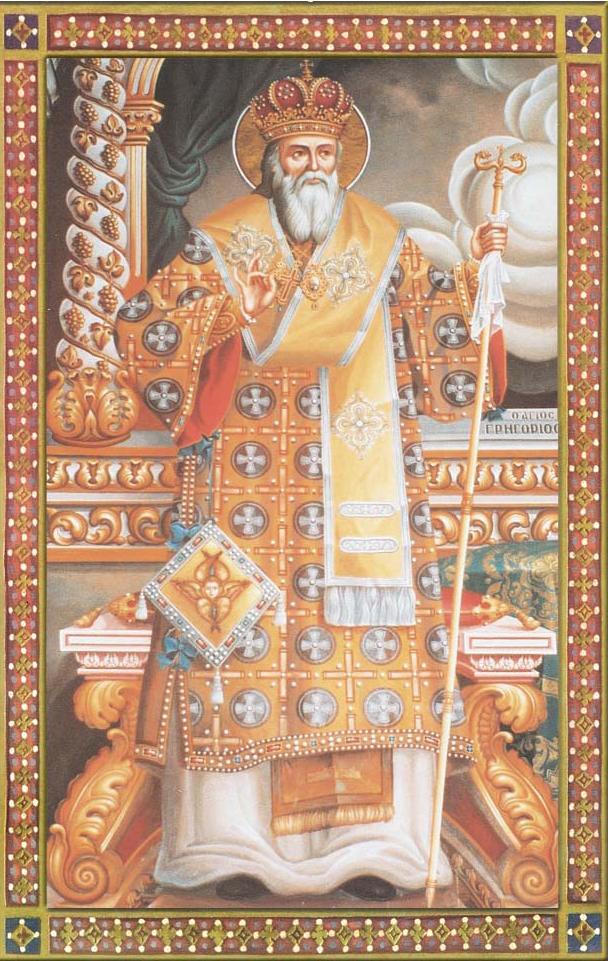 SAINT GREGORY E΄, PATRIARCHAT OF CONSTANTINOPLE
Borrowing a line from Rupert Brooke, it can be said that there is some corner of a foreign field that is forever Greece, the foreign strand being what is now Istanbul and the precious fragment of Greece which is the holy patriarchate if Orthodoxy. This holy ground has been the focal point for Christianity down through the centuries, displaying a durability that enabled it to withstand a relentless Muslim onslaught. Its hallowed grounds, second in sacredness only to the burial site of Jesus Christ, to this day bears mute testimony to the glory and the tragedy of its leaders, chief among whom was the nineteenth–century Patriarch Gregory V, revered now as Saint Gregory of Constantinople. High on the honor roll of patriarchs is the noble Gregory, who was born in the village of Demetsana in the rugged Peloponnesos mountain range in 1745, the son of John and Asimina Angelopoulos, a family who preferred the bleak hill country, which held no attraction for the oppressive Turks, at least not in any great numbers. A brilliant scholar, he excelled in whatever studies the local schools offered and went on to secondary education in Athens, Smyrna, and Patmos, after which he became a monk, adopting the name of Gregory. His excellent service record came to the attention of Metropolitan Prokopios of Smyrna, who called him to his see and appointed him chancellor of the archdiocese of the area. When Prokopios was elevated to the supreme post of patriarch, Gregory succeeded him as metropolitan in the diocese of Smyrna. He assumed his role in 1785 and four short years later was called to Constantinople and made ecumenical patriarch. The next several years were turbulent ones because of Gregory’s resistance to Turkish oppression and his endorsement of the patriotic factions on the Greek mainland whose guerilla operations presaged the revolution which was to throw off the Ottoman yoke. Gregory grew weary of this strife and retired to Mt. Athos in 1798 where he refreshed his spirit, but in 1806 he was recalled to reassume the duties of patriarch, and he returned to be once again caught up in the deadly tug of war which continued to plague him and the members of his Synod, ever on the alert lest one slip prove fatal not only for them but for the whole of Christianity. Again he retired to Mt. Athos after two years of constant wariness, and once more recalled some ten years later in 1818 to shore up the defenses of Christianity against Islam. The beleaguered Patriarchate continued for another three years to stave off the menace of the Turks, but in that fateful year of 1821, on March 25 to be exact, a call to arms and declaration of independence was sounded by another prelate in distant Patras, a proclamation for freedom which proved to be the death knell for Gregory of Constantinople. The news of the Greek insurgence stunned the truculent Turks and so enraged them that they devised the most heinous retaliation possible. A group of homicidal Turks recruited from among the most sanguinary of their many wolf packs, swooped down on the hapless keepers of the vicarage of Jesus Christ and seized from among them the holy Patriarch Gregory, the supreme symbol of Christianity and of the glory of Greece. This man of God was snatched from his chambers by a frenzied posse of cutthroats who dragged him to the great entrance gate and on that spot hanged him. Because his countrymen had seen fit to cast off their yoke after nearly four hundred years of harassment, this innocent vicar of Christ was garroted by the basest of homicidal maniacs. Not content with this, the body of the great patriarch was dragged through the streets by these scourges of God and he was cast into the Bosporos. Sailors recovered the body of the martyred Gregory and in a scene reminiscent of Calvary he was laid to rest in Odessa, thereafter to be exhumed and interred with the Cathedral Church of the Annunciation in Athens, there to lie in honored glory. Of the three gates of the Patriarchate, the center gate that was the site of this infamous tragedy was closed and remains closed to this day, never to be opened again. The memory of Gregory is commemorated on April 10, the day of this brutal assassination.