

 THE HOLY FEMALE MARTYRS AGAPE, CHIONIA AND IRENE
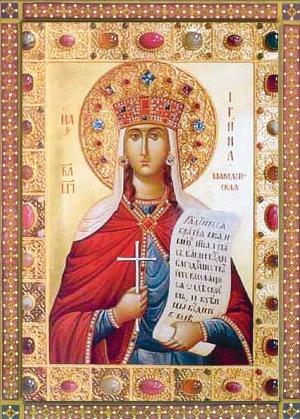
All three were sisters from the vicinity of Aquileia. When Emperor Diocletian was staying in Aquileia he ordered that the distinguished spiritual father Chrysogonus be killed. At that time, an aged Presbyter Zoilus had a vision in which the location of the unburied body of Chrysogonus was revealed. Hurrying, the elder found the martyred body of Chrysogonus, placed it in a sarcophagus and kept it in his home. Thirty days later, St. Chrysogonus appeared to him and informed him that, in the course of nine days, those three maidens would suffer martyrdom and that he, too, would also die at that time. The same news was received in a vision by Anastasia, [ a woman endowed with moral and spiritual insight], who had followed the example of her teacher, Chrysogonus. Indeed, after nine days the Elder Zoilus died and those three sisters were brought to trial before the emperor. The emperor urged these three maidens to worship the idols, but they all refused and confessed their steadfast faith in Christ. Irene said to the emperor: “How stupid it is to worship things made of stone and wood, which were ordered for an agreed price and made by the hands of a mortal man.” The enraged emperor cast them into prison. When the emperor departed for Macedonia, all slaves and prisoners were taken with him, among whom were these three saintly maidens. The emperor turned them over to a certain Commander Dulcitius for torturing. This commander, inflamed by dark passion, wanted to defile the virgins however, when the commander attempted to enter the prison while the virgins were praying to God he went insane. He fell among the black cauldrons and pots before the gates and began to embrace and kiss them and departed sooty and blackened. The emperor upon hearing about this incident ordered that another commander, Sisinius, take over the trial of these sisters. After prolonged torture, the judge condemned the first two sisters to death by burning and he detained Irene for a while longer hoping to defile her. But, when he sent Irene to the brothel with the soldiers, an angel of God saved this chaste virgin and staved off these soldiers and brought her to a hill. The next day, the commander with his soldiers went to this hill and were unable to ascend it. He then ordered that Irene be shot with arrows. St. Anastasia [the disciple of Chrysogonus] gathered the bodies of these three sisters into one place and honorably buried them. They all suffered honorably for Christ the King and Lord about the year 304 A.D.
THE HOLY MARTYR LEONIDES AND WITH HIM THE FEMALE MARTYRS: CHARIESSA, NICE, GALINA, CALLIS, NUNECHIA, BASILLISSA AND THEODORA
They were thrown into the sea but the sea received them not. They walked upon the sea as upon dry land and sang to God: “One field of battle, I ran O Lord, and the army pursued me; O Lord I did not deny You; O Lord, save my soul!” Seeing them the heathens, at first, were amazed but after that tied stones around their necks and again threw them into the depths of the sea and they drowned. They all suffered honorably for Christ the King and Lord in the year 281 A.D.
SAINT MICHAEL OF SMYRNA
Michael of Asia Minor exemplifies in the highest tradition the defense of Christianity in the face of the withering blasts of the Muslims. Because he came to know both worlds, Michael looms as an heroic figure despite the fact that he was nothing more than a man in the street with whom all can identify. He held no high office, lay or clerical, made no name for himself as a monastic, but he took the stand for Christianity as few men have done. Like all the Orthodox, he had the Savior in his heart and proved it beyond any reasonable doubt, not, however, until he appeared to have become the one least likely to do so. The village of his birth remains obscure, save to say that it was not on the Greek peninsula but somewhere in the remoteness of Asia Minor where Greeks had lived for centuries. Orphaned as a child, he had become a master coppersmith at an early age and like most Greeks, was anxious to work out of his own shop in full expression of his own artistic ability. Competition in this field was stiff, but for a Greek to compete against Turkish craftsmen, even those of mediocre talent, was a near impossibility. The Turks saw to it that only their shops prospered. A Turkish businessman happened to see an example of Michael’s craftsmanship and proposed to back Michael with adequate financing in a partnership by which both would profit. The price that Michael had to pay was conversion to Islam, since a Turk could hardly be expected to go into business with a Christian. At the age of eighteen, Michael saw no harm in this, since he merely had to appear to have defected and thereby have his own business. He lacked reason no more than he lacked talent, but in his boyish eagerness he failed to realize the overt seriousness of apostasy. The full meaning of the sacraments which were actually dear to his young heart gave way to his anxiety to prosper and escape the wretchedness of hunger and deprivation. He had made this ill-considered venture for only a few months when his folly was brought to bear on him with a sudden surge of the Christian spirit he had sought to disregard out of expediency. The advent of the Christian Lenten season found him in a state of complete remorse and an abandonment of his coppersmith ambitions. In the absence of his Muslim partner, he rejoined his Christian friends and perhaps because of his return, much like the prodigal son, he was more of a Christian in the Orthodox family than ever before. Basking in the glory of the light of the holy season, he observed fasting to the letter and when at last the “Christos Anesti” echoed and re-echoed throughout the city he was brimming over with the love of the Savior. The joy of celebrating the risen Christ was all consuming and an exuberant Michael went to seek out his former partner. Unaware of what had happened, the Turk was confronted by an elated Michael and thinking him to have drunk too much wine, went along with the young Greek’s proposal to answer some questions. When Michael asked him if he would exchange a piece of gold for lead, the bemused Turk answered “of course not.” Both agreed that would be folly. The young man then said to the unsuspecting Turk that he had exchanged his gold for lead and was returning the lead to get his gold. Assuming this to be a riddle by which the golden Greek was looking for a better business arrangement, he asked for a clearer definition. It was then that Michael said he had forsaken his Lord, the gold to which he referred, for the lead of the Muslim faith, and was returning to the golden light of Christianity. The Turk became infuriated at having allowed himself to be led into this personal affront by a young upstart and let loose a torrent of rage, only exacerbated by the calm demeanor of the youthful Christian. Not one to allow money to slip through his fingers, he contained his wrath at last and tried to prevail upon the lad to resume their arrangement. This was met with a firm declaration that under no circumstances would the young Greek allow himself to become an apostate as he had so unwisely done before. The promise of further wealth was meaningless. The inevitable charge of treason was brought against Michael whose defense of Christ brought the death sentence. He was beheaded on 16th April 1772, at age nineteen, and is enshrined in the Church of Saint Photini.