

THE PRIESTLY-MARTYR SIMEON, PERSIAN BISHOP
During the reign of the wicked Emperor Sapor [Savori], Simeon was tortured for Christ along with his two presbyters, Audel and Ananias. The emperor’s eunuch, Ustazan, who had earlier denied Christ and afterward, touched by the rebuke of St. Simeon, again, confessed the True Faith before the emperor. A thousand other Christians were also led to the place of execution with Simeon. Simeon intentionally moved out of the way in order to be the last one to be beheaded so as to encourage the other Christians to the end, so that, not one of them would waver because of their fear of death. When the presbyter Ananias placed his head on the chopping block, his entire body quivered. The emperor’s court clerk Fusik, who secretly was a Christian, began to encourage Ananias saying: ” Do not be afraid old man, close your eyes and be brave so that you may see the divine light.” As soon as Fusik said this, he was recognized as a Christian and was accused before the emperor. The emperor exhausted him through great torture, as well as his daughter, the maiden Askitria. After St. Simeon saw his flock depart to the other world, he was finally beheaded. The following year on Great Friday (Good Friday), Azat [Ustazan], the beloved eunuch of the emperor, was also slain for Christ and with him a thousand other faithful. Then the emperor mourned for his eunuch and suspended the further killing of Christians. They all suffered honorably for Christ the King and Lord in the year 341 or 344 A.D.
SAINT ACACIUS, BISHOP OF MELITENE
Acacius lived the ascetical life in the place where he was born, i.e., in Melitene, Armenia. Blessed Otreius, bishop of that city, who participated at the Second Ecumenical Council [Constantinople 381 A.D.], ordained him a presbyter. Following the death of Otreius, Acacius became a bishop. He participated at the Third Ecumenical Council [Ephesus 431 A.D.], which condemned the evil blasphemy of Nestorius against the Mother of God. Here, together with St. Cyril of Alexandria, Acacius zealously fought for the purity of the Orthodox Faith. St. Acacius possessed much Grace from God and worked many miracles. After long and zealous service to God, Acacius died peacefully in the year 435 A.D.
SAINT AGAPITUS, POPE OF ROME
Agapitus was sent to the Emperor Justinian in Constantinople by Theodahad, the King of the Goths, to dissuade him from his campaign against the Goths. Enroute, he healed a mute and blind person. In Constantinople, Agapitus assisted in confirming Orthodoxy and died in the year 536 A.D.
THE VENERABLES SABATIUS AND ZOSIMUS
Sabatius and Zosimus were the co-founders of the ascetical [monastic] community on the Solovetz Island in the White Sea. Many great saints were glorified in the Solovetz Community. St. Sabatius died in 1435 A.D., and Zosimus died in 1478 A.D.
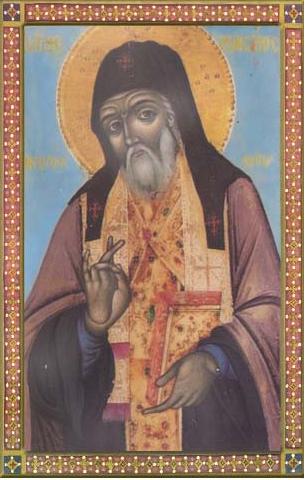 SAINT MACARIUS, BISHOP OF CORINTHOS
The honorable family into which Makarios was born in 1731 included his renowned father, George Georganta, a leading citizen of Corinth who could claim to lineal descent one of the great national martyrs Lukas the Notaras (1453), Saint Gerasimos, patron saint of Cephalonia (1579) and no less than the two grand patriarchs of Jerusalem named Dositheos (1707) and Chrysanthos (1731). Circumstances dictated that Makarios, from the outset a serious student of academic excellence and a churchgoer of undeniable piety, should enter holy orders. His rapid advance brought him prematurely to the gates of Monastery of the Great Spilarion, led by his reputable tutor, Eustathios of Cephalonia. Refused admission because of his age, he returned to his parents in Corinth and undismayed, he prevailed upon them to allow him rein in pursuit of even higher learning, eventually opening a school of his own for the youngsters of Corinth so that they, in his own words, “would not be ignorant and blind to the teaching of the Christian faith.” He allowed the indigent to attend free of charge, setting an example of devotion and dedication to the Church. When the post of archbishop of Corinth became vacant in 1764, the populace looked beyond their own priests to Makarios, and because of his immense popularity and well established piety the post was kept open until the proper proceedings had been adhered to. A short stay at the monastery was followed by a visit to Constantinople where Makarios was warmly received by Patriarch Samuel who had but to spend a few moments with this man of Corinth and unhesitatingly appointed him the city’s archbishop. In 1765 a city witnessed the enthronement of one of its native sons as its spiritual leader. A teacher at heart, Makarios as archbishop made the literacy of all his people of paramount importance so that they might enjoy the beauty and power of reading the Scriptures instead of having it read to them. Amazed that even some of his clergy were illiterates who had somehow found ways to become ordained and thereafter live off the help of those whom he was supposed to help. Unqualified clerics soon found themselves in search of either better preparation or another pursuit, gradually replaced by suitable men pledged to Christ and not to themselves. Administrative changes were brought about throughout the diocese until such time as communicants were properly served and indifference replaced with harmony, concern for one another, and above all a common purpose in the worship of Jesus Christ. In 1769, the Russo—Turkish conflict so affected the politics and policies of Catherine II, that its far reaching effects fell upon the city of Corinth, bringing about the exile of Makarios, who was forced to flee to the island of Zakynthos with his brother and family. In the several years on this island, Makarios was never out of touch, occasionally taking the time to venerate the shrine of his kinsman, Saint Gerasimos, at the latter’s burial site on the island of Cephalonia. The divisive forces intertwined in state and church were such that the intrigues of war produced circumstances which saw vacated clerical posts throughout the Peloponnesos, not the least of which was that of ancient Corinth, whose spiritual leader was languishing on a distant island. In a swirl of unrest and indecision, Patriarch Theodosios II of Constantinople methodically filled the vacant posts, automatically making Archbishop Makarios an exile. Amid further confusion and misunderstanding Makarios was asked to resign, something he flatly refused to, citing ecclesiastical law and precedent. Makarios seemed doomed until a new Patriarch, Sophronios of Constantinople, intervened in his behalf by formal recognition of the archbishop. The patriarch realized that a return to Corinth was an ill considered step and prevailed upon the exiled cleric to remain free to do as he wished under the grant of a small pension. Rather than allow himself to crawl into obscurity, Makarios came forth with even greater eagerness to serve the Lord, and given the latitude, a blessing in disguise, he gave his full expression to his religious fervor. He preached in churches of his choosing wrote extensively on religious themes, and traveled to Mount Athos and Chios, meeting along the way men such as Nikodemos of Mount Athos with whom he collaborated in writing a number of works which are classics of Orthodox spirituality. His long and fruitful life ended on the island of Chios on 17 April 1805.