

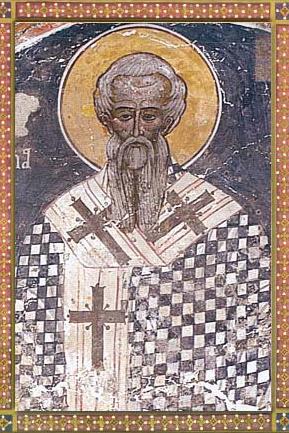
 THE PRIESTLY-MARTYR BLAISE
Saint Blaise was born in the Province of Cappadocia. From his early childhood, he was God-fearing and meek. Because of his great virtues, he was chosen as bishop of the city of Sebastea [in Armenia]. Blaise was a great spiritual and moral beacon in this pagan city. At the time of a grave persecution of Christians, St. Blaise encouraged his flock and visited the martyrs of Christ in prison, especially among them was the eminent and glorious Eustratius. When the city of Sebastea was completely depleted of Christians – some were slain, and others fled – the Elder Blaise withdrew to Mt. Argeos and settled there in a cave. Wild beasts recognized the holy man, gathered around him and he tenderly caressed them. But the persecutors found the saint in this remote place and brought him to trial. Along the way, Blaise cured a young boy who had a bone caught in his throat. To the plea of the poor widow whose pig had been snatched by a wolf, the saint, by the power of his prayer, commanded the wolf to return it. The sinister judges tortured Blaise severely: flogging him and scrapping him with an iron comb. By his steadfastness in the Faith of Christ, Blaise converted many pagans to the Faith. Seven women and two children languished in prison with him. The women were beheaded first and, after that, the wonderful Blaise with these two children was beheaded. He suffered and was glorified in the year 316 A.D. People pray to St. Blaise for the well being of their domestic livestock and for protection against wild beasts. However, in the west, he is also invoked for diseases of the throat.
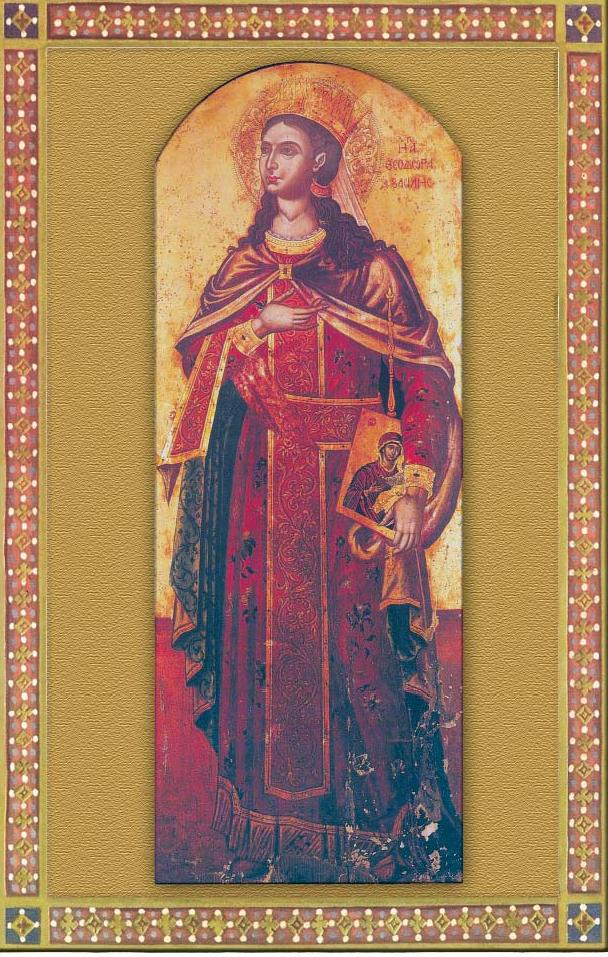 SAINT THEODORA
Saint Theodora, a Greek empress, was the wife of the nefarious Emperor Theophilus the Iconoclast. After the death of Theophilus, Theodora became the ruling empress and reigned together with her son Michael III. At the Council in Constantinople (842 A.D.), she immediately restored the veneration of icons. On this occasion, the Feast of the Triumph of Orthodoxy was instituted which is still celebrated today on the First Sunday of the Honorable Fast [First Sunday in Lent]. This holy and meritorious woman of the Church gave up her soul to God on February 11, 867 A.D. It was at that time, by the divine and wonderful Providence of God, at the solemn triumph of Orthodoxy over all heresies, that St. Cyril and St. Methodius were sent as Christian missionaries to the Slavs.
THE HOLY MARTYR GEORGE OF KRATOVO
By origin, George was a Serb from the town of Kratovo. He was a silversmith by trade and, in his heart and soul, was a convinced and a devout Christian. George was eighteen years old when the Turks tried to convert him to Islam. George remained as firm as a diamond in his faith. The Turks tortured him with many cruel tortures and finally burned him at the stake. He suffered for the beautiful Faith of Christ on February 11, 1515 A.D. in Sofia, Bulgaria, during the reign of Sultan Selim and was glorified with unfading glory in the heavens.
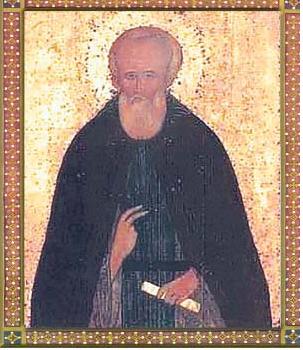 Saint Dimitrios of Priluki
Saint Dimitrios of Priluki, Wonderworker, was born into a rich merchant’s family in Pereyaslavl-Zalessk. From his youth the saint was uncommonly handsome. Receiving monastic tonsure at one of the Pereyaslavl monasteries, the saint later founded the St. Nicholas cenobitic monastery on the Sts. Boris and Gleb Hill at the shore of Lake Plescheevo near the city, and became its igumen. In 1534 St. Dimitrios first met with St. Sergius of Radonezh, who had come to Pereyaslavl to see Metropolitan Athanasios. From that time, he frequently conversed with St. Sergius and became close with him. The fame of the Pereyaslavl igumen was so widespread that he became godfather to the children of Great Prince Dimitrios Ioannovich. Under the influence of the Radonezh wonderworker, St. Dimitrios decided to withdraw to a remote place, and went north with his disciple Pachomios. In the Vologda forests, at the River Velika, near the Avnezh settlement, they built a church of the Resurrection of Christ and they prepared to lay the foundations for a monastery. The local inhabitants were fearful that if a monastery were built there, their village would become monastery property. They demanded that the monks leave their territory, and wishing to be a burden to no one, they moved farther away. Not far from Vologda, at the bend of a river in an isolated spot, St. Dimitrios decided to form the first of the cenobitic monasteries of the Russian North. The people of Vologda and the surrounding gladly consented to help the saint. The owners of the land intended for the monastery, Elias and Isidore, even trampled down a grain field, so that a temple might be built immediately. In 1371 the wooden Savior cathedral was erected, and brethren began to gather. Many disciples of the monk came there from Pereyaslavl. St. Dimitros combined prayer and strict asceticism with kindliness. He fed the poor and hungry, he took in strangers, he conversed with those in need of consolation, and he gave counsel. He loved to pray in solitude. His Lenten food consisted of prosphora with warm water. Even on feastdays, he would not partake of the wine and fish permitted by the Rule. Both winter and summer he wore an old sheepskin coat, and even in his old age he went with the brethren on common tasks. The saint accepted contributions to the monastery cautiously, so that the welfare of the monastery would not be detrimental to those living nearby. The Lord granted His servant the gift of clairvoyance, and he attained a high degree of spiritual perfection. St. Dimitrios died at an advanced age on February 11, 1392. The brethren approaching found him as though asleep, and his cell was filled with a wondrous fragrance. Miracles from the relics of St. Dimitrios began in the year 1409, and during the fifteenth century his veneration spread throughout all Rus. And no later than the year 1440, the Priluki monk Makarios recorded his Life (Great Reading Menaion, February 11) based on the narratives of St. Dimitrios’s disciple Igumen Pachomios.