

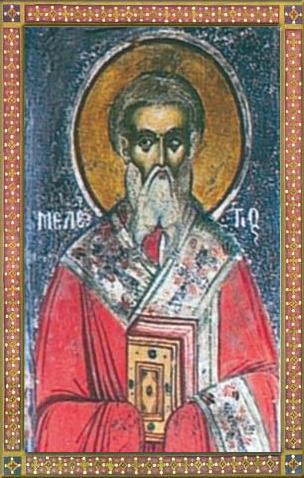
 Saint Meletius, Archbishop of Antioch
This great and holy man was an outstanding interpreter and defen-der of Orthodoxy. The whole of his life was devoted to the fight against the Arian heresy, which did not recognise the Son of God and blasphemed against the Holy Trinity. He was three times removed from his archiepiscopal throne by the heretics, and driven off into Armenia. The struggle between the Orthodox and the here-tics became so bitter that once, while St Mclctius was preaching to the people in church on the divine Trinity in unity, his own deacon, a heretic, ran up to the bishop and shut his mouth with his hand. Being unable to preach with words, Meletius preached by signs. Thus, he raised his arms on high, opened three fingers to their ful-lest extent and showed them to the people, then closed his hand and raised the one fist. He took part in the Second Ecumenical Council in 381, where the Emperor Theodosius showed him specially great honour. At that Council, God showed a mystery through His archbishop. When Meletius was propounding the doctrine of the Holy Trinity to the Arians, he first raised three fingers, separated one by one, then brought them together; and at that moment light-ning flashed from his hand before the gaze of all present. At that Council, Meletius established Gregory the Theologian in the seat of Constantinople. While the Council was still in session, St Meletius finished his earthly course in Constantinople. His relics were taken to Antioch.
Saint Mary (MariNus).
Saint Mary was a woman with a man’s courage. After the death of her mother, her father desired to become a monk. Mary would not be separated from him, so they decided to go together to a men’s monastery-Mary with short hair and in man’s raiment as a youth. Her father died, and Mary became a monk and received the name Marius. There was an inn near the monastery, and the innkeeper’s daughter fell in love with the pious monk Marinus. After pursuing him without success, she accused Marius of unlawful relations with her, because she had known some other man and borne him a son. Mary did not defend herself and was driven forth with scorn from the monastery. With the strange child in her care, she lived for three years in a grove belonging to the monastery, enduring hunger and hatred, and every sort of hardship and privation. As a result of all this, the innkeeper’s daughter became deranged and, a little later, Mary died. Immediately after her death it was discovered that the `Monk Marius’ was a woman. As soon as the innkeeper’s daughter touched the relics of St Mary, she was healed of her insanity and confessed her terrible sin. St Mary entered into rest and went to eternal joy in 508.
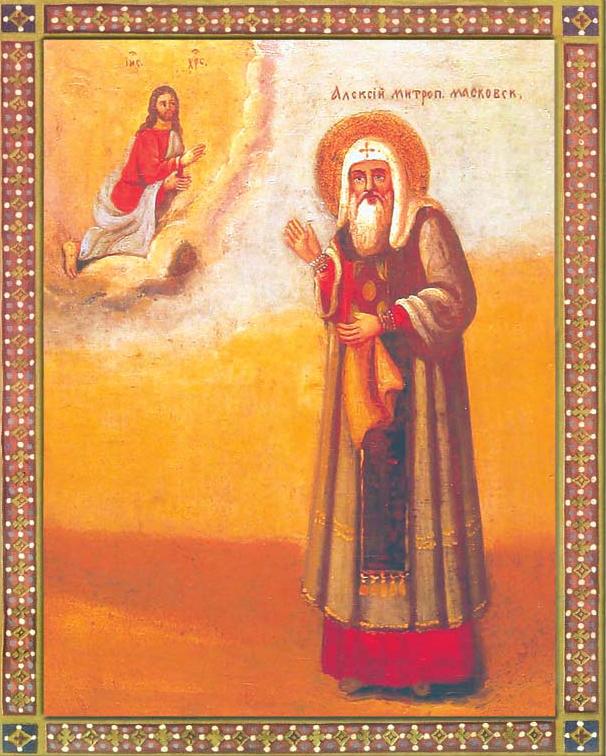 Saint Alexis, Metropolitan of Moscow
A great hierarch of the Russian Church in a difficult period of Tartar oppression of the Russian people. Once in childhood he went bird-hunting, then went to sleep and in a dream heard a voice that said: `Alexis, why rush around so fruitlessly? I will teach you to catch men!’ He became a monk at the age of twenty, and in time became Metropolitan of Moscow. He twice went among the `Golden Horde’ of the Tartars, once to south the wrath of Verdevir Khan against the Russian people, and the second time at the invitation of Amurdt Khan, to cure his wife’s blindness. This woman had been blind for three years, but was healed and her vision restored when Alexis prayed and anointed her with holy water. After a life of great endeavour and fruitfulness, Alexis entered into rest in 1378 at the age of 85, and went to the court of the Lord.
Saint Antony, Patriarch of Constantinople
He was at first an ascetic, a man of great compassion, and then Pat-riarch in the time of the Emperor Leo the Wise (889-912). He pro-fessed his father monk and built a monastery over the relics of St Callia.
Saint Bassian of Uglich
Saint Bassian of Uglich was a disciple of St. Paisios of Uglich. He was born in the village of Rozhalov, in the Kesov district of the city of Bezhetsk Verkha. He was descended from the Shestikhin princes, whose ancestor was the prince St. Theodore of Smolensk.St. Bassian came to the Protection monastery when he was thirty-three years of age, and was soon tonsured by St. Paisios. He fulfilled his obediences without complaint and lived in great abstinence. In 1482, St. Bassian discovered the Protection Icon of the Most Holy Theotokos. Having spent twenty years at the monastery of St. Paisios, St. Bassian then asked a blessing to live in silence. His teacher blessed him saying, “Go my child, be guided by Christ with the blessed yoke of the Lord as it pleases Him. Soon you yourself shall form your own monastery and gather a monastic flock to the glory of the the Most Holy Trinity.”In 1492 St. Bassian left the monastery and, after spending time at the Nikolo-Uleimsk monastery, he went to a remote place thirty versts south of Uglich and began to live as a hermit. Soon people learned of his solitary habitation and began to come for advice and guidance. In 1492, the saint built a wooden church dedicated to the Most Holy Trinity, and soon those wishing to live the monastic life came to be guided by him. St. Bassian did not cease his relationship with his teacher until the latter’s death, at which he was present together with other disciples. Having dwelt at the Trinity monastery for seventeen years, St. Bassian died on February 12, 1509. Three years later, a man named Gerasimos received healing from unclean spirits at his grave, and another fellow named Valerian was healed of palsy. St. Bassian was glorified in 1548 at the uncovering of his incorrupt relics, over which a stone crypt was built. St. Bassian is commemorated twice during the year: on the day of his repose, February 12, and on June 6 with his spiritual teacher St. Paisios of Uglich.
The Iveron Icon of the Mother of God
The Iveron Icon of the Mother of God (which is preserved on Mt. Athos) was kept in the home of a certain pious widow, who lived near Nicea. During the time of the emperor Theophilos, the Iconoclasts came to the house of this Christian, and one of the soldiers struck the image of the Mother of God with a spear. Blood flowed from the place where it was struck.The widow, fearing its destruction, promised the imperial soldiers money and implored them not to touch the icon until morning. When the soldiers departed, the woman and her son (later an Athonite monk), sent the holy icon away upon the sea to preserve it. The icon, standing upright upon the water, floated to Athos. For several days, the Athonite monks had seen a fiery pillar on the sea rising up to the heavens. They came down to the shore and found the holy image, standing upon the waters. After a Molieben of thanksgiving, a pious monk of the Iveron monastery, St. Gabriel, had a dream in which the Mother of God appeared to him and gave him instructions. So he walked across the water, and taking up the holy icon, he placed it in the church.On the following day, however, the icon was found not within the church, but on the gates of the monastery. This was repeated several times, until the Most Holy Theotokos revealed to St. Gabriel Her will, saying that She did not want the icon to be guarded by the monks, but rather She intended to be their Protectress. After this, the icon was installed on the monastery gates. Therefore this icon came to be called “Portaitissa” or “Gate-Keeper”