

THE VENERABLE AUXENTIUS
Saint Auxentius was a very prominent aristocrat among the noblemen and courtiers at the court of Emperor Theodosius the Younger in Constantinople. Enflamed with love for Christ, Auxentius was tonsured a monk and remained for a short time in Constantinople. When men began to praise him, he fled from their praise and settled on a mountain called Skopa near Chalcedon, which later was referred to as Auxentius’ Mountain. His desire to remain there permanently, hidden from men, was not realized for some shepherds discovered him and make his whereabouts known. They began to bring the sick to him for healing. He healed many. He restored sight to the blind; cleansed lepers anointing them with oil; he also raised the palsied and freed many who were demon possessed. All of this was reason for amazement, but his humbleness was cause for even greater amazement. Whenever he was implored to heal someone he defended himself with the words: “I, also, am a sinful man!” Compelled by many requests, he approached healing in the following manner: he either invited all present to pray to God together with him for the sick person; or he first strengthened the faith in the people and then he told them that God will give to them according to their faith; or he prayed over the head of the sick person: “The Lord Jesus Christ heals you!” He did this so that the act of working miracles would not be attributed to him but rather to God Almighty. He participated at the Fourth Ecumenical Council [Chalcedon, 451 A.D.] and strongly defended Orthodoxy against the Eutychian and Nestorian heresies. In the year 470 A.D., the Lord took his youthful soul in his old age and his aged body remained in the earth from which it was created.
Saint Abraham, Bishop of Charres
Saint Abraham, Bishop of Charres, lived during the mid-fourth and early fifth centuries, and was born in the city of Cyrrhus. In his youth he entered a monastery. Later he became a hermit in Lebanon, a place where many pagans lived. St. Abraham suffered much vexation from the pagans, who wanted to expel him from their area. He once saw tax-collectors beating those who were unable to pay. Moved to pity, he paid the taxes for them, and those people later accepted Christ. The Christian inhabitants of this village built a church and they fervently besought St. Abraham to accept the priesthood and become their pastor. The monk fulfilled their wish. Having encouraged his flock in the faith, he left them in place of himself another priest, and he again retired to a monastery. For his deep piety he was made bishop of Charres; his pastors the saint constantly taught by his God-pleasing life. From the time of his accepting of the priesthood, he never used cooked food. The emperor Theodosius the Younger wanted to meet the bishop and made him an invitation. Having arrived in Constantinople, St. Abraham soon died. His remains were solemnly transferred to the city of Charres and there given over to burial.
Saint Maron
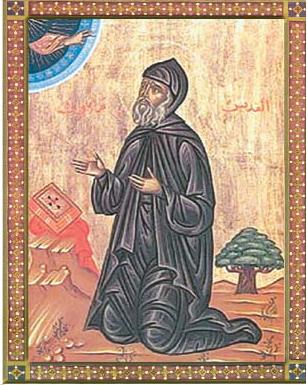
Saint Maron was born in the fourth century near the city of Cyrrhus in Syria. He spent almost all his time beneath the open sky in prayer, vigil, ascetical works and strict fasting. He obtained from God the gift of healing the sick and casting out demons. He counselled those who turned to him for advice to be temperate, to be concerned for their salvation, and to guard against avarice and anger. St. Maron, a friend of St. John Chrysostom, died before 423 at an advanced age.
THE VENERABLE ISAAC, RECLUSE OF THE MONASTERY OF THE CAVES IN KIEV
Saint Issac lived during the time of Saints Anthony and Theodosius. He came to the monastery as a wealthy merchant. He left all and distributed everything to the poor and dedicated himself to the most strict form of asceticism in an enclosed cell. St. Anthony himself passed one prosfora(*) through an opening every other day. Deluded by demons who appeared to him in angelic light he bowed down to them and, after that, he bowed down before Satan himself believing that he was Christ. Because of that he became ill, and remained ill for two years after which he regained his health and became a more cautious and a more experienced ascetic. Because of this, before his death, God bestowed upon him abundant Grace. He died in the year 1090 A.D.]