

SAINT LEO I, POPE OF ROME
Saint Leo was born in Italy of devout parents. At first, he served as archdeacon under Pope Sixtus III and following the death of Sixtus was elevated against his will to the throne of the Pope of Rome. When Attila, with his Huns, drew near to Rome was prepared to destroy and to set fire to the city, Leo came out before him in his episcopal vestments mitigated the wrath of the leader of the Huns and averted the destruction of Rome. As much as Attila allowed himself to be counseled by this holy man so also had he to be afraid of the vision of the Apostles Peter and Paul who stood along side Leo and with flaming swords threatened him. Not only did St. Leo save Rome, but he also contributed much to save Orthodoxy from the heresy of Eutyches and Dioscorus. This heresy consisted in the merging of the divine and human natures of Christ into one and following this, in the denial of the two wills in the person of the Lord Savior. Because of this, the Fourth Ecumenical Council [Chalcedon 451 A.D.] was convened at which time the Epistle of St. Leo was read. St. Leo had written this epistle and placed it on the tomb of St. Peter, who corrected it. Before his death, Leo spent forty days in fasting and prayer at the tomb of St. Peter, beseeching him to tell him whether his sins are forgiven. The Apostle Peter appeared to him and said that all of his sins are forgiven except the sins of ordaining priests when it is evident how grave a sin it is to ordain one who is unworthy. The saint again fell into prayer until he was told that even those sins were forgiven. He peacefully gave up his soul to the Lord. St. Leo died in the year 461 A.D
SAINT FLAVIAN
Saint Flavian became patriarch of Constantinople following St. Proclus. He was a contemporary of St. Leo the Pope. He fought resolutely against Eutyches and Dioscorus, but did not live to see the Triumph of Orthodoxy at the Fourth Ecumenical Council [Chalcedon 451 A.D.), for prior to that at a heretical council [Ephesus, 431 A.D.] he was mercilessly beaten trampled upon and died there. Flavian was a faithful soldier of Christ, courageous defender and confessor of the Orthodox Faith. He died in the year 449 A.D.
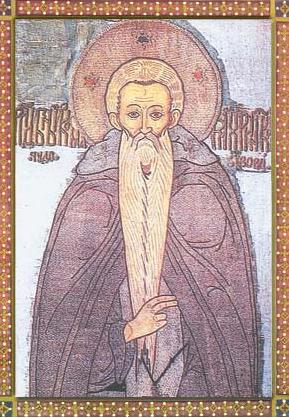 Saint Cosmas of Yakhrom
Saint Cosmas of Yakhrom was the servant of a certain nobleman, whom he comforted during his prolonged illness by reading him books. And so, travelling from city to city, they happened to stop at the River Yakhroma. Here in the woods an icon of the Dormition of the Most Holy Theotokos appeared to Cosmas, and he heard a voice commanding him to become a monk and to build a monastery. His sick master then received healing from the icon, and Cosmas went to Kiev, where he was tonsured in the Monastery of the Caves. Then with the icon of the Mother of God, and on an inspiration from above, he again went to Yakhrom, 40 versts from the city of Vladimir, constructing a temple in honor of the Dormition of the Most Holy Theotokos with the help of some good Christians. Brethren began to gather around the monk, and a monastery was formed. St. Cosmas was chosen as igumen. During this time, word of the monk’s ascetic struggles reached even the Great Prince. St. Cosmas died at an advanced old age on February 18, 1492, and was buried in the monastery he founded. His memory is celebrated also on October 14, the day that the Yakhrom Icon of the Mother of God is commemorated.