

SAINT GREGORY, BISHOP OF NYSSA
Saint Gregory was the brother of Basil the Great. At first, he was only a presbyter since he was married; but when his wife Blessed Theosevia died, Gregory was chosen and consecrated as bishop of Nyssa. He was distinguished by his great secular learning and spiritual experience. He participated at the Second Ecumenical Council (Constantinople, 381 A.D). It is thought that he composed the second half of the Symbol of Faith [The Creed]. He was a great orator, an exegete of Holy Scripture and a theologian. Because of their defeat, the Arians especially attacked him as their worst enemy, so that, during the reign of Emperor Valens, their ally of the same mind, succeeded in ousting Gregory from the episcopal throne and banished him into exile. This Holy Father spent eight years in exile, patiently enduring all miseries and all humiliations. He finally died in old age toward the end of the fourth century and was translated into the Kingdom of God remaining on earth throughout the ages as a great beacon of the Church.
THE VENERABLE AMMON, EPYPTIAN ASCETIC
For fourteen years, Ammon prayed to God and struggled to conquer anger within himself. He attained such perfection of goodness, that he was not even conscious that evil existed in the world. He was particularly knowledgeable in Holy Scripture. He died at the beginning of the fifth century.
 SAINT MARCIAN
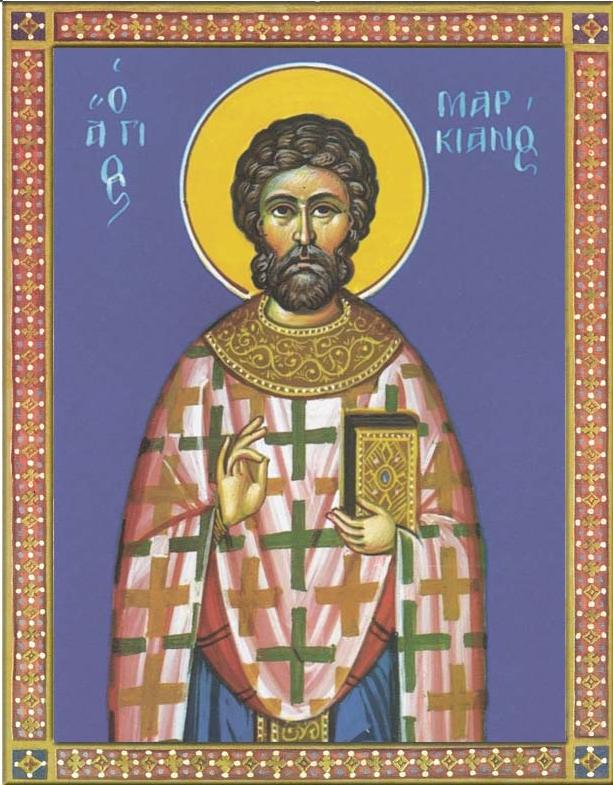
Saint Marcian was born in Rome. As a presbyter, he lived the remainder of his life in Constantinople during the greater part of the reign of Emperor Marcian and Empress Plucheria. Inheriting enormous wealth from his parents, Marcian generally spent it on two goals: either on building or restoring churches or on charity for the poor. He built two new churches in Constantinople, St. Anastasia and St. Irene, both famous for their beauty and sacredness. When he was asked, “Why do you spend so much on churches?” He replied, “If I had a daughter and wanted to marry her to a nobleman, would I not spend much gold in order to adorn her as a worthy bride? And, here I am adorning the Church, the Bride of Christ.” As much as this wonderful man was generous toward the churches and the indigent; so much was he austere, very austere toward himself following the apostolic exhortation: “If we have food and clothing, we shall be content with that” (I Timothy 6:8). It is written about him: “He was totally in God and God in him, and presented himself to God in fullness of years and good works,” in the year 471 A.D.
Saint Paul of Obnora
Saint Paul of Obnora, a famed disciple of St. Sergius of Radonezh, was born at Moscow in the year 1317. From his youth he distinguished himself by his piety and kindliness towards the poor and suffering. His rich parents prepared him for a secular life, but at twenty-two years of age he secretly left his parental home and received tonsure at the Nativity monastery on the Volga (in the Yaroslav diocese). From there Paul transferred to the Holy Trinity monastery to St. Sergius of Radonezh, spending several years with him as his disciple, obeying the holy Elder in all things. With the blessing of St. Sergius, he settled a short distance from the monastery in a separate cell, where he spent fifteen years as a hermit. Having asked the blessing of St. Sergius to go off into the wilderness for a quiet and solitary life, St. Paul wandered about for a long while, seeking a place of solitude. He wandered a great deal in the wilderness. He spent time with St. Abraham of Chukhloma and finally, he remained in the Komel forest. At the Gryazovitsa River, in the hollow of an old linden tree, the monk built a small cell and dwelt there for three years in complete silence, “not giving his body rest, that he might receive future rest.” Then he moved on to the River Nurma, where he built a hut and dug a well, spending his days in vigil and prayer. Five days out of the week he went without food, and only on Saturday and Sunday did he partake of some bread and water. The news about the hermit spread abroad, and those wishing spiritual guidance began coming to him. Despite his love for the solitary life, St. Paul never refused anyone spiritual consolation and guidance. He was also visited by St. Sergius of Nurma, who sought solitude with the blessing of St. Sergius of Radonezh, and who also spent his ascetic life in these places. With the blessing of St. Sergius and the agreement of Metropolitan Photios, St. Paul built the Holy Trinity church in 1414, around which a monastery sprang up (later called the Monastery of St. Paul of Obnora). Having written a strict monastic Rule for the brethren, St. Paul entrusted the guidance of the new monastery to his disciple Alexei, while he himself continued as before to live in a solitary cell on a hill. He remained a responsive and good counsellor for anyone needing his help. St. Paul died at 112 years of age. His final words were, “Brethren, have love one for another and keep to the rule of the monastic community.” The Life of the saint was written in about the year 1546, and his glorification occurred in 1547.