

 VENERABLE GEORGE THE CHOZIBITE
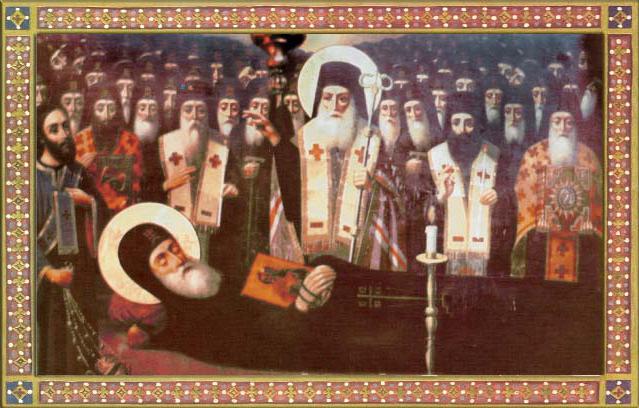
Saint George lived an ascetical life in the seventh century in Choziba Monastery in Jericho on the road from Jerusalem, the monastery where the Venerable John Chozibite first led an ascetical life.
SAINT DOMNICA
During the reign of Emperor Theodosius, Domnica, unbaptized, came from Carthage to Constantinople with four other pagan maidens. Patriarch Macarius baptized them and gave his blessing to them to live as nuns. With great zeal, St. Domnica gave herself up to a life of asceticism and in that zeal did not waver until her death in extreme old age. She died in the Lord about 474 A.D. She was so enlightened by the Holy Spirit that she was able to discern events in the future and through prayer to work miracles.
THE HOLY MARTYRS JULIAN AND BASILISSA
Julian and Basilissa were of noble and wealthy parents. United in marriage, they vowed to live chastely as brother and sister. They distributed all of their property to the poor and both were tonsured. Julian founded a monastery and Basilissa founded a convent. Julian had about ten-thousand monks and Basilissa about a thousand nuns. When a terrible persecution began under Diocletian, Basilissa implored God that none of her nuns would become frightened of the tortures and would not fall away from the Orthodox Faith. The Lord heard the prayers of His worthy handmaiden and, in the course of six months, received unto Himself all the nuns, one by one and finally their abbess Basilissa. Before her death, Basilissa had a vision of her sisters [nuns] from the other world. To her, all of them appeared to her radiant and joyful as angels of God and beckoned their spiritual mother to come to them as soon as possible. Unlike Basilissa’s convent, Julian’s monastery was set ablaze by the persecutors and Julian was inhumanly tortured and died from the most difficult sufferings. During his tortures, the Lord watched over him and strengthened him so that he heroically endured, preserved his Faith and glorified the Name of Christ. Beheaded along with Julian were Celsus and Maronilla, the son and wife of the tormentor Marcian, who witnessing Julian’s heroism in suffering and torture, were themselves converted to the Faith of Christ. Also beheaded were twenty Roman soldiers; seven brothers from that town; the presbyter Anthony; and a certain Anastasius, whom Julian at the time of his torture, resurrected from the dead by prayer. All suffered honorably for Christ and became citizens of the heavenly kingdom about the year 313 A.D.
THE VENERABLE AGATHON
Agathon was a great Egyptian ascetic who practiced extreme asceticism in the fifth century. He was a contemporary of St. Macarius and a disciple of St. Lot [Egyptian Ascetic]. He labored and tried to fulfill all the commandments of our Lord. One of the brethren complimented him on a small knife with which he used to cut brushwood used for making baskets. Upon hearing this compliment, the saint joyfully handed over the knife to that brother as a gift. St. Agathon also said, “It would be very satisfying for me if I could assume unto myself the body of a leper and give him mine.” Is this not perfect love?
SAINT GREGORY, BISHOP OF OHRID
Gregory was a devout teacher and shepherd of Christ’s flock. He died in the year 1012 A.D. In one of the inscriptions in the Church of St. Sophia in Ohrid, he is referred to as “Gregory, the all-wise.”
Hieromartyr Isidore
Hieromartyr Isidore was priest of St. Nicholas church in the city of Yuriev (Derpto, at present Taru in Estonia). According to the terms of a treaty concluded in 1463 between the Moscow Great Prince Ivan III and the Livonian knights, the latter were obligated to extend every protection to the Orthodox at Derpto. But the Livonian knights (who were German Catholics) broke the treaty and tried to force the Orthodox to become Roman Catholics. The priest Isidore bravely stood forth in defense of Orthodoxy, preferring to accept a martyr’s crown rather than submit to the Catholics. The Latin bishop and the Roman Catholic nobles of Yuriev had been told that St. Isidore and the Orthodox population of the city had spoken against the faith and customs of the Germans. When St. Isidore and seventy-two of his parishioners went to bless the waters of the River Omovzha (or Emaiyga, now Emajogi) for the Feast of Theophany, they were arrested and brought before the Latin bishop Andrew and the civil judges of the city. Pressure was brought on them to convert to Catholicism, but the saint and his flock refused to renounce Christ or the Orthodox Faith. Enraged by this, the authorities had them thrown into prison. St. Isidore encouraged his flock to prepare themselves for death, and not to fear torture. He partook of the reserved Gifts he carried with him, then communed all the men, women, and children with the Holy and Life-Giving Mysteries of Christ. Then the bishop and the judges summoned the Orthodox to appear before them once more, demanding that they convert to Catholicism. When they refused to do so, they were dragged back to the river and pushed through the hole in the ice that they had cut to bless the water. So they all suffered and died for Christ, Who bestowed on them crowns of unfading glory. During the spring floods, the incorrupt bodies of the holy martyrs, including the fully-vested body of the hieromartyr Isidore, were found by Russian merchants journeying along the river bank. They buried the saints around the church of St. Nicholas. Although people began to venerate these saints shortly after their death, they were not officially glorified by the Church until 1897.