

 THE HOLY MARTYRS PROCLUS AND HILARIUS
These holy martyrs were born in Kallippi in Asia and Proclus was the uncle of Hilarius. They were martyred during the reign of Trajan. “What is your lineage?” the judge inquired of Proclus. Proclus answered: “My lineage is Christ and my hope is my God.” When the judge threatened him with tortures, Proclus said: “When you are afraid to transgress the orders of the emperor in order not to fall into temporal sufferings, how much more are we Christians afraid to transgress the commandment of God so that we may not fall into eternal sufferings!” While they were torturing Proclus, Hilarius came before the judge and said: “I also am a Christian!” After much suffering, they were both sentenced to death: Proclus was crucified on a cross and Hilarius was beheaded. Both entered into the joy of their Lord.
THE VENERABLE MICHAEL OF MALEINOS
Michael was a wealthy man of noble birth. Rejecting earthly goods in his youth, he withdrew to Mt. Malea, near Mt. Athos, where he lived a life of asceticism, purifying his heart through fasting and prayer. Later on, he had many disciples, of which the most prominent was St. Athanasius the Athonite. Michael died peacefully about the year 940 A.D.
THE HOLY FEMALE MARTYR GOLINDUC [MARY]
Golinduc was a Persian by birth. She entered into marriage with a Persian sage and lived three years in the marital state. She then had a vision of angels who showed her the other world: the torments of sinners and the unbelievers and the joy of the righteous. After this, she left her husband and was baptized. At baptism, she received the name of Mary. Persecuted by her husband, she was sentenced to prison for life. She was imprisoned for eighteen years and remained steadfast in her faith. After this, she was thrown into a pit with a terrible snake but God saved her and the snake did not harm her. When evil young men were sent to defile her, God made her invisible to their eyes. Astonished at her sufferings, many Persians embraced the Faith of Christ. She visited Jerusalem where she denounced the Severian heresy, which taught that the divine nature in Christ suffered for which they read the Trisagion [TrisvjatojeThe ThriceHoly Hymn] in the following form: “Holy God, Holy Mighty, Holy and Immortal crucified for us, have mercy on us.” Finally, after preaching the True Faith, she peacefully died near the city of Nisibus in the year 587 A.D.
SAINT VERONICA
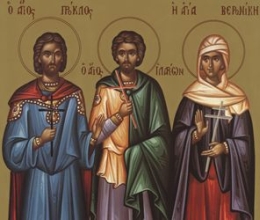
Veronica is the woman with the issue of blood whom the Lord healed. “And, behold, a woman, which was diseased with an issue of blood twelve years, came behind Him, and touched the hem of His garment” (St. Matthew 9:20). Out of gratitude to the Lord her Healer, Veronica ordered a statue of the Lord Jesus be made for her before which she prayed to God. According to tradition, this statue was preserved until the reign of Emperor Julian the Apostate who altered the statue into an idol of Zeus. This is one of the rarest instances that statues of saints were used in the Eastern Church. As is known, the latter became a common practice in the Western Church. Saint Veronica remained faithful to the Faith of Christ until death and died peacefully.
THE HOLY MARTYRS THEODORE AND JOHN
Theodore and John were father and son, and by descent Varangians (Vikings) who were baptized and then settled in the pagan city of Kiev. The enraged pagans destroyed their home with them in it and, thus, both suffered for Christ. Their relics repose in the monastery of the Caves of Anthony in Kiev. Those without children and those who miscarry invoke their intercession.