

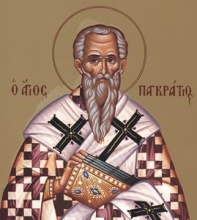
 THE PRIESTLY-MARTYR PANCRATIUS [PANCRAS] THE BISHOP OF TAORMINA
Among the many who made the journey to Jerusalem to hear the words of Jesus Christ were the parents of an only child whose name, Pankratios, is too little known, despite the fact that not only did he commit himself to Jesus Christ as a boy, but as he grew to manhood, he became a missionary and confidant of the two mightiest saints of Christianity, Sts. Peter and Paul. The parents of the boy, who was to join the company of saints with whom he served the Messiah, made a journey on foot from ancient Antioch to Jerusalem that altered the course of their lives, making devout Christians of the parents and of the son a true servant of the Lord. Pankratios had come of age when the Messiah was crucified, and although there is no record that he enjoyed the company of the living Christ, he did pledge himself to what was then called the New Faith of the Nazarenes and went forth to preach with a missionary zeal that soon enough drew him to the attention of St. Peter. Pankratios and his parents had the distinction of being baptised by St. Peter who made it a point to visit the family whenever he was in Antioch, a city in which he won so many converts that the name “Christian” supplanted the original Nazarene.Pankratios was assisted in his missionary work by his father, Markellos, who went so far as to forsake his enterprises and give all his worldly goods to the poor to help his son in full service to Jesus Christ. Other areas were in greater need of missionaries, and to this end, St. Peter ordained Pankratios bishop of Taormina in distant Sicily, there to serve a predominantly Greek colony that knew little or nothing about Jesus Christ. Not one to sit back and gaze out over the sea in contentment, Pankratios preached aboard the ship that carried him to Sicily so that when it made port the vessel’s chief officers, Lykaonides and Romulus, were confirmed Christians who made it their business to let every seafarer they could reach hear about the faith of Jesus Christ. The ship had no sooner docked than Pankratios disembarked and set about the Lord’s business in a hurry and never slackened his pace until his untimely and brutal death. It was during his ministry in spiritually darkened Sicily that Pankratios met the magnificent St. Paul, considered by most to be the greatest apostle of Christianity. No higher tribute could have been paid a fellow Christian than to receive the plaudits of St. Paul who commended Pankratios for his most impressive work in introducing Christianity to islanders who for too long had not only been isolated from the mainland but from God’s light as well. To convert hidebound pagans of that area, known for their deep seated resentment for mainland intruders into very devout Christians was no small task, but the pagan priests were no match for Pankratios who saw to the rapid elimination of ritualistic temples replaced by the churches of Jesus Christ. Pankratios had a formidable ally in the magistrate, Bonafatios, whom he had converted to Christianity, in gratitude for which the magistrate enlisted a whole host of labourers whom he supervised in the erection of a new Christian church, a feat accomplished in a thirty- day period. The very sight of this church which seemed to have mushroomed from out of the the earth was awe-inspiring enough to win converts, and the great joy of Pankratios knew no bounds, earning him the respect of even those who hesitated to join the ranks of Christians. It seems that the Messiah had no sooner departed this earth than there started to appear false prophets here and there and, unfortunately for Pankratios, one such rabble rouser emerged to set himself up as a spurious spiritual leader, finding followers among the hesitant and the easily misled. This affront to God was named Montanos, reputed to have been a Christian priest, perhaps gone mad, whose fanatical followers come to be known as Montanists clinging to the utterances of this chief much as did that unfortunate band in Guyana twenty centuries later. Driven by their leader not to destroy themselves but to destroy Pankratios, the envy of Montanos, a group of assassins stormed into the Church of Pankratios and brutally murdered him. The courageous bishop of Sicily gave his life for Christ on July 9.
THE PRIESTLY-MARTYR CYRIL, BISHOP OF GORTINA IN CRETE
As an eighty-four year old man, Cyril suffered for Christ during the reign of Decius. He was thrown into fire but was saved by the Providence of God. Then the judge issued the following sentence: “Cyril, who was delivered from the fire, just judgment cannot tolerate him among the living, therefore, I am ordering him to be slain by the sword.” With joy did the holy elder place his head under the sword and was beheaded to live eternally in the Kingdom of Christ.
THE VENERABLE MARTYRS PATERMUTHIUS AND COPRES
Emperor Julian the Apostate tortured Patermuthius and Copres. Patermuthius was seventy-five years old and Copres was forty-five years old. The emperor succeeded in turning Copres away from the Faith of Christ and persuaded him to embrace the idols. The apostate Copres cried out: “I am Julian’s, not Christ’s.” But when the aged Patermuthius rebuked him and reminded him of eternal torments, Copres came to his senses and cried out before the emperor: “I am Christ’s and not Julian’s.” Both were beheaded. Also beheaded with them was Alexander, one of the emperor’s soldiers who, witnessing their bravery in suffering, became a Christian. They honorably suffered for Christ and to Christ they went in the year 361 A.D.
SAINT THEODORE, BISHOP OF EDESSA AND OTHERS WITH HIM
At age twenty, Theodore was tonsured a monk and spent thirty-six years as a monk. During the reign of Emperor Michael and Empress Theodora, Theodore was elected as bishop of Edessa. He died in the year 848 A.D. Along with him is also mentioned his teacher, St. Theodosius the Syrian Stylite, his brother St. John the Hermit and St. Ader, a wealthy nobleman who left his wife and was tonsured a monk.