

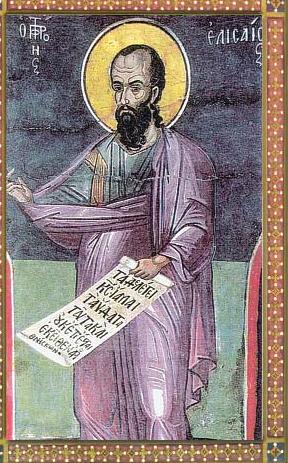
 THE HOLY PROPHET ELISHA
Elisha lived nine hundred years before Christ. When the Lord willed to take the aged Prophet Elijah to Himself, He revealed to him that He had designated Elisha, the son of Shaphat of the tribe of Reuben from the town of Abel-Meholah, as his successor in the prophetic service. Elijah informed Elisha of God’s will and draped him with his mantle and implored from God the two-fold grace of prophecy for him. Elisha immediately departed his home and family and followed Elijah. When the Lord took Elijah in a fiery chariot, Elisha remained to continue the prophetic service with yet a greater power than Elijah. By his purity and zeal, Elisha was equal to the greatest prophets and, by the miraculous power that was given to him by God, Elisha exceeded them all. He parted the waters of the Jordan as Moses once parted the Red Sea; the bitter waters in Jericho he made drinkable; he brought forth water into the excavated trenches during the war with the Moabites; he multiplied the oil in the pots of the poor widow; he resurrected the dead son of the Shunammite woman; he fed a hundred people with twenty small loaves of bread; he healed Commander Naaman of leprosy; he invoked leprosy upon his servant Gehazi because of his greed; he blinded the entire Syrian army and also forced another army to flee; he foretold many events to the people as well as to individuals. Elisha died at a very old age.
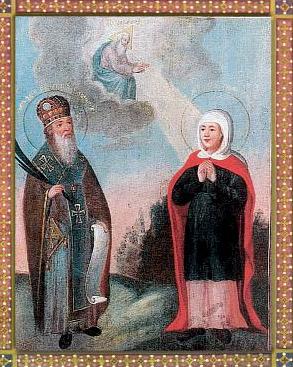 SAINT METHODIUS, PATRIARCH OF CONSTANTINOPLE
Methodius was born in the town of Syracuse in Sicily. After the completion of his secular studies, he was tonsured a monk and began to live a life of asceticism in a monastery. Patriarch Nicephorus took him into his service. During the reign of the iconoclastic emperors, he became widely known as a superb defender of the veneration of icons. For this, the wicked Emperor Theophilus exiled him to an island with two common criminals where he languished in a damp prison for seven years without light and without sufficient food as though in a grave. During the time of the pious Empress Theodora and her son Michael, Methodius was freed and was chosen as patriarch (according to an earlier prophecy of St. Joannicius the Great). The first week of the Great Fast [Lenten Season] Methodius solemnly carried the icons into the church and wrote a Canon in honor of icons. Unable to outwit him, the vile heretics hired a woman who declared that the patriarch had an impure relationship with her. The whole of Constantinople was horrified at this slander. Nevertheless, not knowing how he could otherwise prove his innocence, the patriarch overcame his embarrassment, removed his clothes and stood naked before the court which he himself had requested, and showed his withered body, debilitated from fasting. The court was clearly convinced that the patriarch had been slandered. Hearing of this, the people rejoiced and the heretics were shamed. Then, the woman admitted that she was persuaded and paid to bring this slander against the saint of God. Thus, those who thought to bring shame upon Methodius unintentionally increased his fame. This great confessor of the Faith died peacefully in the year 846 A.D. and took up habitation in the Kingdom of God.
SAINT JOHN, METROPOLITAN OF EUCHAITA
John was surnamed Mavron “The Black.” He was a very educated man and, at the same time, a spiritual man. At the time of Emperor Alexius Comnenis, John in his old age, became the metropolitan of Euchaita. He is especially famous in that St. Basil, St. Gregory the Theologian and St. John Chyrsostom (January 30) appeared and explained to him how all three of them are equally glorified in heaven. After this vision the dispute among the people concerning who of the three saints was greater and who was lesser was quieted down. St. John also wrote the famous Canon to the Most Sweet Jesus and a Canon to the Guardian angel and, in addition to this, other beneficial writings. He died peacefully in the year 1100 A.D.
VENERABLE NIPHON
Niphon was born in the region of Argyrokastron in the village of Lukov. He was the son of a priest. From his youth he was attracted to solitude and prayer. That desire finally led him to Mt. Athos where he lived a life of asceticism, at first in the cave of St. Peter the Athonite and, after that, in the wilderness of St. Anne. He did not even want to eat bread but fed on vegetation and roots. Some envious ones accused him of loathing bread and from this accusation he easily and quickly justified himself. Finally, he became associated with St. Maximus of Kapsokalyvia. Because of his sincere love for God, Niphon was endowed with the gift of miracle-working and discernment. He healed the sick by his prayer and by anointing with oil and discerned events which had occurred and which will take place. About himself he prophesied that he would die during the Fast of Saint Peter [This fast precedes the feast of Saints Peter and Paul]. When the day of his death dawned, he said to the brethren assembled around him: “Do not weep, rather rejoice, for in me you will have an intercessor before God for your salvation.” Finally, he said: “It is time for me to depart” and he gave up his holy soul to God on June 14, 1330 A.D.