

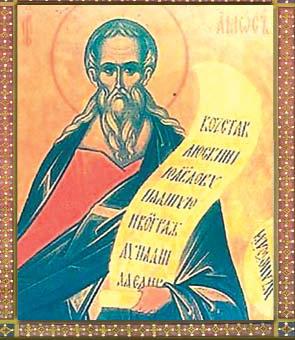
 THE HOLY PROPHET AMOS
Amos was born in the village of Thecua near Bethlehem. He was of simple origin and life. Amos was a swine herdsman for a wealthy man of Jerusalem. But God Who does not look at who is who by his outward appearances but rather by the purity of his heart, and Who took both Moses and David from their sheep, and appointed them as leaders of the people, chose this Amos as one of His prophets. He rebuked King Uzziah and his pagan priests for idolatry and dissuaded the people from worshipping the golden calves in Bethel, teaching them to worship the One Living God. When the chief pagan priest persecuted Amos, he prophesied that the Assyrians will conquer Israel, that they will slay the king and the sons of Amaziah and that the Assyrian soldiers will defile Amaziah’s wife before his eyes because he led the people into adultery with idols. All of this materialized. The son of a pagan priest struck the prophet on the forehead with his staff so forcefully that Amos fell. Barely alive, Amos was brought to his village of Thecua where he surrendered his holy soul to God. Amos lived in the eighth century before Christ.
THE HOLY MARTYRS VITUS, MODEST AND CRESCENTIA
St. Vitus was born in Sicily of famous but non-believing parents. Modest was his teacher and Crescentia was his governess. St. Vitus was baptized at an early age and, at the age of twelve, withdrew to live a life of great mortification. Angels appeared to him, directed and strengthened him in his mortification and he, himself, was as radiant and beautiful as an angel of God. The hand of a judge who beat him withered but Vitus healed his hand through prayer. Seeing twelve radiant angels in his room “whose eyes were as stars and whose faces were as lightning,” his father was blinded. Vitus, through prayer, restored his sight. When his father wanted to kill him, an angel appeared to Vitus and took him together with Modest and Crescentia to Lucania on the shore of the river Silaris. Here, Vitus worked many miracles over the infirm and the insane. At the request of Emperor Diocletian, Vitus traveled to Rome where he expelled an evil demon from the emperor’s son for which the emperor did not reward him but, on the contrary, cruelly tortured him because he would not worship the dumb idols. However, the Lord delivered him from all torments and by His invisible hand translated him again to Lucania where he, Modest and Crescentia presented themselves to the Lord. The relics of St. Vitus are located in Prague, the Czech Republic.
THE VENERABLE MARTYR DOULAS
Doulas lived a holy life in a monastery in Egypt. One of his brethren, out of envy, accused him of sacrilege, the stealing of ecclesiastical articles. They removed the cassock from the innocent Doulas and turned him over to the prince for trial. The prince ordered him to be scourged and wanted to cut off his hands according to the law for such a crime but, at that moment, that brother repented and declared the innocence of Doulas. After twenty years of exile and humiliation, Doulas was restored to the monastery and, on the third day, reposed in the Lord. His body vanished in a miraculous way.
THE HOLY MARTYR LAZAR [LAZARUS], SERBIAN PRINCE
Lazar was one of the Serbian noblemen who ruled the Serbian empire after the death of Tsar Dushan. After the death of Tsar Urosh, Patriarch Ephrem crowned Lazar as the Serbian king. Lazar sent a delegation to Constantinople with the monk Isaiah to implore the patriarch to lift [remove] the anathema from the Serbian people. He fought against the Turkish powers on several occasions. Finally, he clashed [fought] on the Field of Blackbirds [Kosovo Polje] on June 15, 1389 A.D. against the Turkish Emperor Amurat where he was beheaded. His body was translated and interred in Ravanica, his memorial church [Zaduzbina] near Cuprija and later was translated to Ravanica in Srem and from there, during the Second World War (1942) was translated to Belgrade and placed in the Cathedral Church of the Holy Archangel Michael where it rests today incorrupt and extends comfort and healing to all those who turn to him with prayer. [In 1989, on the occasion of the six-hundred year anniversary of his martyrdom, St. Lazar’s relics were again translated to the monastery of Ravanica in Cuprija]. St. Lazar restored the monasteries of Hilendar [Mt. Athos] and Gornjak. He built Ravanica and Lazarica [in Krusevac] and was a benefactor of the Russian monastery St. Pantaleon [Mt. Athos] as well as many other churches and monasteries.
SAINT EPHREM, SERBIAN PATRIARCH
As the son of a priest, Ephrem from an early age yearned for a spiritual and ascetical life. He fled to Mt. Athos when his parents wanted him to marry. Later, he returned and lived a life of asceticism in the Ibar gorge and in the monastery of Decani [Kosovo]. When rivalry and war broke out concerning precedence in the State and, unfortunately even in the Church, the Assembly [Sabor] chose Ephrem to succeed the deceased Sava as patriarch in 1375 A.D. When he was informed of his election, he wept bitterly but was unable to refuse. He crowned Prince Lazar as Tsar in 1382 A.D., renounced his throne and turned it over to Spiridon and again withdrew to the wilderness. Following the death of Spiridon in 1388 A.D., Tsar Lazar begged him to accept the throne again. He governed the Serbian Church in the difficult time of the defeat at Kosovo [1389 A.D.] until 1400 A.D. when he died in the eighty-eighth year of his earthly life and took up habitation with the Lord Whom he loved. His relics repose in the monastery of Pec [Kosovo].
BLESSED AUGUSTINE, THE BISHOP OF HIPPO
Augustine turned from paganism to Christianity, thanks to the counsels, tears and prayers of his mother Monica. He was a great teacher of the Church and an influential writer but with certain unapproved extremes in his teaching. As bishop of Hippo, he glorified the Lord for thirty-five years and lived a total of seventy-six years on earth (354-430 A.D.).
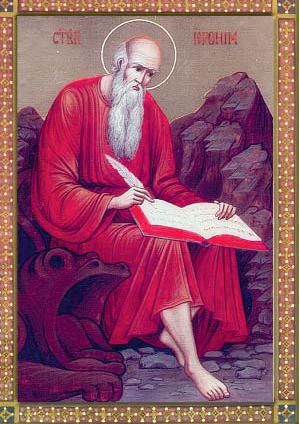 SAINT JEROME (HIERONYMUS)
Saint Jerome born at Stridon, a town on the confines of Dalmatia and Pannonia, about the year 340-2; died at Bethlehem, 30 September, 420. He went to Rome, probably about 360, where he was baptized, and became interested in ecclesiastical matters. From Rome he went to Trier, famous for its schools, and there began his theological studies. Later he went to Aquileia, and towards 373 he set out on a journey to the East. He settled first in Antioch, where he heard Apollinaris of Laodicea, one of the first exegetes of that time and not yet separated from the Church. From 374-9 Jerome led an ascetical life in the desert of Chalcis, south-west of Antioch. Ordained priest at Antioch, he went to Constantinople (380-81), where a friendship sprang up between him and St. Gregory of Nazianzus. From 382 to August 385 he made another sojourn in Rome, not far from Pope Damasus. When the latter died (11 December, 384) his position became a very difficult one. His harsh criticisms had made him bitter enemies, who tried to ruin him. After a few months he was compelled to leave Rome. By way of Antioch and Alexandria he reached Bethlehem, in 386. He settled there in a monastery near a convent founded by two Roman ladies, Paula and Eustochium, who followed him to Palestine. Henceforth he led a life of asceticism and study; but even then he was troubled by controversies which will be mentioned later, one with Rufinus and the other with the Pelagians.
The literary activity of St. Jerome, although very prolific, may be summed up under a few principal heads: works on the Bible; theological controversies; historical works; various letters; translations. But perhaps the chronology of his more important writings will enable us to follow more easily the development of his studies. A first period extends to his sojourn in Rome (382), a period of preparation. From this period we have the translation of the homilies of Origen on Jeremias, Ezechiel, and Isaias (379-81), and about the same time the translation of the Chronicle of Eusebius; then the “Vita S. Pauli, prima eremitae” (374-379). A second period extends from his sojourn in Rome to the beginning of the translation of the Old Testament from the Hebrew (382-390). During this period the exegetical vocation of St. Jerome asserted itself under the influence of Pope Damasus, and took definite shape when the opposition of the ecclesiastics of Rome compelled the caustic Dalmatian to renounce ecclesiastical advancement and retire to Bethlehem. In 384 we have the correction of the Latin version of the Four Gospels; in 385, the Epistles of St. Paul; in 384, a first revision of the Latin Psalms according to the accepted text of the Septuagint (Roman Psalter); in 384, the revision of the Latin version of the Book of Job, after the accepted version of the Septuagint; between 386 and 391 a second revision of the Latin Psalter, this time according to the text of the “Hexapla” of Origen (Gallican Psalter, embodied in the Vulgate). It is doubtful whether he revised the entire version of the Old Testament according to the Greek of the Septuagint. In 382-383 “Altercatio Luciferiani et Orthodoxi” and “De perpetua Virginitate B. Mariae; adversus Helvidium”. In 387-388, commentaries on the Epistles to Philemon, to the Galatians, to the Ephesians, to Titus; and in 389-390, on Ecclesiastes. Between 390 and 405, St. Jerome gave all his attention to the translation of the Old Testament according to the Hebrew, but this work alternated with many others. Between 390-394 he translated the Books of Samuel and of Kings, Job, Proverbs, Ecclesiastes, the Canticle of Canticles, Esdras, and Paralipomena. In 390 he translated the treatise “De Spiritu Sancto” of Didymus of Alexandria; in 389-90, he drew up his “Quaestiones hebraicae in Genesim” and “De interpretatione nominum hebraicorum.” In 391-92 he wrote the “Vita S. Hilarionis”, the “Vita Malchi, monachi captivi”, and commentaries on Nahum, Micheas, Sophonias, Aggeus, Habacuc. In 392-93, “De viris illustribus”, and “Adversus Jovinianum”; in 395, commentaries on Jonas and Abdias; in 398, revision of the remainder of the Latin version of the New Testament, and about that time commentaries on chapters xiii-xxiii of Isaias; in 398, an unfinished work “Contra Joannem Hierosolymitanum”; in 401, “Apologeticum adversus Rufinum”; between 403-406, “Contra Vigilantium”; finally from 398 to 405, completion of the version of the Old Testament according to the Hebrew. In the last period of his life, from 405 to 420, St. Jerome took up the series of his commentaries interrupted for seven years. In 406, he commented on Osee, Joel, Amos, Zacharias, Malachias; in 408, on Daniel; from 408 to 410, on the remainder of Isaias; from 410 to 415, on Ezechiel; from 415-420, on Jeremias. From 401 to 410 date what is left of his sermons; treatises on St. Mark, homilies on the Psalms, on various subjects, and on the Gospels; in 415, “Dialogi contra Pelagianos”.
St. Jerome owes his place in the history of exegetical studies chiefly to his revisions and translations of the Bible. Until about 391-2, he considered the Septuagint translation as inspired. But the progress of his Hebraistic studies and his intercourse with the rabbis made him give up that idea, and he recognized as inspired the original text only. It was about this period that he undertook the translation of the Old Testament from the Hebrew. But he went too far in his reaction against the ideas of his time, and is open to reproach for not having sufficiently appreciated the Septuagint. This latter version was made from a much older, and at times much purer, Hebrew text than the one in use at the end of the fourth century. Hence the necessity of taking the Septuagint into consideration in any attempt to restore the text of the Old Testament. With this exception we must admit the excellence of the translation made by St. Jerome. His commentaries represent a vast amount of work but of very unequal value. Very often he worked exceedingly rapidly; besides, he considered a commentary a work of compilation, and his chief care was to accumulate the interpretations of his predecessors, rather than to pass judgment on them. The “Quaestiones hebraicae in Genesim” is one of his best works. It is a philological inquiry concerning the original text. It is to be regretted that he was unable to continue, as had been his intention, a style of work entirely new at the time. Although he often asserted his desire to avoid excessive allegory, his efforts in that respect were far from successful, and in later years he was ashamed of some of his earlier allegorical explanations. He himself says that he had recourse to the allegorical meaning only when unable to discover the literal meaning. His treatise, “De Interpretatione nominum hebraicorum”, is but a collection of mystical and symbolical meanings. Excepting the “Commenta rius in ep. ad Galatas”, which is one of his best, his explanations of the New Testament have no great value. Among his commentaries on the Old Testament must be mentioned those on Amos, Isaias, and Jeremias. There are some that are frankly bad, for instance those on Zacharias, Osee, and Joel. To sum up, the Biblical knowledge of St. Jerome makes him rank first among ancient exegetes. In the first place, he was very careful as to the sources of his information. He required of the exegete a very extensive knowledge of sacred and profane history, and also of the linguistics and geography of Palestine. He never either categorically acknowledged or rejected the deuterocanonical books as part of the Canon of Scripture, and he repeatedly made use of them. On the inspiration, the existence of a spiritual meaning, and the freedom of the Bible from error, he holds the traditional doctrine. Possibly he has insisted more than others on the share which belongs to the sacred writer in his collaboration in the inspired work. His criticism is not without originality. The controversy with the Jews and with the Pagans had long since called the attention of the Christians to certain difficulties in the Bible. St. Jerome answers in various ways. Not to mention his answers to this or that difficulty, he appeals above all to the principle, that the original text of the Scriptures is the only one inspired and free from error. Therefore one must determine if the text, in which the difficulties arise, has not been altered by the copyist. Moreover, when the writers of the New Testament quoted the Old Testament, they did so not according to the letter but according to the spirit. There are many subtleties and even contradictions in the explanations Jerome offers, but we must bear in mind his evident sincerity. He does not try to cloak over his ignorance; he admits that there are many difficulties in the Bible; at times he seems quite embarrassed. Finally, he proclaims a principle, which, if recognized as legitimate, might serve to adjust the insufficiencies of his criticism. He asserts that in the Bible there is no material error due to the ignorance or the heedlessness of the sacred writer, but he adds: “It is usual for the sacred historian to conform himself to the generally accepted opinion of the masses in his time” (P.L., XXVI, 98; XXIV, 855). Among the historical works of St. Jerome must be noted the translation and the continuation of the “Chronicon Eusebii Caesariensis”, as the continuation written by him, which extends from 325 to 378, served as a model for the annals of the chroniclers of the Middle Ages; hence the defects in such works: dryness, superabundance of data of every description, lack of proportion and of historical sense. The “Vita S. Pauli Eremitae” is not a very reliable document. The “Vita Malchi, monachi” is a eulogy of chastity woven through a number of legendary episodes. As to the “Vita S. Hilarionis”, it has suffered from contact with the preceding ones. It has been asserted that the journeys of St. Hilarion are a plagiarism of some old tales of travel. But these objections are altogether misplaced, as it is really a reliable work. The treatise “De Viris illustribus” is a very excellent literary history. It was written as an apologetic work to prove that the Church had produced learned men. For the first three centuries Jerome depends to a great extent on Eusebius, whose statements he borrows, often distorting them, owing to the rapidity with which he worked. His accounts of the authors of the fourth century however are of great value. The oratorical consist of about one hundred homilies or short treatises, and in these the Solitary of Bethlehem appears in a new light. He is a monk addressing monks, not without making very obvious allusions to contemporary events. The orator is lengthy and apologizes for it. He displays a wonderful knowledge of the versions and contents of the Bible. His allegory is excessive at times, and his teaching on grace is Semipelagian. A censorious spirit against authority, sympathy for the poor which reaches the point of hostility against the rich, lack of good taste, inferiority of style, and misquotation, such are the most glaring defects of these sermons. Evidently they are notes taken down by his hearers, and it is a question whether they were reviewed by the preacher. The correspondence of St. Jerome is one of the best known parts of his literary output. It comprises about one hundred and twenty letters from him, and several from his correspondents. Many of these letters were written with a view to publication, and some of them the author even edited himself; hence they show evidence of great care and skill in their composition, and in them St. Jerome reveals himself a master of style. These letters, which had already met with great success with his contemporaries, have been, with the “Confessions” of St. Augustine, one of the works most appreciated by the humanists of the Renaissance. Aside from their literary interest they have great historical value. Relating to a period covering half a century they touch upon most varied subjects; hence their division into letters dealing with theology, polemics, criticism, conduct, and biography. In spite of their turgid diction they are full of the man’s personality. It is in this correspondence that the temperament of St. Jerome is most clearly seen: his waywardness, his love of extremes, his exceeding sensitiveness; how he was in turn exquisitely dainty and bitterly satirical, unsparingly outspoken concerning others and equally frank about himself. The theological writings of St. Jerome are mainly controversial works, one might almost say composed for the occasion. He missed being a theologian, by not applying himself in a consecutive and personal manner to doctrinal questions. In his controversies he was simply the interpreter of the accepted ecclesiastical doctrine. Compared with St. Augustine his inferiority in breadth and originality of view is most evident. His “Dialogue” against the Luciferians deals with a schismatic sect whose founder was Lucifer, Bishop of Cagliari in Sardinia. The Luciferians refused to approve of the measure of clemency by which the Church, since the Council of Alexandria, in 362, had allowed bishops, who had adhered to Arianism, to continue to discharge their duties on condition of professing the Nicene Creed. This rigorist sect had adherents almost everywhere, and even in Rome it was very troublesome. Against it Jerome wrote his “Dialogue”, scathing in sarcasm, but not always accurate in doctrine, particularly as to the Sacrament of Confirmation. The book “Adversus Helvidium” belongs to about the same period. Helvidius held the two following tenets:
Mary bore children to Joseph after the virginal birth of Jesus Christ;
from a religious viewpoint, the married state is not inferior to celibacy.
Earnest entreaty decided Jerome to answer. In doing so he discusses the various texts of the Gospel which, it was claimed, contained the objections to the perpetual virginity of Mary. If he did not find positive answers on all points, his work, nevertheless, holds a very creditable place in the history of Catholic exegesis upon these questions. The relative dignity of virginity and marriage, discussed in the book against Helvidius, was taken up again in the book “Adversus Jovinianum” written about ten years later. Jerome recognizes the legitimacy of marriage, but he uses concerning it certain disparaging expressions which were criticized by contemporaries and for which he has given no satisfactory explanation. Jovinian was more dangerous than Helvidius. Although he did not exactly teach salvation by faith alone, and the uselessness of good works, he made far too easy the road to salvation and slighted a life of asceticism. Every one of these points St. Jerome took up. The “Apologetici adversus Rufinum” dealt with the Origenistic controversies. St. Jerome was involved in one of the most violent episodes of that struggle, which agitated the Church from Origen’s lifetime until the Fifth Ecumenical Council (553). The question at issue was to determine if certain doctrines professed by Origen and others taught by certain pagan followers of Origen could be accepted. In the present case the doctrinal difficulties were embittered by personalities between St. Jerome and his former friend, Rufinus. To understand St. Jerome’s position we must remember that the works of Origen were by far the most complete exegetical collection then in existence, and the one most accessible to students. Hence a very natural tendency to make use of them, and it is evident that St. Jerome did so, as well as many others. But we must carefully distinguish between writers who made use of Origen and those who adhered to his doctrines. This distinction is particularly necessary with St. Jerome, whose method of work was very rapid, and consisted in transcribing the interpretations of former exegetes without passing criticism on them. Nevertheless, it is certain that St. Jerome greatly praised and made use of Origen, that he even transcribed some erroneous passages without due reservation. But it is also evident that he never adhered thinkingly and systematically to the Origenistic doctrines. Under these circumstances it came about that when Rufinus, who was a genuine Origenist, called on him to justify his use of Origen, the explanations he gave were not free from embarrassment. At this distance of time it would require a very subtle and detailed study of the question to decide the real basis of the quarrel. However that may be, Jerome may be accused of imprudence of language and blamed for a too hasty method of work. With a temperament such as his, and confident of his undoubted orthodoxy in the matter of Origenism, he must naturally have been tempted to justify anything. This brought about a most bitter controversy with his wily adversary, Rufinus. But on the whole Jerome’s position is by far the stronger of the two, even in the eyes of his contemporaries. It is generally conceded that in this controversy Rufinus was to blame. It was he who brought about the conflict in which he proved himself to be narrow-minded, perplexed, ambitious, even timorous. St. Jerome, whose attitude is not always above reproach, is far superior to him. Vigilantius, the Gascon priest against whom Jerome wrote a treatise, quarrelled with ecclesiastical usages rather than matters of doctrine. What he principally rejected was the monastic life and the veneration of saints and of relics. In short, Helvidius, Jovinian, and Vigilantius were the mouthpieces of a reaction against asceticism which had developed so largely in the fourth century. Perhaps the influence of that same reaction is to be seen in the doctrine of the monk Pelagius, who gave his name to the principal heresy on grace: Pelagianism. On this subject Jerome wrote his “Dialogi contra Pelagianos”. Accurate as to the doctrine of original sin, the author is much less so when he determines the part of God and of man in the act of justification. In the main his ideas are Semipelagian: man merits first grace: a formula which endangers the absolute freedom of the gift of grace. The book “De situ et nominibus locorum hebraicorum” is a translation of the “Onomasticon” of Eusebius, to which the translator has joined additions and corrections. The translations of the “Homilies” of Origen vary in character according to the time in which they were written. As time went on, Jerome became more expert in the art of translating, and he outgrew the tendency to palliate, as he came across them, certain errors of Origen. We must make special mention of the translation of the homilies “In Canticum Canticorum”, the Greek original of which has been lost.