

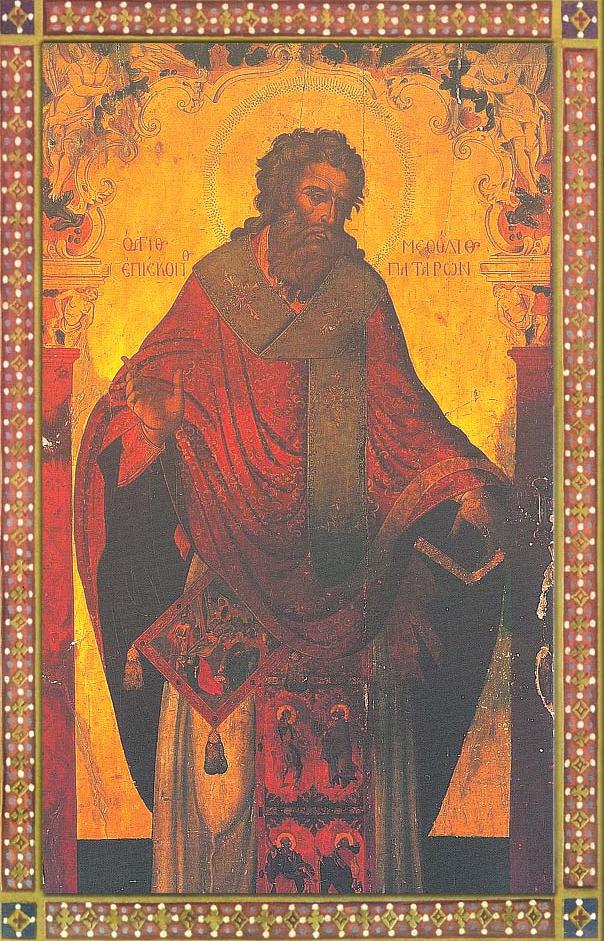
 THE HOLY MARTYR METHODIUS, BISHOP OF PATARA
From his youth, Methodius dedicated himself to asceticism and, as a city on a hill, was seen and summoned to the episcopacy in the city of Patara in Lycia. As a learned and eloquent hierarch, Methodius wrote against the heresy of Origen. His “God-inspired words shown throughout the entire world as lightning.” The pagans rose up against him, tortured him and beheaded him in Chalcis in Syria in the year 311 A.D.
THE HOLY MARTYRS ARISTOCLES, DIMITRIANUS AND ATHANASIUS
Aristocles was a priest of the cathedral church in the town of Tamasus on Cyprus and lived a God-pleasing life. Because of his great zeal for the Faith, Aristocles was made worthy of a voice from heaven instructing him to go to Salamis in Cyprus and to receive the wreath of martyrdom. Dimitrianus the deacon and Athanasius the reader accompanied him. Arriving at Salamis, these men of God began to preach Christ. The pagans seized them and after torturing them, Aristocles was beheaded and Dimitrianus and Athanasius were burned alive in the year 306 A.D.
THE VENERABLE NAHUM OF OHRID
Nahum’s principle feast is celebrated on December 23 and June 20 is his summer feast (Life of St. Nahum December 23). During the summer feast there is a great assembly of people at the monastery of St. Nahum. Many sick people come or are brought to beseech healing through faith and prayer over the relics of the saint. Not only Orthodox people but also those from other faiths come to seek favor from St. Nahum. In 1926, a Muslim from Resna brought and donated a bell to the monastery out of thanksgiving because St. Nahum healed his brother from his deathbed and restored him to life. The donor was Jemail Zizo and his brother, who was healed, was called Suleiman Zizo. Both were prominent citizens of Resna.
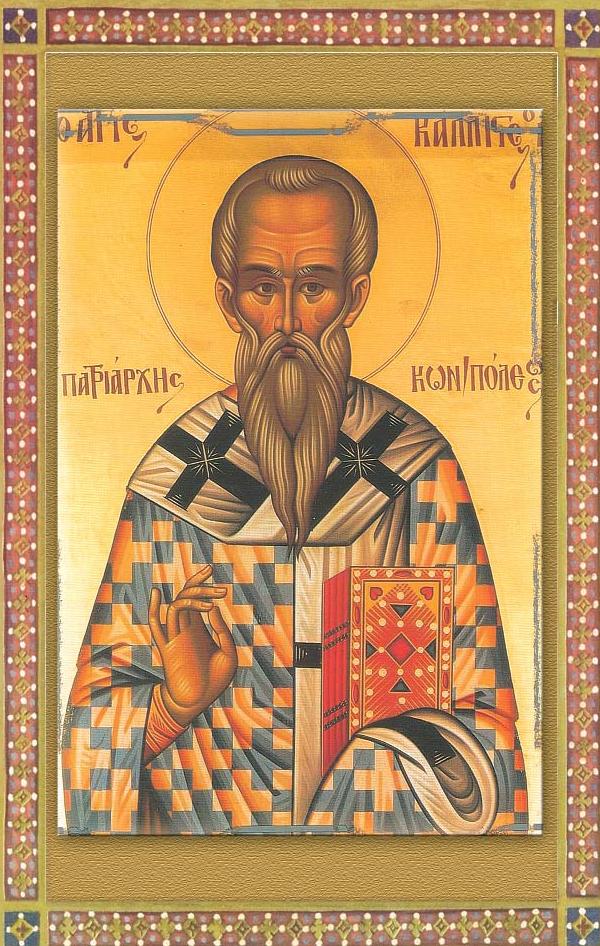 SAINT KALLISTOS I, PATRIARCH OF CONSTANTINOPLE
As a disciple of Gregory Sinaite, Kallistos lived a life of asceticism for twenty-eight years on Mt. Athos in the Scete of Magoula at the monastery Philotheou. He later founded the monastery of St. Mamas. He was elected patriarch of Constantinople in the year 1350 A.D. After four years he withdrew from the patriarchal throne and again returned to Mt. Athos. During the reign of John Paleologus, he was again returned to the throne where, as patriarch, he remained until his death. He died in the year 1368 A.D. enroute to Serres where he traveled to meet the Servian Empress Helena who came to seek help against the Turks. In the company of Ignatius, he complied a beautiful guide [manual] for ascetics. In addition to this, he wrote the hagiography of St. Gregory Sinaite and St. Theodosius of Trnovo as well as numerous homilies. It is interesting to note how St. Maximus of Kapsokalyvia prophesied the death of Patriarch Kallistos. On his way to Serbia, Kallistos traveled through the Holy Mountain. Seeing him, St. Maximus said: “This elder will never see his flock again for behind him is heard the funeral chant: “Blessed are the undefiled in the way’ ” (Psalm 119:1).
SAINT LEUCIUS, BISHOP OF THE CITY OF BRINDISI [ITALY]
Leucius was born in Alexandria and, at the early age, entered a monastery. He was made worthy of great revelations and powerful grace so that he resurrected the dead and drove out demons from men. At first, he was a bishop of Alexandria and, by command from heaven, Leucius crossed over to Italy to the pagan town of Brindisi, which he completely baptized and built a church to the Mother of God. After many and successful labors he took up habitation in eternity during the reign of Emperor Theodosius II, in the fifth century.
BLESSED STUDIOS
Studios was a prominent patrician and consul in Constantinople. He founded the church of St. John the Forerunner near the Golden Gates and a monastery named Studion after him. This monastery became famous for the many glorious men, spiritual fathers, ascetics and many who suffered for the Faith [martyrs], the most famous of which was St. Theodore the Studite. The Latin Crusaders destroyed this monastery in 1204 A.D. but Emperor Constantine Paleologue Porphyrogenitus rebuilt it in the year 1293 A.D. A Turkish mosque stands on that place today.