

Anastasia the patrician of Alexandria
As a lady in waiting in the court of the great Emperor Justinian, the extremely attractive Anastasia very often heard her name called out by the Empress Theodora. This call heard by no one, but felt within this gifted girl, was a loud and clear call of the spirit which came from the highest of authority, the answer to which was made in a fashion that could lead only to sainthood. The entrancing beauty of this noble maiden assured her a place in the royal household which, she had chosen, could have been as commonly known as that of Jezebel or Delilah. Instead she chose to heed the call from above with such resolve that her place is not in the history books where she might have been recorded as an empress who could have helped rule the world. Her place is on the sacred roster of saints, one of many known to so few people but very well known to God. The story of Anastasia’s life is a reversal of the conventional rags to riches theme which makes for interesting reading in the minds of some, but a riches to rags story, by design rather than misfortune, affords far more rewarding reading in the discriminating minds of those who place greater value on a stirring of the spirit than a tickling of the mind. Anastasia was endowed not only with outstanding beauty but with considerable wealth as well, the combination of which made her a coveted prize in her lofty social circle. Her deep Christian faith placed her on a level even higher than that of Emperor Justinian and Empress Theodora, the royal pair responsible for the erection of the awesome Church of Hagia Sophia in Constantinople, as well as the Monastery of St. Catherine at the foot of Mount Sinai. Anastasia’s social position grew to be less a concern for her as her love for Jesus Christ deepened, reaching a point where her absence was noticed at state functions. She abandoned the posturing required at these affairs to kneel in a chapel, therefore secluding herself to study the holy Scriptures in preparation for the calling which subordinated the activities that swirled in her meaningless social circle. Eager to serve the Messiah, Anastasia fled the clamor and intrigue of the royal court, and after converting her assets into cash, she left the city unnoticed and went directly to Alexandria where she was unrecognized. She lost no time in putting her money to good use and built a nunnery second to none in the empire, in which she herself spent many years in becoming a full–time servant of the Lord. When she was not sewing garments for the needy, as well as church materials, she sought seclusion in which she could pray and meditate. She became a highly respected figure in this citadel of Christianity which is still in existence and bears the name of St. Anastasia of Alexandria, Egypt. Following the death of Empress Theodora, the Emperor Justinian decided to remarry and he made it known he wanted as his new bride the girl named Anastasia, who had not escaped his eyes at court and whose memory had not escaped him in the intervening years. Unaware of her actual presence, he sent out representatives to find her, confident that wherever she was and whatever she was doing, she would drop everything for the opportunity to become the empress of the mighty Byzantine Empire. News of the emperor’s search preceded his agents and a distraught Anastasia, long since pledged in chastity to serve the Lord, decided to vanish as she had years before in Constantinople. Bidding a reluctant farewell to her sister nuns, she fled to the desert. She had no wish to be empress, nor could she anticipate Justinian’s reaction has she refused his bidding, but taking no risks, she traveled in the disguise of a monk for fear of recognition, accompanied by Abbot Daniel of Alexandria until she was safely secluded in a spot well off the beaten paths. Alone in this bleak spiritual haven, Anastasia was never to reappear in public, but to the occasional stranger who chanced upon her spiritual retreat, she identified herself as a monk named Anastasios the Eunuch, concealing her lovely features with a false beard when anyone came near. For the next twenty years she lived thus until her final hour was approaching, at which time the Abbot Daniel was summoned to give her final communion and to identify her as the lovely Anastasia who forsook the Byzantine throne for Jesus Christ. She died on March 10.
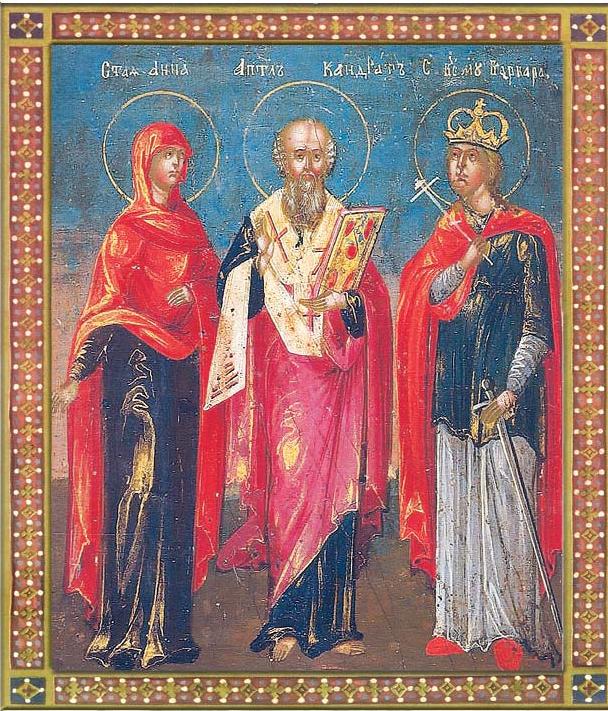 The Martyr Codratus of Corinth, and others with him
In a time of persecution of Christians, many of the faithful fled to the mountains and caves. The mother of this Codratus did so. She was pregnant just at that time, and gave birth to Codratus in a forest, dying almost at once. He was kept safe and fed by the provi-dence of God and his guardian angel. Codratus grew up in solitude with nature. He who gave manna from heaven to the Israelites in the wilderness released a sweet dew from a cloud onto the mouth of the child Codratus. When he was twelve years old, he went down to the town, and there some good people took a fancy to him and educated him. He studied medicine and then began to heal the sick, using both natural medicines and, more importantly, the spiritual power and prayer which had been with him from childhood. When a new persecution arose under Decius, Codratus was taken for trial and thrown into prison. Five of his friends stood beside him and confess-ed the name of Christ. They were: Cyprian, Dionysius, Anectus, Paul and Crescens. They were all dragged through the streets and struck with sticks and stones by the unbelievers, especially by the children, until they arrived at the scaffold. Here the martyrs prayed to God and were beheaded with the sword. A spring of water gushed out onto the earth at the spot, which to this day is called by Codratus’s name and commemorates the heroic death for Christ of the holy six. They suffered with honour for the truth in Corinth in the year 250, in the time of the Emperor Decius and his governor Jason.