

THE HOLY MARTYRS, EUTROPIUS, CLEONICUS AND BASILISCUS
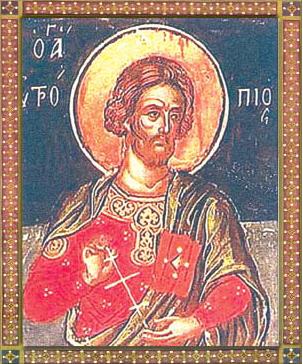
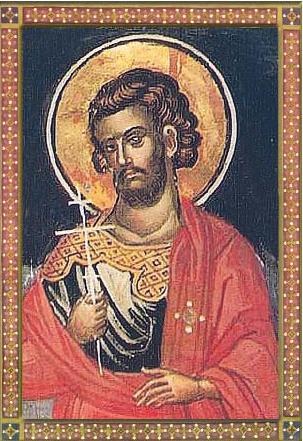 They were companions of St. Theodore Tiro. When the righteous Theodore gloriously died, they remained behind in prison, and for a long time they were not sentenced due to a change in the emperor’s deputy in the city of Amasea. When the new governor arrived, more inhuman than his predecessor, he ordered that these three be brought before him. All three were youths. Eutropius and Cleonicus wereblood brothers, and Basilliscus was a kinsman of St. Theodore. All three were like blood brothers in brotherly love. As such, they said before the governor, “As the Holy Trinity is undivided, so also are we by our faith undivided and in love inseparable.” In vain was all the flattery on the part of the governor and in vain were his attempts to bribe Eutropius. First of all, the deputy invited Eutropius to dine with him. Eutropius refused, quoting from the Psalms, “Happy the man who follows not the counsel of the wicked” (Psalm 1:1). After that, the deputy offered him a large amount of money, one hundred-fifty litres of silver, which Eutropius also refused and reminded the governor that because of silver, Judas lost his soul. After all attempts at interrogation and torture, the first two were sentenced to be crucified, and Basilliscus was sentenced to be beheaded. And so it was, two brothers crucified on two crosses for which they gave thanks to Christ that He made them worthy of the same death by which He Himself died. The third, Basilliscus, was beheaded. They all entered the Kingdom of Joy where St. Theodore, their commander, awaited them and who before them was glorified by Christ the Lord and Victor. They suffered honorably in the year 308 A.D.
SAINT PIAMA THE EGYPTIAN
For the sake of Christ, Piama did not wish to marry; she dedicated herself to a life of asceticism in the home of her mother. She ate very little food, and that, every other day. She spent most of her time in prayer and contemplation. Piama possessed the “Gift of Discernment.” She died peacefully, wedding her soul to the Lord about the year 377 A.D.
THE PRIEST-MARTYR THEODORETUS
The Emperor Constantine built a cathedral church of special beauty in Antioch. The people called this church “the golden church” because of the gold-plated exterior and interior and because of the many appointments of gold and silver housed in it. The emperor donated a great deal of land to this church for the upkeep of the clergy whose number was significant. The custodian of these appointments and all other precious items in the church was the presbyter Theodoretus,(*) and rare devotion. When Julian the Apostate began his reign, he denied Christ and, even though he was baptized, stirred up a persecution against Christians. Julian, his uncle of the same name, came to Antioch and began to plunder the “golden church.” He summoned Theodoretus, the custodian of the treasury, to court and counseled him to deny Christ. Not only did Theodoretus refuse to deny Christ, but he also insulted the Emperor Julian because of his apostasy from the True Faith and his return to idolatry, as a dog returning to his own vomit. When the wicked judge, out of rage, urinated in the “golden church,” St. Theodoretus prophesied a horrible death for him, which shortly happened. Theodoretus was beheaded by an axe for his faith in Christ. From the time that Judge Julian had urinated in the church, he felt pains in the lower part of his body. The entire lower half of his body was eaten away by worms, so that he vomited up his apostate soul in the most horrible pains. Also, according to the prophecy of Theodoretus, Felix, Julian’s assistant, diedof a hemorrhage from the mouth immediately after the beheading of this righteous man. St. Theodoretus was beheaded in the year 362 A.D. and was translated to the All-glorious kingdom of Christ the King.]