

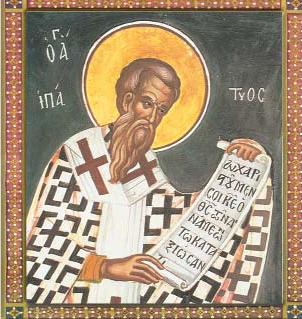
 Hieromartyr Hypatios, Bishop of Gangra
The Hieromartyr Hypatios, Bishop of Gangra, was bishop of the city of Gangra in Paphlagonia (Asia Minor). In the year 325 he participated in the First Ecumenical Council at Nicea, at which the heresy of Arius was anathematized. When St. Hypatios was returning in 326 from Constantinople to Gangra, followers of the schismatics Novatus and Felicissimus fell upon him in a desolate place. The heretics ran him through with swords and spears, and threw him into a swamp. Like the Protomartyr Stephen, St. Hypatios prayed for his murderers. An Arian woman struck the saint on the head with a stone, killing him. The murderers hid his body in a cave, where a Christian who kept straw there found his body. Recognizing the bishop’s body, he hastened to the city to report this, and the inhabitants of Gangra piously buried their beloved archpastor. After his death, the relics of St. Hypatios were famous for numerous miracles, particularly for casting out demons and for healing the sick. From of old the hieromartyr Hypatios was particularly venerated in the Russian land. Thus in the year 1330 the Ipatiev monastery was built at Kostroma, on the place where the Mother of God appeared with the Pre-eternal Christ Child, the Apostle Philip, and the hieromartyr Hypatios, Bishop of Gangra. This monastery later occupied a significant place in the spiritual and social life of the nation, particularly during the Time of Troubles. The ancient copies of the Life of the hieromartyr Hypatios were widely distributed in Russian literature, and one of these was incorporated into THE READING MENAION of Metropolitan Makarios (1542-1564). In this Life there is an account of the appearance of the Savior to St. Hypatios on the eve of the martyr’s death. The entry for the saint’s Feast consists of his Life, some prayers, and words of praise and instruction. The pious veneration of St. Hypatios was also expressed in Russian liturgical compositions. During the nineteenth century a new service was written for the hieromartyr Hypatios, distinct from the services written by St. Joseph the Studite, contained in the March MENAION.
Saint Apollonios
Saint Apollonios, when he was a fifteen-year-old youth, withdrew into the inner Thebaid desert (Lower Egypt), where he spent forty years in monastic struggles. Directed by God, he founded a monastery near Hermopolis, where eventually about five hundred monks gathered. St. Apollonios was strict in fasting, only on Sundays did he eat cooked food, and on other days he ate wild plants. All the monks followed the example of St. Apollonios, engaging in spiritual struggles at the monastery. The holy ascetic died in the fourth century.
Hieromartyrs Auda, Bishop of Persia and the Deacon Benjamin
St. Auda was a bishop in Persia. He destroyed a temple of the fire-worshippers, and was brought to trial before the Persian emperor Izdegerd I (401-402), who ordered the saint to rebuild the temple. When Bishop Auda refused, the emperor ordered soldiers to destroy all the Christian churches, persecute the Christians, and to torture them. St. Auda was the first to be martyred. He was beheaded after lengthy tortures. After thirty days, the other martyrs were also executed. Among them was the deacon Benjamin, who suffered particularly cruel torments. They stuck sharp needles under his nails and impaled him on a spear. The hieromartyrs died in the old Persian city of Suza.
Saint Hypatios, Igumen of Rufinus in Chalcedon
Saint Hypatios, Igumen of Rufinus in Chalcedon was born in Phrygia (Asia Minor) into the family of a lawyer and he received a fine education. Once, when he was eighteen years old, his father punished him, after which the youth left home and went to Thrace (Balkans). There he herded cattle for a time, and then he lived with a priest who taught him how to chant the Psalms. Soon the chosen one of God was tonsured in one of the monasteries. Struggling against the temptations of the flesh, the holy ascetic spent fifty days in a strict fast. One night, with the blessing of the igumen, he drank some wine and ate some bread in the presence of the brethren, and was healed of his passions. In search of a new place for ascetic struggles, St. Hypatios settled with two other monks in the neglected Rufinus monastery near Chalcedon (Asia Minor). The monastery was rebuilt and soon many monks gathered about the holy ascetic, and the monastery began to flourish spiritually once more. At the age of forty, St. Hypatios was chosen igumen and he guided the monastery for forty years. Many monks, imitating their guide, attained spiritual perfection. For his strict ascetic life and love for others, St. Hypatios was granted the gifts of wonderworking and healing by the Lord. Through his holy prayers bread was multiplied at the monastery, those afflicted with demons, and the blind, the withered and the hemorrhaging, came to the monastery and were healed. St. Hypatios reposed in 446, at eighty years of age. On the eve of his death, he predicted misfortunes to come: a devastating hailstorm, an earthquake, and Attila the Hun’s invasion of Thrace.
Saint Hypatios the Healer of the Caves
Saint Hypatios the Healer of the Caves, attained glory through his severe fasting and prayerful vigilance. By night he stood at prayer, slept very little, and ate only bread and water. St. Hypatios devoted himself entirely to the service of the sick, and received from God the gift of healing. Those sick with various illnesses often hastened to his prayerful intercession. The memory of St. Hypatios is celebrated also on August 28, on the Synaxis of the Saints of the Far Caves.
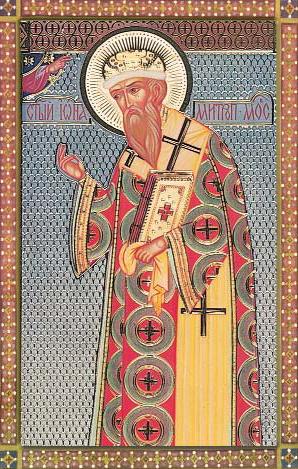 Saint Jonah, Metropolitan of Moscow
Saint Jonah, Metropolitan of Moscow and Wonderworker of All Russia, was born in the city of Galich into a pious Christian family. The father of the future saint was named Theodore. The youth received monastic tonsure in one of the Galich monasteries when he was only twelve years old. From there, he transferred to the Moscow Simonov monastery, where he fulfilled various obediences for many years. Once, St. Photios, Metropolitan of Moscow, visited the Simonov monastery. After the Molieben, he blessed the archimandrite and brethren, and also wished to bless those monks who were fulfilling their obediences in the monastery. When he came to the bakery, he saw St. Jonah sleeping, exhausted from his work. The fingers of the saint’s right hand were positioned in a gesture of blessing. St. Photios said not to wake him. He blessed the sleeping monk and predicted to those present that this monk would be a great hierarch of the Russian Church, and would guide many on the way to salvation.The prediction of St. Photios was fulfilled. Several years later, St. Jonah was made Bishop of Ryazan and Murom. St. Photios died in 1431. Five years after his death, St. Jonah was chosen Metropolitan of All Russia for his virtuous and holy life. The newly-elected Metropolitan journeyed to Constantinople in order to be confirmed as Metropolitan by Patriarch Joseph II (1416-1439). Shortly before this the nefarious Isidore, a Bulgarian, had already been established as Metropolitan. Spending a short time at Kiev and Moscow, Isidore journeyed to the Council of Florence (1438), where he embraced Catholicism. A Council of Russian hierarchs and clergy deposed Metropolitan Isidore, and he was compelled to flee secretly to Rome (where he died in 1462). St. Jonah was unanimously chosen Metropolitan of All Russia. He was consecrated by Russian hierarchs in Moscow, with the blessing of Patriarch Gregory III (1445-1450) of Constantinople. This was the first time that Russian bishops consecrated their own Metropolitan. St. Jonah became Metropolitan on December 15, 1448. With archpastoral zeal he led his flock to virtue and piety, spreading the Orthodox Faith by word and by deed. Despite his lofty position, he continued with his monastic struggles as before. In 1451 the Tatars unexpectedly advanced on Moscow; they burned the surrounding area and prepared for an assault on the city. Metropolitan Jonah led a procession along the walls of the city, tearfully entreating God to save the city and the people. Seeing the dying monk Anthony of the Chudov monastery, who was noted for his virtuous life, St. Jonah said, “My son and brother Anthony! Pray to the Merciful God and the All-Pure Mother of God for the deliverance of the city and for all Orthodox Christians.” The humble Anthony replied, “Great hierarch! We give thanks to God and to His All-Pure Mother. She has heard your prayer and has prayed to Her Son. The city and all Orthodox Christians will be saved through your prayers. The enemy will soon take flight. The Lord has ordained that I alone am to be killed by the enemy.” Just as the Elder said this, an enemy arrow struck him. The prediction of Elder Anthony was made on July 2, on the Feast of the Placing of the Robe of the Most Holy Theotokos. Confusion broke out among the Tatars, and they fled in fear and terror. In his courtyard, St. Jonah built a church in honor of the Placing of the Robe of the Most Holy Theotokos, to commemorate the deliverance of Moscow from the enemy. St. Jonah reposed in the year 1461, and miraculous healings began to take place at his grave. In 1472 the incorrupt relics of Metropolitan Jonah were uncovered and placed in the Dormition Cathedral of the Kremlin (the Transfer of the holy Relics is celebrated May 27. A Council of the Russian Church in 1547 established the commemoration of St. Jonah, Metropolitan of Moscow. In 1596, Patriarch Job added St. Jonah to the Synaxis of the Moscow Hierarchs (October 5).