

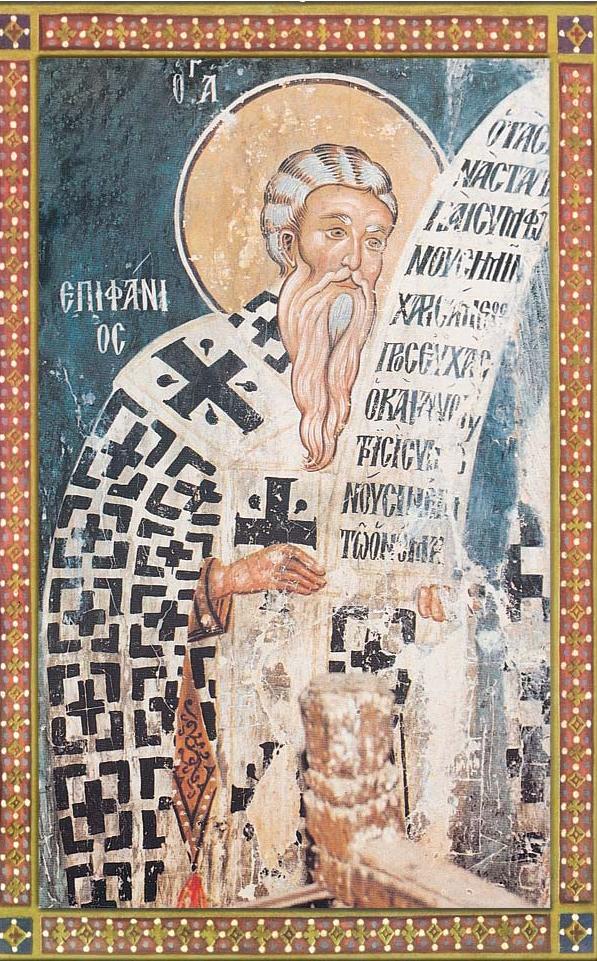
 SAINT EPIPHANIUS, BISHOP OF CYPRUS
Epiphanius was a Jew by birth and, witnessing the Faith of Christ, was baptized with his sister Callithrope. At age twenty-six, he was tonsured a monk in the monastery of St. Hilarion. Later, he established a separate monastery where he became famous throughout all of Palestine and Egypt because of his asceticism, spiritual wisdom and miracle-working. Fleeing from the glory of men, Epiphanius withdrew to Egypt. Enroute, he met up with the great Paphnutius who predicted that he would become bishop on the island of Cyprus. Indeed, after many years, by the Divine Providence of God, Epiphanius arrived at Cyprus where he, unexpectedly was chosen as bishop. At the age of sixty, he became the bishop of Salamis and, as such, governed the Church of God for fifty-five years. He lived a total of one-hundred fifteen years on this earth and rested from this life so as to live eternally in the kingdom of Christ. Before his death, he was summoned to Constantinople by Emperor Arcadius and his wife Eudoxia to an assembly of bishops which, according to the wish of the emperor and the empress, should have condemned St. John Chrysostom. Arriving in Constantinople, Epiphanius went directly to the palace of the emperor where the emperor and empress detained him for a long while trying to persuade him to declare himself against Chrysostom. The citizens and Chrysostom heard that Epiphanius agreed with the emperor against Chrysostom. That is why Chrysostom wrote him a letter: “Brother Epiphanius, I heard that you advised the emperor that I be exiled; know ye, that you will never see your throne again.” To that Epiphanius replied to him: “O suffering John, withstand insults; know ye, that you will never reach the place to which you are exiled.” And both prophecies of these saints were quickly fulfilled. Not wanting to agree in anyway with the emperor to the exile of Chrysostom, Epiphanius secretly boarded a boat and departed for Cyprus, but he died on the boat. The emperor banished Chrysostom into exile to Armenia. But, this saint died enroute. St. Epiphanius rested in the year 403 A.D. Among the many works of St. Epiphanius, the most famous is the Medicine Chest [Panarium] in which eighty heresies are listed and refuted.
SAINT HERMAN, THE PATRIARCH OF CONSTANTINOPLE
Herman was the son of the head imperial senator who was killed by Emperor Constantine Pogonatus. This same evil emperor castrated the senator’s son, Herman, and forcibly banished him to a monastery. As a monk, Herman shone like a star by his life and good works. Because of that, he was chosen as the first bishop of Cyzicus and, when Anastatius II was crowned emperor, Herman was elected as patriarch of Constantinople. As patriarch he baptized the ill-reputed Copronymos who, during the time of his baptism, soiled the water with his uncleanliness. Then the patriarch prophesied that this child, when he becomes emperor, will introduce into the Holy Church some impure heresy. And this happened. When Copronymos became emperor, he restored the heresy of the iconoclasts. Leo Isaurian, the father of Copronymos, initiated the persecution of icons and when Patriarch Herman protested, the arrogant Leo cried out: “I am emperor and priest!” He removed Herman from the patriarchal throne and banished him to a monastery where this saint lived for ten more years until the Lord called him to Himself and to the heavenly kingdom in the year 740 A.D.
THE HOLY MARTYR PANCRAS
Pancras came to Rome from Phrygia where, as a fourteen-year-old boy, he was tortured and killed for Christ in the year 304 A.D. This saint is greatly revered in the west. In Rome, there exists a church dedicated to him and, in this church, his holy relics repose.