

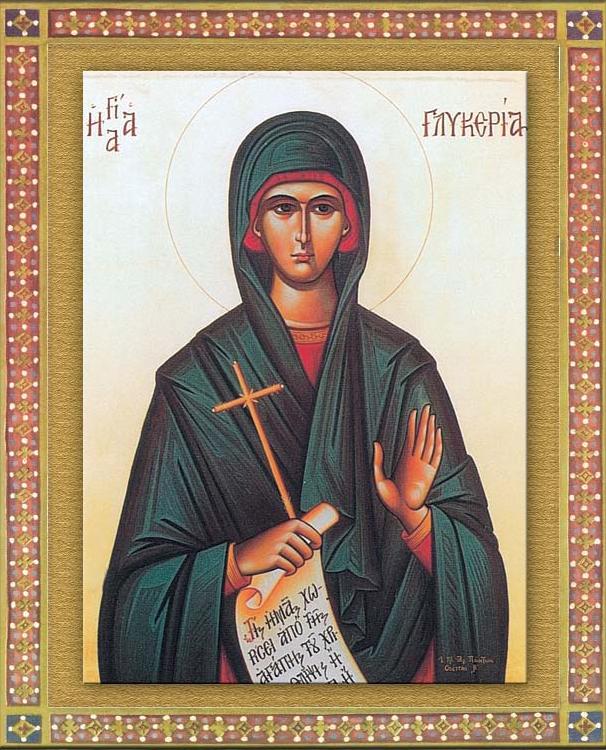
 THE HOLY FEMALE MARTYR GLYCERIA
Glyceria was the daughter of a Roman governor. Becoming impoverished after her father’s death, Glyceria settled in Trajanopolis in Thrace. During the reign of the nefarious Emperor Antoninus, Glyceria was taken to offer sacrifices to the idol of Jupiter [Zeus]. She traced the sign of the cross on her forehead and when the Prefect Sabinus questioned her concerning her lamp, (for all of them carried lamps in their hands), Glyceria pointed to the cross on her forehead and said: “This is my lamp.” As a result of her prayer lightning struck the idol and smashed it to pieces. The prefect became angry and ordered her flogged and thrown into prison. The prefect sealed the doors to the prison, determined to starve the virgin to death. However, an angel of God appeared to Glyceria and administered heavenly food to her. After a period of time, when the prefect thought that the virgin must have died from hunger, he opened the doors of the prison and was astonished when he saw her healthy, radiant and joyful. Witnessing this miracle, Laodicius, the jailer confessed Christ the Lord and was immediately beheaded. After that Glyceria was thrown into a fiery furnace but remained unharmed by the fire. Standing in the midst of the fire and, remembering the miracle of the three youths in the Babylonian furnace, Glyceria praised the Lord. Finally, she was thrown to the lions and, praying to God, this holy virgin gave up her soul to the Lord for Whom she bravely endured many tortures. She suffered honorably in the year 177 A.D. A healing oil [myrrh] emitted from her relics which healed the sick of the gravest diseases.
THE HOLY MARTYR ALEXANDER
Alexander was a Slav. As an eighteen year old soldier in the army of Emperor Maximilian, he refused the order of the emperor to give honor to the Roman idols and for that which he was handed over to Captain Tiberian, to either counsel Alexander to deny Christ or else torture and kill him. Since all the counseling was in vain, Tiberian took Alexander with him across Macedonia to Constantinople where he traveled for duty. In every town along the way, the young Alexander was cruelly tortured but, in every town, Christians came out before him and begged him for a blessing and they encouraged him in his mortification. Pimenia, his mother, followed after him. During the course of this travel, an angel of God appeared many times to Alexander soothing his pains and encouraging him. In one place, Carasura, the martyr performed a miracle through prayer: when thirst overcame him and the soldiers who escorted him, he brought forth a well of cold water from an arid place. On the shore of the Ergina river, Tiberian ordered the executioner to behead Alexander and to toss his body into the water. When the executioner swung at the martyr’s head, he saw radiant angels of God around Alexander and became frightened and his hand dropped. Alexander asked him why his hand dropped and the executioner replied that he sees some radiant young men around him. Yearning death and union with the Lord, Alexander prayed to God to withdraw the angels from him so that the executioner would not be frightened. And thus, the executioner carried out his work in the year 298 A.D. Pimenia removed the body of her son and honorably buried him. Many healings occurred at the grave of the martyr. After death, the martyr appeared to his mother and informed her of her imminent translation to the other world.
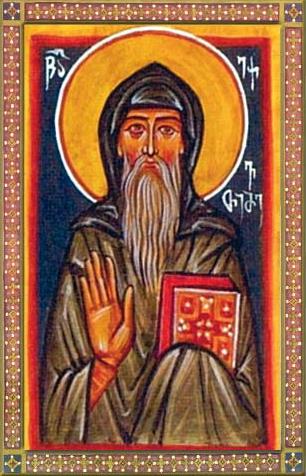 THE VENERABLES JOHN, EUTHYMIUS, GEORGE AND GABRIEL OF THE MONASTERY IVIRON [MT. ATHOS]
All four venerables were the founders of the famous Iberian [Georgian] monastery on the Holy Mt. Athos. At first, St. John lived a life of asceticism in the Lavra [Monastery] of Athanasius and, after that, founded his monastery, Iviron. John died in the year 998 A.D. Euthymius and George translated the Holy Scripture into the Georgian language. Euthymius died in the year 1029 A.D. and George died in 1066 A.D. Gabriel was found worthy to receive the miracle-performing Icon of the Mother of God which arrived at the monastery by way of the sea.