

 THE HOLY MARTYR ISIDORE
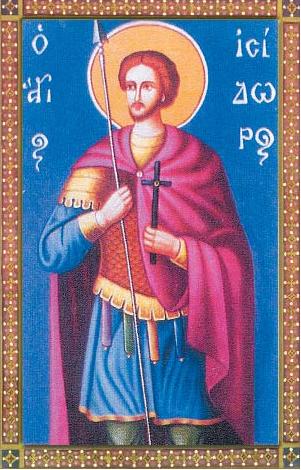
During the reign of Decius, Isidore was drafted by force from the island of Chios into military service. From childhood, Isidore adhered to the Faith of Christ and spent his entire life in fasting, prayer and good works. But when in the army Isidore declared himself a Christian, the commander seized him, required of him an answer and counseled him to deny Christ and offer sacrifices to the idols. The saint replied: “Even if you kill my body, you have no authority over my soul. I possess the True, Living God, Jesus Christ Who now lives in me and after my death, He will be with me and I am in Him and will remain in Him and I will never cease to confess His Holy Name as long as my soul is in my body.” First, the commander ordered that Isidore be whipped with oxen tails and after that they cut out his tongue. Even without his tongue, Isidore, by the Spirit of God, spoke and confessed the Name of Christ. Meanwhile, the punishment of God came upon the commander and he, suddenly, became mute. Finally, the mute commander gave the sign to behead Isidore. Isidore was elated at this sentence and after praising God went to the scaffold where he was beheaded in the year 251 A.D. His companion, Ammon buried his body and following that also suffered and received the martyr’s wreath.
THE VENERABLE SERAPION, THE SINDONITE
Sindon means “linen cloth” in which the bodies of the dead were wrapped. Serapion was called the Sindonite because he covered his naked body with a single linen cloth. He carried a Book of the Gospels in his hand. Serapion lived like a bird without a roof and without any worries moving from place to place. He gave his sindon to a needy person who was shivering from the frost and remained completely naked. When someone asked him: “Serapion, who uncovered you?” He pointed to the Holy Gospels and said: “This!” After that he even gave the Book of the Gospels away as a ransom for a man in debt whose lender was threatening him with prison for this debt. Once in Athens, he did not eat anything for four days because he had nothing available and began to cry out from hunger. When the Athenian philosophers asked him why he was crying out so, Serapion replied: “I was indebted to three; two of which I have satisfied but the third one is still tormenting me. The first lender is carnal lust which tormented me from my youth; the second lender is avarice and the third lender is the stomach. Those two have left me, but the third one still torments me.” The philosophers gave him a gold coin to purchase bread. He went to a baker, purchased only one loaf of bread, left the gold coin and departed. In his old age, he presented himself peacefully to the Lord in the fifth century.
BLESSED ISIDORE, “FOOL FOR CHRIST”
Isidore was a German by descent. Having come to Rostov, he fell in love with the Orthodox Faith and, not only became a communicant of the Orthodox Church, but assumed the difficult life of asceticism as a “Fool for Christ.” He walked around completely in rags. Pretending insanity through his madness, he spent the entire day teaching men and at night, he spent in prayer. He spent nights in a hut made of branches which he had built in a muddy terrain. Great and awesome were the miracles which this saint performed both during life and after death. To a merchant, who was thrown from a boat and was drowning in the sea, Isidore appeared walking upon the water and led him to the shore. When the servants of the Prince of Rostov refused Isidore a glass of water that he asked for and drove him away from the door, then all the vessels with wine dried up. When Isidore died in his hut on May 14, 1484 A.D., the whole of Rostov smelled from a wonderful aroma. The merchant whom the Blessed Isidore saved from the sea, erected a church in his honor over the spot where his hut was located.