

 SAINT PETER THE APOSTLE (THE CHAINS OF ST. PETER)
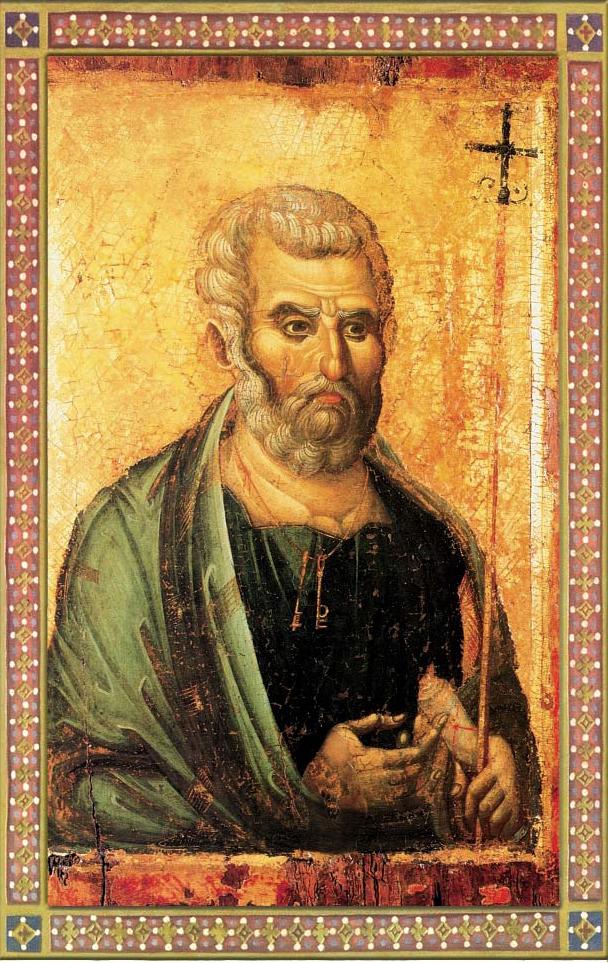
Saint Peter is commemorated on this day because of the chains by which he was shackled by the lawless Herod and which during the appearance of an angel in prison fell from him, “Suddenly the angel of the Lord stood by him and a light shone in the cell. He tapped Peter on the side and awakened him, saying, `Get up quickly.’ The chains fell from his wrists” (Acts of the Apostles 12:7). The chains were preserved by Christians as much for the memory of this great apostle as well as for their healing power, for many of the sick were healed by touching them as well as with the towel of the Apostle Paul, “then when the face cloths or aprons that touched his skin were applied to the sick, their diseases left them and the evil spirits came out of them” (Acts of the Apostles 19:12). St. Juvenal, the Patriarch of Jerusalem gave these chains as a gift to the Empress Eudocia, the exiled wife of the Emperor Theodosius the Younger. She divided them into two and sent one half to the Church of the Holy Apostle in Constantinople and the other half to her daughter Empress Eudoxia in Rome, the wife of Valentian. Eudoxia built the Church of St. Peter and deposited these chains in it, together with those chains with which Peter was shackled before his death under Emperor Nero.
THE HOLY MARTYRS SPEUSIPPUS, ELEUSIPPUS, MELEU- SIPPUS AND THEIR GRANDMOTHER LEONILLA.
The three brothers, triplets, Speusippus, Eleusippus, Meleusippus all suffered for Christ in France during the reign of Emperor Marcus Aurelius (161 A.D. -180A.D.). At first, only Leonilla was a Christian while her grandsons were heathens. After prolonged counseling on the part of their pious grandmother and of the local priest, these three brothers received baptism. Having been baptized and with youthful zeal, they began to live a devoted life for their Faith and with this passion destroyed all the idols in the whole vicinity. Accused and brought before the tribunal, they acknowledged their act and openly confessed their faith in Christ. The judge had them thrown into prison and summoned Leonilla, the grandmother, and directed that she, too, go to the prison and counsel her grandsons to deny Christ and to worship the idols. Without a word, Leonilla went to the prison, but instead of counseling her grandsons to deny the True Faith, she began to encourage them not to waver but to endure all torments to the end and to die for Christ. When the judge, again, questioned them and realized their even stronger steadfastness in the Faith, he condemned them to death. At first, all three of them were hanged on a tree where they hung “as strings on a gulsa”* after which, they were flogged and finally burned in fire. A certain woman, Jovilla, enthusiastic at the courage of these martyrs cried out: “I am a Christian also!” They immediately apprehended her who, together with the elderly Leonilla, was beheaded.]
THE VENERABLE MARTYR DAMASKIN OF GABROVO
Saint Damaskin led a life of asceticism in Hilendar [Mt. Athos] where he became the abbot. When he sought from some Turks payment of a debt due to the monastery, they persuaded a Muslim woman to enter the house where Damaskin lived. Then, those same Turks came and, finding this woman, dragged Damaskin before the Cadi [Muslim Judge] who then proposed to him: either be hanged or convert to Islam. To this Damaskin decisively responded, “It would be insanity if I for this transient life would purchase eternal death.” He was hanged in the year 1771 A.D. in Svishtov. Thus, Damaskin sacrificed his body in order to save his soul. God’s punishment immediately befell his murderers. While crossing the Danube river, in a row boat, a storm arose and capsized the boat and drowned them.
THE VENERABLE ROMIL
Saint Romil was born in Vidin. He was a disciple of St. Gregory Sinaite. He lived a life of asceticism in several monasteries. Together with him in the Monastery Ravanica [Serbia] lived Constantine Camblak. St. Romil died in the Lord about the year 1375 A.D. in the Monastery Ravanica.